

Only days before an impending deadline to get bills out of committee, representatives started hearing from experts on a controversial bill to increase gun-related restrictions in the state.
Yet with time ticking down as the House Judiciary Committee’s Democrats try to push through new gun regulations, Wednesday’s conversation spiraled into the bill’s minutiae.
“I’m not suggesting that we ban coat hangers in the state of Vermont,” Billy Clark, an attorney with the Giffords Law Center to Prevent Gun Violence, told the committee.
“So then how do we enforce this? That’s what I’m really trying to get at,” said Rep. Zak Harvey, R-Castleton.
The committee was considering a bill, H.606, which in its most recent form would enhance the penalties for stealing a firearm and expand the groups of people who are prohibited from owning firearms. The bill would also ban devices that, when attached to firearms, could increase their firing speed.
Under current federal law, it’s largely illegal to own or sell new machine guns or attachments that could turn other firearms into automatic machine guns.
Enter the rubber bands and coathangers.
The bill would ban any devices that attach to a firearm to increase its rate of fire. The bill also specifically bans a device called an auto sear, commonly called a Glock switch, which attaches to a semi-automatic firearm, allowing the shooter to fire multiple shots with a single pull of the trigger without manually reloading. The device essentially converts a semi-automatic gun into an automatic one.
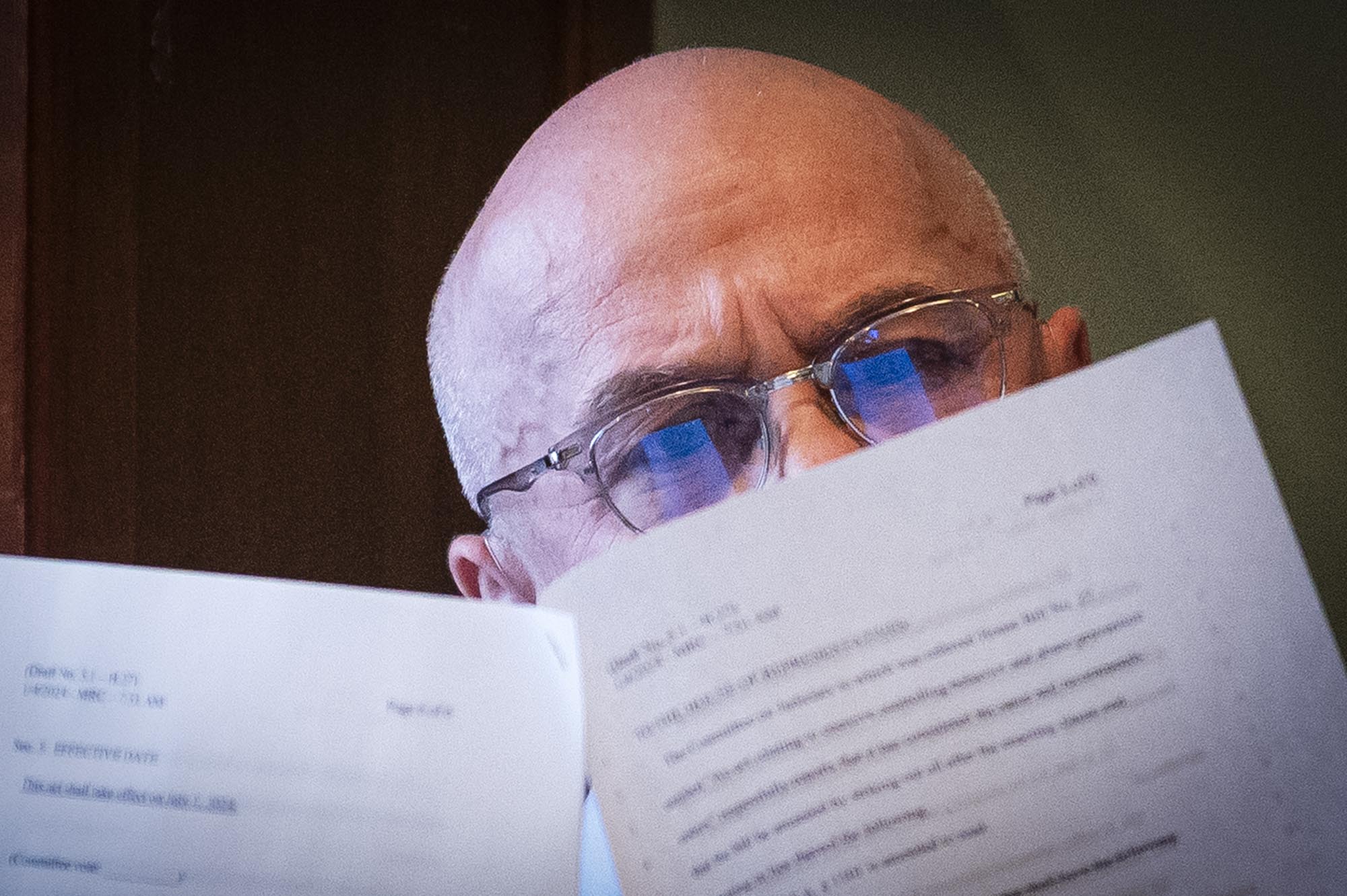
When the committee was reading through the newest version of the bill, vice chair Rep. Tom Burditt, R-West Rutland, interjected. “I got a question for the committee. What’s an auto sear? How does it work?” he asked.
“We’re going to hear from witnesses,” said Rep. Martin LaLonde, D-South Burlington, who chairs the committee. But Burditt wanted to make a point.
With only a couple days until crossover, when bills must make it out of committee to get a shot at becoming a law, the committee decided to start hearing from experts on the bill Wednesday with the hope of voting it out of committee Friday.
And the debate attracted a crowd, forcing gun enthusiasts to sit shoulder to shoulder with anti-gun-violence activists.
Pressure mounting under the impending deadline led Republicans in the committee to challenge Democrats on whether they knew enough about guns — or were giving the bill thorough consideration.
Burditt and LaLonde traded blows. Burditt grilled LaLonde, asking him about specific gun parts, while LaLonde responded by explaining the committee’s procedure.
“Don’t patronize me,” Burditt said.
“Well you’re kind of patronizing me,” LaLonde responded. He told Burditt that the mechanics of every firearm part didn’t matter, that he’s going to hear from experts and understand what he needs to.
Gun enthusiasts encouraged committee members to borrow the definitions of gun parts under federal law, rather than trying to split hairs themselves.
Chris Bradley, executive director of the Vermont Federation of Sportsmen’s Clubs, argued that under the bill a typical rubber band could be configured around a gun to be considered a rapid fire device.
Someone can also cut a coat hanger to fasten a piece that creates a “machine gun” under federal law, said Joseph LoPorto, a lobbyist with the National Rifle Association.
“The federal government has a regulatory system here that is quite complex, that requires a lot of technical expertise that perhaps Vermont may or may not have,” LoPorto said.
— Charlotte Oliver
On the move
In a nearly unanimous vote, the Senate approved an amendment to the Vermont Constitution on Wednesday that would guarantee “equal protection under the law” for people regardless of their race, ethnicity, sex, religion, disability, sexual orientation, gender identity and expression or nationality.
The measure, P.R.4, was up for the equivalent of its third reading in the Senate after gaining initial approval during the 2023-24 legislative biennium, as per the rules for amending the state’s founding document.
Senators approved the proposal 29-0, with just one not voting. That was Sen. Steve Heffernan, R-Addison — who abruptly got up from his seat and left the chamber right before the roll call was taken.
Heffernan said in an interview that he left the chamber because his stomach was feeling “agitated” and he needed to use the restroom. He said he had not made up his mind on how to vote on the amendment, largely because he’d heard from constituents urging him both to vote for and against it.
Heffernan had stepped out of the chamber earlier during Wednesday’s floor session — also on account of his stomach, he said — right after Senate President Pro Tem Phil Baruth moved to take up P.R.4. He was absent for most of the floor discussion that followed, re-entering just as Sen. Ginny Lyons, D-Chittenden Southeast, was finishing urging her colleagues to support it.
He contended that missing explanations for why to vote in favor of the amendment made it more difficult to make up his mind. After Lyons spoke, Heffernan got up and left the chamber again.
“My pizza hit at the right time, I guess,” he said, admitting that it was “convenient.”
“Did it happen at a unique time? Yes, it did,” Heffernan added, but argued that “my yes or no vote would have made no difference” to the outcome, regardless.
P.R.4 will now head to the House for a final sign-off from that chamber — which it’s expected to receive — after which the measure would go to a statewide vote in this fall’s general election. Only with a majority vote from the public would it then become part of the Constitution, as Article 23.
— Shaun Robinson
The House advanced a bill Wednesday that would require lobbyists to publicly disclose their efforts to influence legislators with paid advertising year-round — instead of only during the legislative session, as state law dictates now. Supporters have argued the bill, H.686, would bolster transparency by closing what amounts to a loophole in Vermont’s lobbying rules.
The bill is slated for final approval tomorrow, after which it would head to the Senate for further consideration.
— Shaun Robinson
Clarification: This newsletter has been updated to more accurately reflect the legality of owning machine guns.
