

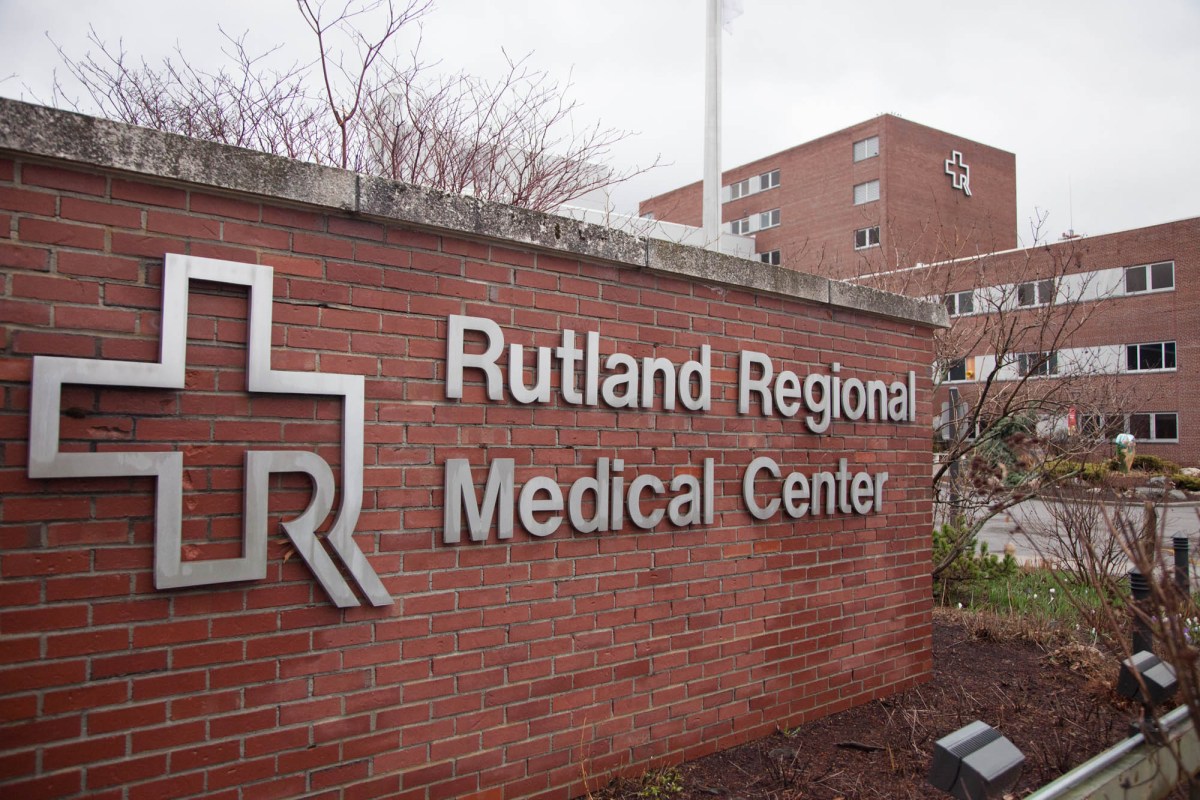
For Ned Coletta, the potential closure of pediatric beds at Rutland Regional Medical Center is not a question of regulatory power and hospital autonomy. It’s a question of whether his 4-year-old will have an appropriate place to stay while doctors manage and monitor his airway condition. It’s a question of how he and his wife could balance the two-hour drive back and forth to another hospital with caring for their other two children at home. It’s a question of how they could again bear to put their child, alone, terrified and wailing, on a helicopter to Dartmouth Hitchcock Medical Center. It’s a question of whether they should leave Rutland.
The Collettas’ concerns are a version of those so many parents, doctors and nurses in the Rutland region share. Since the medical center’s October announcement of the potential closure of its five inpatient pediatric beds, over 150 comments have poured into the Green Mountain Care Board’s public comment box, almost entirely in opposition to the change. Friday’s first public hearing on the closure ran hours longer than scheduled, as parents and health care providers weighed in and the board interrogated the hospital’s rationale for closure.
But as the care board deliberates these details of closure, it also opens a new chapter of regulatory power and hospital independence. The closure is the first instance of how the state’s main health care regulator flexes its newly granted ability to block hospital service cuts. The Green Mountain Care Board is an independent state regulator tasked with setting hospital budgets and commercial insurance premiums, and, as of last legislative session, its authority has extended to hospital service reductions. On Friday, the board may vote to prevent the hospital from closing the pediatric service.
“I think it’s really a useful tool, in that when the hospital wants to cut things, they’re looking at their four walls, and they’re making decisions as to their fiduciary obligations and their need for that particular place, but they’re not taking a broader bird’s eye lens for the most part, as to how it impacts the system,” the care board’s chair, Owen Foster, told VTDigger of this new authority. As few other states have regulators with this type of power, he said Vermont is “pioneering” in this ability.
In its notice to the board of the planned closure, Rutland Regional Medical Center outlines a vision for closing its five beds and shifting instead to treating acute pediatric patients in the emergency department or transferring them to one of the region’s large academic medical centers — Dartmouth Hitchcock in Lebanon, New Hampshire, or the University of Vermont Medical Center in Burlington. Under the proposed plan, babies less than a month old would be readmitted to the labor and delivery unit, while adolescent patients could go to alternative adult inpatient units at RRMC.
Many opponents argue that these proposed alternatives fall short of the care Rutland’s children need and would exceed the cost the state’s health care system can support.
“I’ve lived through this a few times,” Coletta said of the occasions when his son has needed to go to the emergency department with breathing issues before being admitted as an inpatient, “and it’s not that easy.”
‘Not just small adults’: Care in the emergency department
The emergency department, by nature, is a space for triage. “They’re not specialists. They’re not focused on children’s pulmonology issues,” Coletta said. His son has had to stay in the hospital overnight to ensure that his oxygen levels stabilize well enough to return home. Coletta worries about the ED becoming the default place to do this.
Many of Rutland’s pediatricians and nurses fear the same thing: “The ED is not a family-centered nor child-friendly space. The ED environment is not meant for specialized pediatric care. It is a loud, overwhelming, chaotic, developmentally-inappropriate, adult-centered care environment,” a group of pediatric hospital providers wrote in a letter to the care board.
During Friday’s hearing, one of those signatories, Amy Pfenning, a pediatric nurse practitioner at the hospital, elaborated on that concern: “It truly isn’t developmentally appropriate,” she said to the board. “Putting children on a stretcher with a teddy bear is terrifying. It is terrifying when they have an acute illness.”
In a pediatric unit, a child is shielded from seeing other patients who come in mental distress or with physical trauma wounds. In the pediatric unit, the doors close fully, and the hospital bracelet sets off an alarm if a child starts to wander out toward the parking lot, Pfenning continued. In the emergency department this is not the case.
“A trauma room that, essentially, is staged with a teddy bear and a coloring book and a red wagon, does not make it a pediatric room,” Pfenning said.
Brooke White, a nurse at RRMC wrote to the care board and illuminated some of these specific concerns that come with treating a pediatric patient: “Children are not just ‘small adults’; they have unique vital signs, medication dosages, and assessment needs,” she wrote in her letter, adding that as a pediatric nurse she frequently went to the ED to help staff place IVs and direct care.
The hospital, for its part, says that the volume of pediatric patients requiring inpatient stays is simply not enough to justify keeping the beds open — roughly 117 children this year were admitted for a day or less. Under the new model, children who need observation for a day or less would receive the care through an extended ED stay.
During the presentation to the care board, representatives from the hospital explained that on 169 days so far this year, its pediatric beds had zero overnight patients. Further, 63% of patients who were admitted to the inpatient beds stayed for less than one day. They say this compromises their practitioners’ ability to keep their skills fresh and get trained up to speed — though care board member Thom Walsh pointed out that studies showing a correlation between low volume and compromised quality are weak when it comes to common pediatric admissions. It’s much more consistent for complex pediatric surgery, he said, which is not the type of care the pediatric providers at RRMC are responding to.
Local care vs. transfers hours away
Part of the hospital’s ability to reduce the length of pediatric stays may come from keeping children close to home, posited Rebecca Merrifox, a pediatrician in Rutland. She sees patients in and out of the hospital.
“We can wrap around our patients and our families really well,” she said during the care board meeting. “We can get them right in (to the office) the next morning and follow them up. I anticipate that if some of these sick children were transferred to other hospitals, those stays would actually be longer because the follow-up wouldn’t be quite as easy or as comprehensive as what we currently have.”
The value of having care providers, from inside and outside the hospital, embedded in the community has stood out to Coletta as well: “They know who your kid is. They know everything about them. They know you, and they actually care.”
It’s not just the type of care that a child would receive outside of their community that opponents worry about; it’s also the act of physically getting the child there, should they need to be taken to larger hospitals far away.
RRMC’s representatives estimate that this year between 60 and 80 patients have had inpatient stays longer than one day at the hospital. Under their new plan, those children would be possible transfers. This year, an estimated 15 children have needed more acute care than the Rutland hospital could provide and were transferred elsewhere.
The hospital has established a transfer agreement with UVMMC, but in that agreement, the Burlington hospital is not required to admit the patient to their inpatient beds. It means a child could go from Rutland’s ER, into an ambulance, to waiting in the emergency department in Burlington.
RRMC says it is still “exploring similar transfer agreements” with other hospitals, like Dartmouth. Officials reported that they have communicated with local ambulance teams about this process.
From here, many worry that the wait times can tick up to a dangerous level: It can take hours to receive and assemble a transport team to prepare an ambulance to move a child in distress. Then, it takes nearly two hours to drive from Rutland to either Burlington or Lebanon, where DHMC is located.
“Please consider that it is unethical and unsettling to place a low-acuity child at risk by transferring them at night, mid-winter to a facility 2 hours away. This is unacceptably dangerous,” the group of pediatric staff wrote in their same letter to the care board. They estimate that a “minimum” of three hours should be added to the transport time, to account for all that is needed for set up and breakdown.
Others also worry about the drain this would cause on the Rutland region’s EMS resources. A local ambulance taking a four hour round trip to the outer edges of the state could pull resources away from responding to stroke or heart attack patients more quickly, worried Myla Lindroos, an emergency nurse at the Rutland hospital, during the Friday hearings. “They can’t get that tissue back. They can’t get that brain tissue back, that personhood. They may never be able to walk up the stairs unaided again because they lost that heart tissue that they should have been able to have restored, with timely transport.”
Plus, transport is destabilizing to the child. Coletta’s son has needed to go to higher-level care centers twice: once by ambulance and once by helicopter. “That’s actually not an experience that helps you get better faster,” he said. “That’s beyond terrifying and adds a whole ’nother layer of stress and risk to the situation, in my view.”
Even still, Coletta felt lucky that, through it all, the expense was something his family could manage.
Cost to the individuals, cost to the hospital
It is expensive not only to the families — who shoulder the medical bills of expensive transport and hospital care, who bear the costs of driving hours from home to visit their sick child, missing work to do so, while potentially paying for food and lodging away from home. But it may also risk creating more expense to the system overall, care board members pointed out during the Friday hearing.
In its presentation to the board, the hospital maintained that this choice is driven not by financial realities but because low patient volume compromises quality. However, an earlier letter the hospital’s Chief Legal Officer, Mitchell Braroody, sent the care board does specify the significant losses to its revenue the hospital expects recent legislative changes will bring. He estimates an approximately $17 million drop in the hospital’s revenue in light of last year’s drug pricing cap, for instance.
During Friday’s presentation, Jennifer Bertrand, the hospital’s chief financial officer, walked the care board through her estimate that sending young patients to RRMC’s emergency department instead of inpatient care would actually reduce the cost of local care. For 121 patients, she found that the cost of emergency department based care was $741,253 while inpatient hospital care came to $970,224.
She further estimated that cutting this service would save the hospital more than $500,000 in a year, mostly in salary reductions as the hospital consolidates 27 full-time staff equivalents to 14. However, the hospital still hopes to keep these providers employed at RRMC, even if they are re-assigned.
Incongruous costs to the system
Care board member David Murman interrogated these figures during the Friday hearing.
He pointed out an incongruence in the hospital’s cost analysis: In calculating expenses, the medical center includes the costs of services across its Women and Children’s Unit (that includes labor and delivery, peri- and post-natal care), hospital representatives“ neglect to include the revenue from those services.
The hospital said the service closure could save the state’s health care system $229,000 in net costs. But many took issue with this number.
Murman pointed out the higher cost of care in an academic medical center, the added cost that an additional ED admittance would bring, on top of the personal expenses incurred by a family. “Have you calculated out those costs?” he asked the hospital representatives. They had not.
Following the hearing, RRMC CEO Judi Fox issued a statement, saying, “Rutland Regional Medical Center (RRMC) is committed to providing the highest quality care for children and families in our region. The proposed redesign of pediatric services presented today to the Green Mountain Care Board adjusts our care delivery to meet evolving clinical needs and workforce realities while supporting the long-term sustainability of our health care system. We recognize that any decisions involving children are especially difficult, and we approach this work with the utmost care and responsibility.”
She was unable to respond to additional questions by press time.
Walsh, one of the care board members, picked up the issue of affordability during the hearing, concluding, “it’s not clear to me that this would make anything more affordable for your community.”
Walsh asked about maintaining fewer than five pediatric beds, adopting the more adaptable stepdown beds or having a swing bed (which can be used for multiple purposes ) model more common in other rural settings. Jessica Holmes, also a member of the care board, inquired about the consideration of expanding pediatric service to address the volume concerns.
Board members echoed a question put most concisely by their chair, Foster: “Why now?”
The Vermont Agency of Human Services is in the midst of organizing a broader, statewide health care transformation, aimed at tackling questions of low volume and quality just like the ones RRMC are facing. That statewide strategic plan is not expected to be available until 2028.
In the meantime, Foster recently explained, hospitals are beginning an “unintentional transformation,” cutting services before the state has a chance to intervene and direct those decisions to maintain access. Already, Copley Hospital, in Morrisville, closed down its birthing center and pre- and post-natal care on Nov. 1; over the past year, UVMMC has moved its kidney transplant services to Dartmouth while also making an effort to shutter dialysis and a Waitsfield clinic.
However, for the first time, the Green Mountain Care Board may now exercise its recently granted authority to intervene. Under Act 68, which the Legislature passed last session, the care board has the power to evaluate hospitals’ proposed service reductions and may act to preserve access to necessary services.
The board has scheduled possible votes on the Rutland closure for Dec. 12 and 17; its deadline to decide is Dec. 20. Pending the care board decision, RRMC has scheduled the closure of the pediatric inpatient beds for Dec. 21.
The possibility of closure is destabilizing for Coletta as he and his wife consider what would be best for their son and their family: “We of course have no idea what to do,” he said. “My job is here, our lives are here, but it really causes us to question whether our jobs and our life should be here.”
