


One of Vermont’s most influential advocacy groups closed its doors for the last time at the end of October — but its work will continue.
Let’s Grow Kids, an organization that pushed for and guided public funding for child care in Vermont over the past decade, was designed to shut down this year. The cornerstone achievement of the campaign — according to the organization’s leadership — was Act 76, Vermont’s 2023 landmark child care law.
That legislation established a new 0.44% payroll tax and directed the revenue, along with annual earmarked state funds — roughly $125 million each year — toward income-based child care subsidies. Now, households earning up to 575% of the federal poverty level qualify for tuition assistance from the state, making child care free or close to it for lower-income households and more affordable for higher earners. The new funding also guarantees higher and more stable revenue for local providers.

The new influx of funding is transforming Vermont’s child care industry, both advocates and providers say.
Jocelyn York, a teacher who has held leadership positions at several Vermont child care centers, said the law has allowed centers like hers “to be able to continue to exist.” Equally, the tuition assistance has provided “a lot more peace of mind for families,” she said, as the cost of high-quality child care continues to rise.
Since the law passed, more Vermont child care centers have opened than closed each quarter, reversing a longstanding trend in the other direction, according to the Let’s Grow Kids 2025 impact report. As over 100 new providers launched, more than 1,700 new slots have been created in the system, and thousands more kids have been enrolled in the expanded tuition subsidy program.
Nonetheless, Aly Richards, the nonprofit’s former CEO, said the work is far from over.

“We’re a catalyst for systemic policy change,” she said, adding that Act 76 merely “set the conditions for the full fix.”
As Let’s Grow Kids sunsets, aspects of its work will be taken up and extended by other early childhood education-focused organizations across the state. Building Bright Futures, the state’s independent early childhood advisory body, will continue providing data-driven evaluations and policy recommendations to the Statehouse. Vermont’s chapter of First Children’s Finance and the Vermont Association for the Education of Young Children, both led by former Let’s Grow Kids staffers, will help support the state’s providers through financial and workforce challenges.
The Let’s Grow Kids Action Network, a leaner and more tightly focused nonprofit that has been supplementing the larger organization’s work since 2020, will also continue its political advocacy with a much smaller team.
The time-limited nature of the Let’s Grow Kids campaign has been essential to its success in both fundraising and advocacy, according to Richards. Her team, she said, “put ourselves out of business on deadline.”
Indeed, the organization’s model was so effective that other leaders around the state — and the country — are eyeing the Let’s Grow Kids model and record of results.
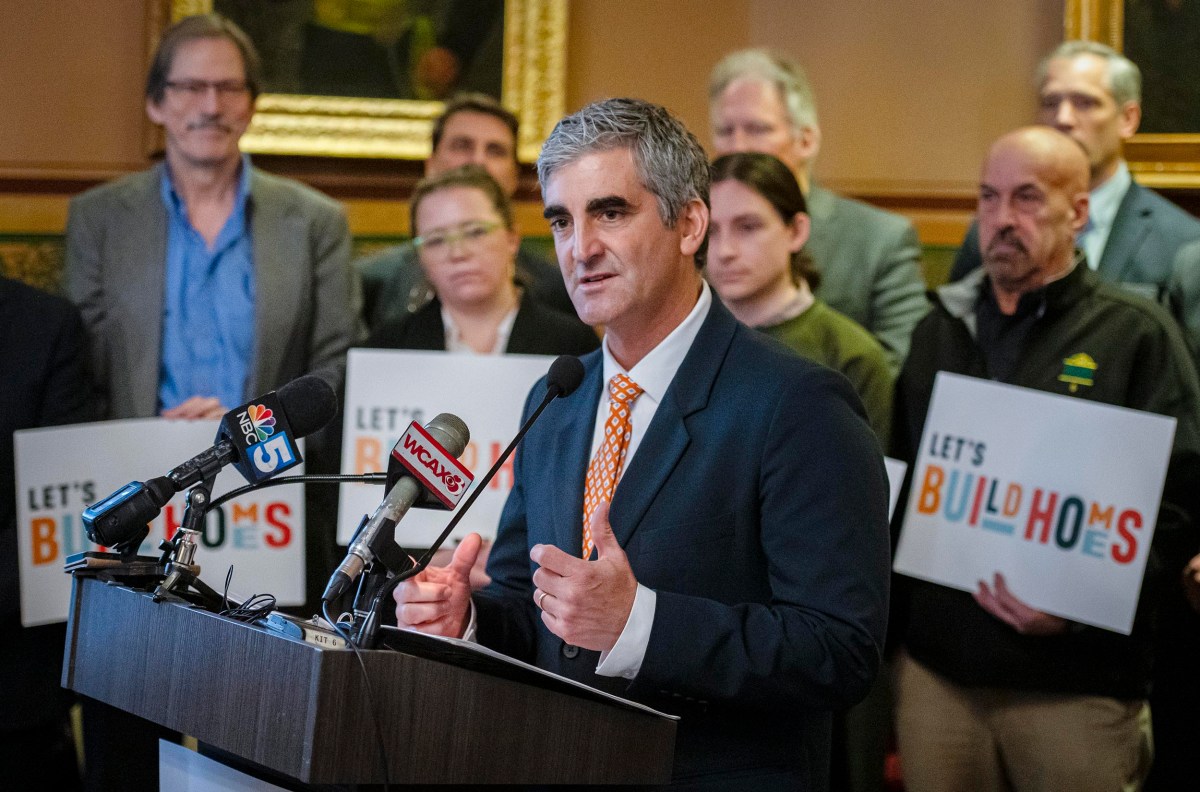
Earlier this year, a group of advocates and business leaders launched a new housing advocacy campaign called Let’s Build Homes. Among them are former Burlington mayor Miro Weinberger, who serves as executive chair, and Vermont Housing Finance Agency Executive Director Maura Collins.
Weinberger said the branding of his organization “alluded” to that of Let’s Grow Kids. He even met with Richards and other leadership to get their blessing.
“The kind of action … inspired by the name, was appealing to us,” Weinberger said. “We do see ourselves as trying to do for housing what they did for child care, in the sense of elevating and inspiring collective action on a key Vermont issue.”
Though Let’s Build Homes is not tied to a specific closure date, part of their initial pitch cited a Vermont Housing Finance Agency report saying that Vermont needs roughly 30,000 more homes within the next five years.
“We’re serious about that,” Weinberger said. “We think that that is achievable.”
It’s the kind of confident optimism, and willingness to take on “the single most achievable but ambitious goal,” that Richards said other states, and other political projects, might learn from Let’s Grow Kids.
A ‘full-court press’
Let’s Grow Kids began with Rick Davis, who in 2000 co-founded the organization’s precursor: the Permanent Fund for Vermont’s Children. Davis said that Buzz Schmidt — an early supporter of the movement in Vermont and founder of GuideStar International, a database tracking the effectiveness of nonprofits and charitable organizations — provided the crucial framework of a time-limited campaign.
Davis said the idea struck him as “brilliant.” With his board’s approval, he transitioned his Permanent Fund into Let’s Grow Kids, and hired Richards, then a deputy chief of staff for Gov. Peter Shumlin, to lead the campaign.
As the nonprofit winds down, remaining assets from its various forms are being redistributed, some as grants to providers and advocacy organizations, and some in the form of a legacy fund operated by the Vermont Community Foundation.
Richards said in an interview last month that her role in the child care reform effort has been as “a believer.” She had already been focused on early childhood education for Shumlin following a realization that the issue was “upstream” of many of the state’s most pressing issues — demographic balance, workforce development and the opioid crisis, among others.
From the statehouse, she noticed a disconnect between lawmakers and Vermont’s network of early childhood educators. There was not a stable channel of communication between lawmakers and the troubled system they were working to fix.
“We can’t get organized if … we haven’t built trust,” she said.
Richards and her team of staff, powered by the 501(c)(3) nonprofit’s nearly $80 million in total private and public funding over the course of its lifetime, acquired a reputation for effectiveness as the years went by. Let’s Grow Kids organized public and private support for its new focus on child care, and in Richards’ words sought to “ready the system for investment,” which meant increasing Vermont’s care capacity, and connecting local providers with grants and technical assistance.
Financial records show that Let’s Grow Kids used its resources boldly, outspending its reported revenue by millions of dollars most years and dipping into considerable but dwindling assets from its frontloaded capital campaigns. At its peak, the nonprofit employed nearly 40 people.
The Let’s Grow Kids Action Network, as a financially separate 501(c)(4), could be even more politically directed in its approach, lobbying sitting officials and endorsing candidates in statewide races.

It was a simultaneous effort at all levels of the state’s child care system, Richards said — a “full-court press.”
“Are we doing good work? That’s nice,” she recalled reflecting sardonically as the years went by. The real question, she said, was always: “Are we on track to win by 2025?”
It was this all-out approach, according to former CEO of Bennington’s Global-Z International and fellow child care advocate Dimitri Garder, that powered the movement and made it attractive to crucial donors, particularly in the business community. Such supporters are able to make big contributions but are wary of perceived waste — planning to close down on a specific date in advance inspired confidence, he said.
That didn’t mean the campaign was always popular in its forcefulness, Garder added — he had heard some lawmakers describe the group’s lobbying as heavy-handed.
“They were a juggernaut, you know?” he said. “Not everybody loved that.”
Noah Futterman, a spokesperson for the Action Network, said the campaign had sometimes needed to push hard for what it wanted — but that was the nature of the work.
“Effective advocacy movements need to be relentless and unapologetically focused on their mission,” he said in a text message. “Real systems-change is hard.”
‘An investment in our children’
When Act 76 finally passed in the 2023 legislative session, it did so through bipartisan support that powered an override of Gov. Phil Scott’s veto.
Let’s Grow Kids’ leadership said supporters — in the statehouse and elsewhere — came to the issue with widely varying priorities for desired outcomes of Act 76.
Studies have shown that access to high-quality child care has far-reaching beneficial impacts on a number of economic and public health metrics, including developmental outcomes for children and workforce participation, especially for mothers.
Davis said for him, the work of child care advocacy had begun with a focus on social equity for kids. But as compelling as that argument might be emotionally, he said, getting the Legislature to approve a new source of revenue required demonstrating that an investment of this size would also create a return on investment for the state.
Garder agreed. Coming to the issue via the Vermont Business Roundtable, a body of business leaders in the state that was deeply involved with advocacy for child care, he said it was unusual for a bill involving a hike in taxes to gain such broad support among his colleagues.
Rep. Michael Marcotte, R-Coventry, one of the bill’s sponsors, was among the Republicans who supported the changes against the governor’s wishes.
For Marcotte, who chairs the House Committee on Commerce and Economic Development, the proposal wasn’t just throwing money at the problem — studies and testimonies had forecast a relatively immediate boost for the state’s finances. The Rand Corporation, in a commissioned report, predicted that the new tax revenue would likely not cause significant hardship, but might boost the state’s gross product by up to $280 million each year.
“I think that people see it as a future investment in the economy of the state, and an investment in our children,” Marcotte said.
Richards said for her, the various justifications for progress on child care don’t need to exist in the same hierarchy for everyone.
“Tell me what you care about, and I’ll tell you why child care is your thing,” she said. “This is the right thing to do for kids.”
‘Feasible’: A new era for child care
Act 76 brought a level of investment that requires ongoing attention, Richards said. While her organization is shuttering, other players in Vermont’s child care industry will continue to advise and support the state’s implementation of new policies.
“We’ve left an ecosystem behind,” Richards said of her partner organizations. “They are in great shape.”
First Children’s Finance Vermont, directed by former Let’s Grow Kids staffer Erin Roche, will lead the business side of the effort. The newer organization, which Roche founded three years ago, offers loans and grants, financial analysis services and hiring consultations to the state’s child care providers.
Roche said workforce issues remain a major outstanding problem in the state’s child care industry — a labor shortage, relatively low wages, and scant benefits have made it difficult to keep pace with the publicly funded boom. Roche is looking to help providers navigate the workforce issue, along with former Let’s Grow Kids colleague Sharron Harrington, who runs the Vermont Association for the Education of Young Children.
Futterman said the Let’s Grow Kids Action Network will be supporting the passage of S.119, a bill that seeks to implement a state-controlled process for licensing early childhood educators, among efforts to further increase child care access and affordability this legislative session.
Richards herself will stay on as an adviser and board chair for the Action Network, and several former Let’s Grow Kids staff occupy the nonprofit’s three other positions.
It’s not surprising to Roche that ex-Let’s Grow Kids staff are in a number of such leadership positions around the state. “They invested so much in the leadership abilities of their staff,” Roche said of Richards and her team.
The emphasis on data-driven reports, and close tracking of the new legislation’s impact, will continue through Building Bright Futures, the state’s independent advisory organization for services to kids from birth through age eight.
Morgan Crossman, the nonprofit’s executive director, said her organization’s Early Childhood Data and Policy Center aims to continue bringing reports to legislators that “help them understand the impact of the law.”
“(Let’s Grow Kids’) absence will be a significant shift in the field and across the state,” Crossman said, but she is confident in the network of organizations the nonprofit is leaving behind.
Building Bright Futures released its five-year strategic plan for Vermont’s early childhood education system last month. Among its priorities are workforce development, support for parents in the workplace and ensuring quality of care.
For many providers, however, Act 76 has already been a lifeline.
Before Jocelyn York became co-executive director of Turtle Island Children’s Center in Montpelier, she worked at the Neighborhood Schoolhouse, an early childhood education center in Brattleboro. Both organizations, she said, were on a “rocky road” prior to the passage of Act 76.
The end of pandemic-era assistance for child care was abrupt, she said, and the cost of tuition was rising fast due to inflation, among other factors.
“Lots of people are struggling to pay,” she said, “and so we weren’t really sure what we could budget for every month.”
York said that throughout the uncertainty surrounding public funding and when providers could expect to see it arrive, Let’s Grow Kids was “so amazing” in its communication and attentiveness to providers.
While gaps remain in the state’s support of the child care industry — particularly for infant and toddler care, York said — the new tuition assistance has been transformative.
“It was feasible to think about moving forward,” York said. “It’s not fixed for everyone, but it’s much better.”
Turtle Island just moved into a new space, and is licensed to enroll up to 77 kids, York said.
York’s experience is par for the course among Vermont’s child care centers, according to advocates. Providers across the state have told VTDigger that Act 76 allowed them to open or expand their business, or stopped it from closing.
Let’s Grow Kids, and the change they pushed through, “made a huge change for the landscape of early childhood (education), particularly in Vermont, but also … creating a model for the rest of the country,” York said.
