This story by Patrick Billow was first published in News & Citizen on Nov. 13, 2025.
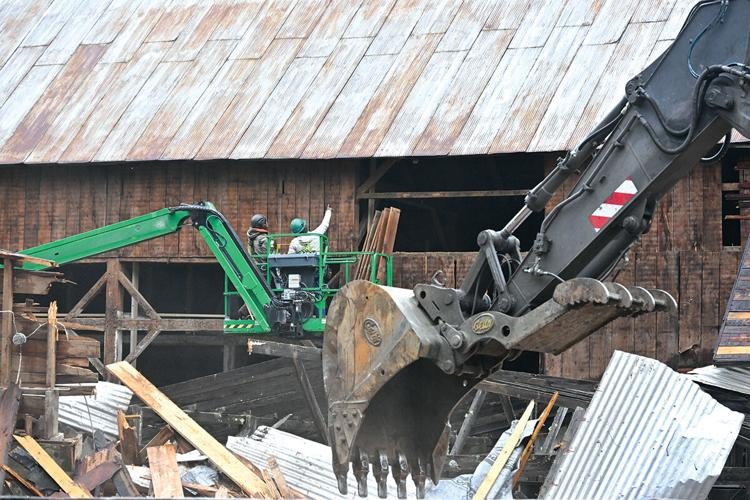
An 1850s Morristown home and barn, which raised a family and thousands of exotic plant species over the last four decades, will soon be wiped from the land — the home by an excavator and the barn by several eager members of the Vermont Youth Conservation Corps.
Don and Lela Avery met in Big Sur, California before they moved with their two sons to a 22-acre property on Duhamel Road in 1979. Leveraging fertile soil next to the Kenfield Brook, they started propagating famously stubborn plants with success, a hobby that blossomed into a renowned business, the Cadys Falls Nursery.
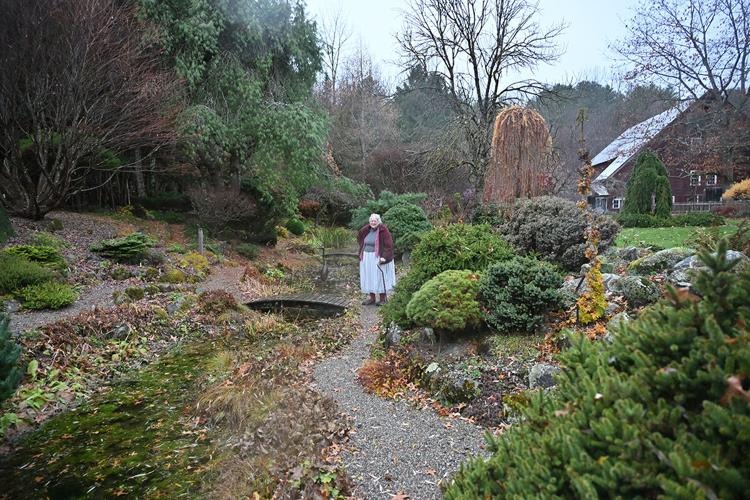
Customers from around the country visited Morristown to purchase rare plant species from Don and Lela. In elaborate gardens around their home, they planted more than 1,400 plant varieties — from showy Lady’s Slippers to dwarf conifers — complemented by paths, sculptures and rock walls that Don built over the years.
The Averys closed the nursery at the onset of the pandemic and opened their beloved gardens to the public. Don and Lela, unbothered and welcoming, would go about their day while guests, plant-savvy or simply seeking serenity, wandered the gardens freely.

But living at the confluence of the Kenfield Brook and Lamoille River has its disadvantages. In terms of 100-year floods— dramatic events that might occur once a century — the Averys have experienced eight in 40 years.
They hoped the flood of 1995 was the worst of it, and after initial concerns that they couldn’t live in the home, the flooding relaxed for decades, and the Averys decided to hunker down.
Then, the Flood of 2023 raised the water level to the first-floor windows of their home.
“We made a decision to stay there and get old there and die there, or whatever you can do,” Don Avery said. “But then 2023 came around and it just slammed us. We weren’t young anymore. We couldn’t really deal with it.”
After a two-year search for a new home, Don and Lela last week signed their property over to the State of Vermont. The Vermont Department of Fish and Wildlife purchased the property through a flood-plain buyout for $850,000, and will restore the land to its natural environment. That money covers the town’s assessed value of the property as well as the cost of removing the home and barn. Including the nursery, there are three active buyouts in Morristown and about 300 in the state.
While the home will be demolished and dragged away, the barn, with its historic features and towering timber frame, is getting a decidedly different treatment. Under the guidance of Huntington-based Building Heritage, workers with the Vermont Youth Conservation Corps are taking the structure apart piece by piece and rebuilding it at a different location.
By the end of the year, every structure and piece of material on the property will have been removed, down to bare soil, except for Don and Lela’s plants, which they have three years to relocate, a courtesy likewise granted to farms during a buyout.
The land will become public, rip rap in the river removed; beavers will move in, and the area will continue to flood, but that could improve flooding conditions downstream, according to Will Eldridge, an aquatic habitat biologist with Vermont Fish and Wildlife.
“This is really best for everybody, so I’m not as heartbroken as some people would think,” Don Avery said.
Built to last
Last Friday, workers with the Vermont Youth Conservation Corps climbed high into the barn’s rafters and used L-shaped metal rods to pry wooden pegs from timber-frame joints. Tyler Hadar, one worker, had devised a system for labeling the timbers with silver placards, so they’d know how to put the barn back together.
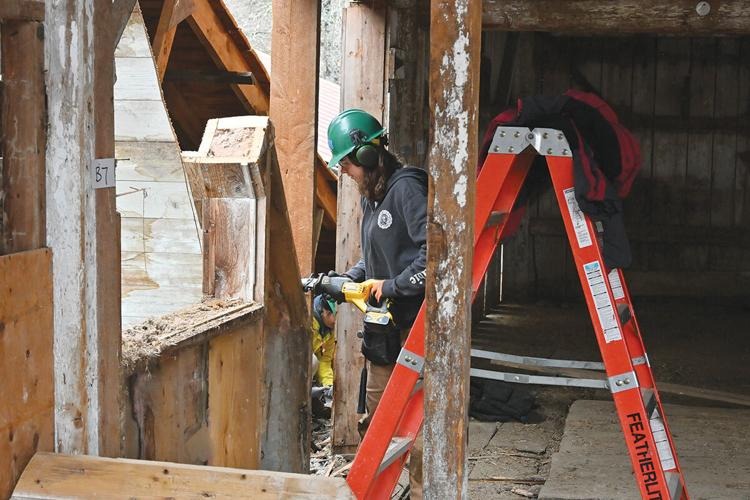
The workers work through different Conservation Corps programs, but they all have an appreciation for the structure they are disassembling. Hadar is with the timber framing program and other workers came from the farming and conservation program.
Working under the guidance of Building Heritage, a historic preservation company, the barn is the first project of its kind for several of the workers, and its new territory for the company as well. Interstate 89 travelers might recognize the massive red East Monitor barn off the highway near Richmond, one of the largest barns in the state, which the preservation company rehabilitated in 2023.
“We’ve renovated lots of old barns, but this is our first time taking one down,” Eliot Lathrop of Building Heritage said.
The barn should be disassembled and gone in five weeks, then rebuilt at Building Heritage’s headquarters in Huntington. Its next home has not been determined, but Lathrop said the company has a host of private and public connections for the structure.

As winter rolls in, the volunteers and three workers with Building Heritage are stripping the two-story barn down to the historic timber frame. Accessory structures attached to the barn, like greenhouses and out-barns, have been torn away and demolished, and the old clapboards and metal roofing thrown away, but the hand-hewn timbers and inside-facing boards will be repurposed.
For workerss in the timber framing program, the project is a practical look at age-old building practices they’re learning about. For farming and conservation workers, it’s a lesson on how to deal with ancient structures that are common throughout Vermont’s landscape.
Jessie Gustafson, another worker with the timber framing program, is happy the barn is being saved, and she’s found a type of serenity among the hand-hewn timbers from 150 years ago.
“I feel like it’s a lot of respect for the trees that went into making this, and the people that took the time to make it,” Gustafson said. “It’s just such a beautiful barn, and it’s fun to be in here. It’s also fun just, like, ripping stuff up.”
Repurposing structures like the barn also cuts down on the amount of material deposited in a landfill, fulfilling a state mandate to reduce waste after a buyout. On Wednesday, King Construction knocked down the Avery’s home of 40 years with an excavator, and the remains will be thrown away.
Although it’s a historic structure with its own timber frame skeleton, layers of plaster and other material in the home rendered it too difficult and expensive to renovate.
Prior to the demolition, the Averys asked friends and neighbors to raid their home. Building material and appliances, including marble windows, a wood stove and hardwood went to seven surrounding counties in Vermont.
It was nice because it all went to people we knew, people who were building a house or renovating their house, so we knew it was all going to get used,” Lela Avery said.
Don’t whither away
With the structures slated for removal by the end of the year, the only thing remaining of the nursery will be Don and Lela’s gardens, but they have three years to remove them from the property.
Vermont Fish and Wildlife doesn’t want to manage the gardens, but the Averys wanted to break it up anyways. They’ve seen some private gardens wither once they become public.
“It’s too personal,” Don Avery said. “We always knew this wouldn’t be here forever, but we wanted someone who would take care of the plants after us.”
They don’t have a plan for all the species, but some of the rare conifers will return to Greg Williams, a Wolcott plant master who taught the Averys how to graft trees decades ago.
“It was a good long run,” Lela Avery said. “We really enjoyed it. We loved our little place there. We loved our business, and we loved our customers.”
Correction: This story has been updated to correct the spelling of Eliot Lothrop’s name and clarify Building Heritage’s arrangement with the Vermont Youth Conservation Corps. It also clarifies that Vermont Fish and Wildlife is the land purchaser.