

The Taconic and Green School District is moving forward with plans to close two elementary schools serving Danby, Mt. Tabor and Sunderland students, despite residents in those towns voting in a non-binding referendum last week to keep the schools open.
During its Tuesday meeting, the school board voted 11-2 to close the Sunderland School and the Currier Memorial School in Danby, which serve grades K-6 and pre-K through grade 5 respectively.
Board members Ron Flynn and Rogan Lechthaler voted against closure. The board needed 10 of its 13 members to vote in favor of closure — a rule enacted during the 2017 merger and creation of the Taconic and Green School District under Act 46.
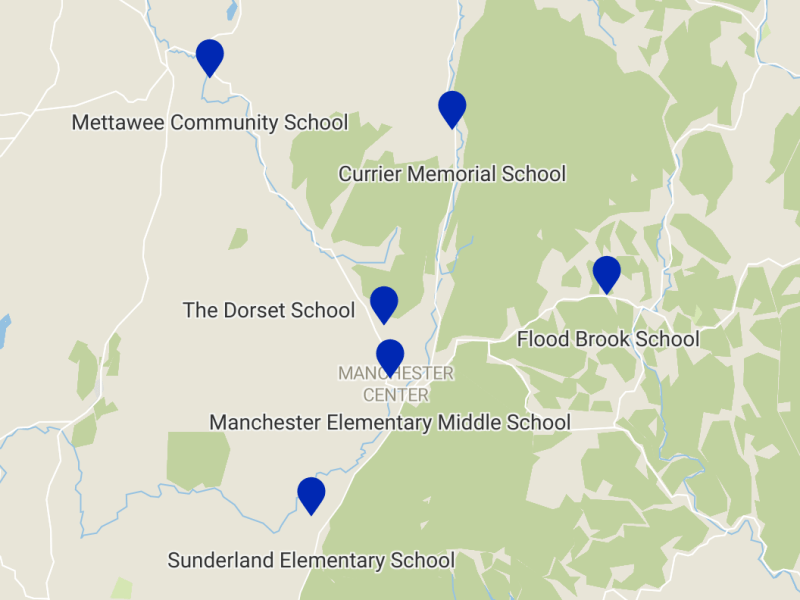
The Taconic and Green School District, part of Bennington-Rutland Supervisory Union, oversees four elementary schools and an elementary-middle school for nine towns including Manchester. Both the Sunderland and Currier Memorial schools currently have fewer than 50 students and are expected to continue seeing enrollment declines, board members said.
The costs of keeping the two schools open, school officials said, have prevented the district from providing equal learning opportunities to all students. The district’s other schools each have 30 to 40 kids per grade and enjoy more robust programming than what the smaller staff at the Sunderland and Currier Memorial schools can provide.
Taconic and Green school board Chair Melanie Virgilio, of Sunderland, said during the Tuesday meeting that the board members who voted for closure believe “that this will really be providing the best next steps for our kids in our communities.”
“I know none of us here are doing this with a light heart,” she said. “I don’t know how best to appropriately apologize, or say that we’re excited. There’s a lot of emotions around this.”
Both schools will close on July 1. The remaining students at the two schools would transfer to the Dorset Elementary School, while the district would shift all of its 6th- and 8th-grade students from the Dorset School to the Manchester Elementary-Middle School. Middle school students at the Flood Brook School would remain at that school.
Teachers and staff at the two schools, meanwhile, will be “reassigned by seniority,” according to Randi Lowe, the superintendent of the Bennington-Rutland Supervisory Union. She said in an email that “almost all, if not all, employees will have positions” in the district’s new configuration.
The vote to close the schools comes amid a tumultuous period of change for Vermont’s public education system. Act 73, the state’s sweeping education reform law, could soon transform how the system works and how the state pays for it.
The school redistricting task force is currently working to create no more than three possible map configurations to merge the state’s 119 school districts and 52 supervisory unions. The Legislature will consider those maps during their upcoming session in January.
In some areas of the state, Act 73 is already having an effect on how districts are structuring themselves.
Danville voters will on Dec. 6 vote whether to shutter high school grades at the Danville School and switch to school choice after a resident petition was verified with enough signatures, according to Danville Town Clerk Michelle LeClerc.
That petition was partly spurred by fears that the Vermont Legislature was likely to pass legislation to restrict school choice for districts that close their schools — a sentiment that others have contested.
But in places like the Bennington-Rutland Supervisory Union, the changes being considered predate the state’s new reform efforts.
Plans for a regional middle school have been in the works at the Bennington-Rutland Supervisory Union for several years, while plans to close some of the Taconic and Green School District’s five schools have been in discussion for at least a year.
Still, the new law’s provisions for when to close smaller schools appeared to, at least in part, motivate the board’s vote to close.
“We have no idea what the state’s going to do, and we can’t guarantee that closing these schools” would protect the school district and supervisory union from getting split apart,” board member Alex Wilde said Tuesday. “Not closing the schools is almost certainly going to let them just tear us to shreds.”
The board is committed to these plans, despite a majority of residents in the three towns voting in an Oct. 28 non-binding referendum against the two schools’ closure.
Just under 20% of registered voters in each town participated in the referendum, according to the results. Danby residents voted 148-46 to keep the schools open, while Mt. Tabor residents voted 22-6. The vote was closer in Sunderland, where 101 residents voted to keep the schools open, versus 73 who voted to close.
Lowe said that the results “were not unexpected and do not raise any additional concerns.”
“We are committed to a transition to new school communities that centers our students and their needs,” she said in an email.
During the Tuesday board meeting, several board members said they were disappointed in the low percentage of residents that voted. Some board members said much of the email correspondence they received in the days leading up to the vote were in favor of closing the schools.
“I don’t know where the ‘no, keep our schools’ emails were, but … it puts us in a tricky spot where the emails are saying one thing but the vote is clearly saying the opposite,” said Lechthaler.
Still, most board members said they felt closure was needed. Jon Wilson, who voted to close both schools, said Tuesday that he felt “like a villain doing that.”
“These schools both have long histories. We’re talking about the death of schools,” he said. But he voted for closure “because, as a school district, I don’t believe we can fulfill our potential if we keep those schools open. That’s sad to say and probably not making me any more friends, but that’s what I believe.”
On Tuesday, Virgilio said that further declines in enrollment at the schools were inevitable. When Currier Memorial School first opened in 1966, she said, there were 200 students there.
“That’s not there anymore,” she said. “I can’t see Danby growing exponentially in the near term, and I can say the same thing about Sunderland.”
While she remarked that these schools had “vibrant communities” in year’s past, she noted “that is not the reality of today, and I don’t see it going back, unfortunately.”
Correction: An earlier version of this story attributed a quote from the meeting to the wrong board member.
