


This story by Patrick Bilow was first published by the News & Citizen on Oct. 16, 2025.
Recreationists exploring the Lamoille Valley Rail Trail could be forgiven for bypassing Wolcott, but there’ll soon be no excuse.
There’s a one-room library, an inviting gazebo and parking lot at the trailhead on School Street, but without public bathrooms or much indoor space, the area serves as more of a launch pad for the trail than a destination for people using it.
With 20,253 users in the second half of 2024 and 15,699 in the first half of 2025, Wolcott is the fourth most popular town on the trail, just behind Cambridge and Johnson, despite having a fraction of the accommodations as those towns. The Wolcott Store is half a mile away, over a one-way bridge and along Route 15 with its narrow shoulder.

But for eastbound travelers, some say the best of the rail trail starts in Wolcott. From the parking lot on School Street, riders, runners and walkers typically hang a left toward Hardwick — over the Fisher Bridge, the last covered train bridge to operate in Vermont, and along the Lamoille River to the front gates of the Northeast Kingdom, right now dipped in gold and red for a few more short days.
The stretch of rail trail from Wolcott to Hardwick is one of Michelle Gudorf’s favorite sections, and it’s definitely her husband’s. They live in Wolcott, but they’ve walked the entire length of the rail trail in chunks since it opened last year, and still their home section stands out.
As a resident who works at the town offices just steps away from the rail trail, Michelle is happy to live and work so close to such a beautiful part of the trail. Not everyone is so lucky, and for those who travel to Wolcott to hop on the rail trail, there hasn’t been much of a reason to hang around, post-adventure. But that’s all changing.
For starters, Wolcott is boosting its curb appeal and creating a clear connection to the trail. In addition to clearing overgrown trees and vegetation and planting a new kiosk with fresh maps along the trail, the town received a grant to resurrect the old train depot foundation at the intersection of the rail trail and the connector trail.
When the railroad was operational, the current library operated as a depot on the foundation. The building was later relocated to serve a more useful purpose as a library a few hundred yards away, but the foundation still stands beneath long grass and short trees.
Utilizing a grant, the town has plans to cut back the vegetation and fill the foundation with gravel to create a rest area with picnic tables and two giant outdoor planters, which were hand-painted at a community event. The new kiosk will also have historical information about the depot and its relocation.

On the other end of the connector path, the rail trail has helped justify some major community upgrades in Wolcott.
Different town entities are developing a plan to renovate the old schoolhouse on School Street, which is connected to the town offices, and move the library next door into the renovated schoolhouse. The current library would then be leased as a café or restaurant with ice cream, accommodating residents of Wolcott and trail users alike.
A coinciding effort to build a decentralized wastewater system in Wolcott — the first of its kind for the town — would also mean public toilets and running water at the trailhead.
Although the area is removed from businesses on Route 15 in Wolcott, the nexus of the rail trail, library, town offices and a new business would create an important community hub, according to Linda Martin, Wolcott selectboard chair.
“There’s been a lot of interest for years to see something done with the old schoolhouse,” Martin said, saying rail trail momentum has helped the town bring those desires to fruition.
Trust in Wolcott
Reigniting an old effort, a few townspeople earlier this year established the Wolcott Community Trust and began fundraising to pay for the schoolhouse renovation. The project is expected to cost $1 million, and the trust has secured $300,000 through a Village Trust Initiative grant, which should cover the planning and early-construction phases, Martin said, adding she’s confident in various fundraising efforts for the remainder of the cost. In most of those grant applications, the rail trail is listed as a burgeoning community asset.
“We’ve got these big goals we’re working towards as a town, and the rail trail has opened up some good opportunities,” Martin said.
The trust initially considered opening the café in the old schoolhouse, but the library could use more space, and its current building fits an intimate café setting, Martin added.
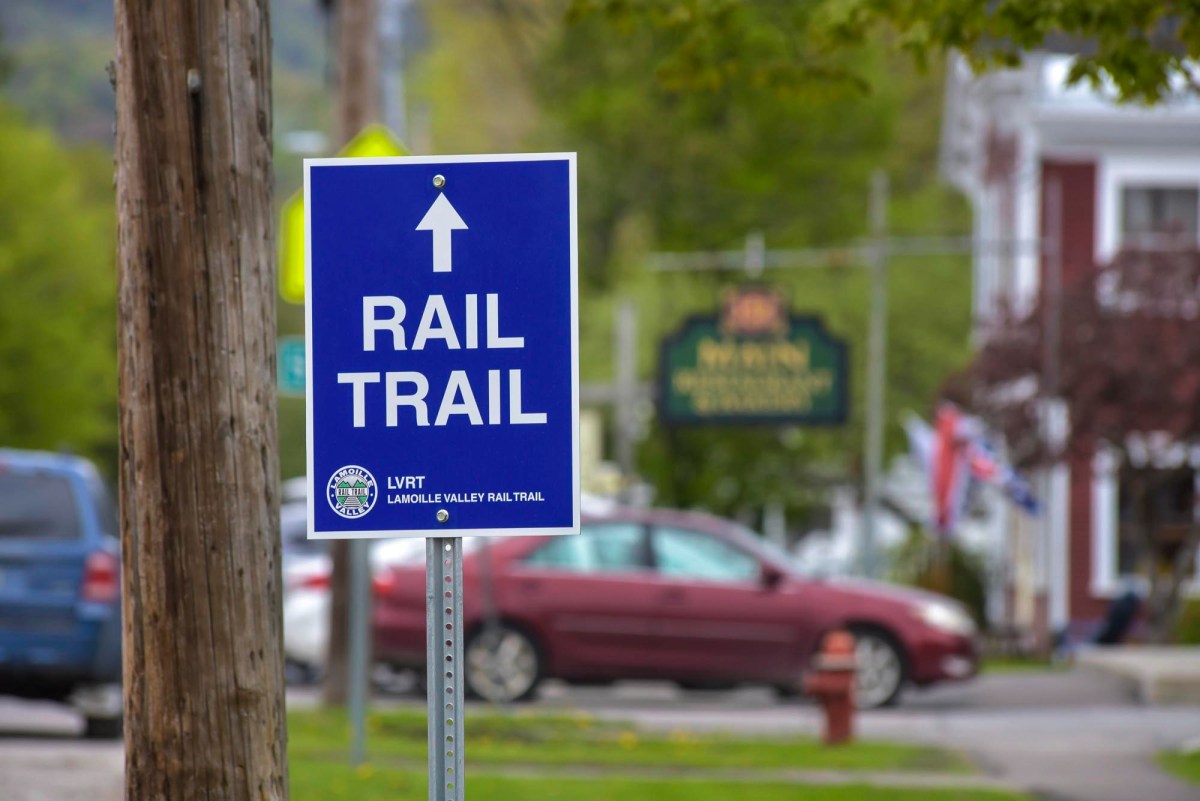
For gas station purchases, used books, cannabis and smoked fish — all nearby on Route 15 in Wolcott — a renovation to the bridge on School Street will create a safer path to and from the rail trail.
The bridge will be closed from March to September next summer. It will have a pedestrian walkway when it opens again, replacing the current right of way that’s barely large enough for one vehicle.
The bridge has sustained damage over years of floods. It’s been stabilized but needs a permanent fix. Because the town opted to close the bridge during construction, and not build a temporary bridge, the state is covering the cost of the project, save for initial, planning costs of around $80,000, Martin said.
