

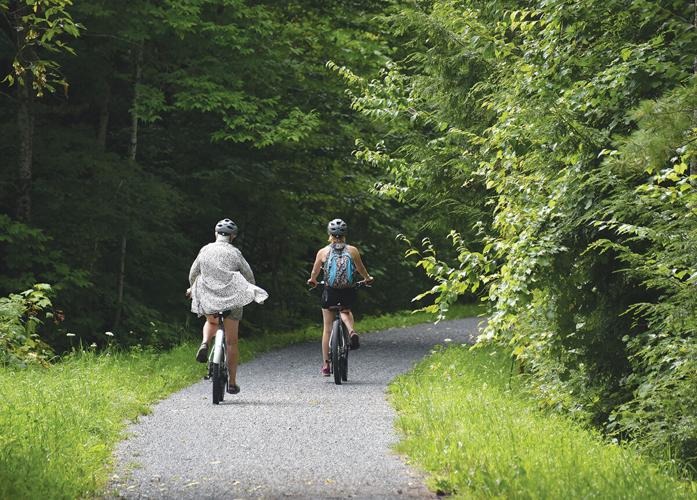
This story by Patrick Bilow and Aaron Calvin was first published in News & Citizen on Sept. 25, 2025.
After a long day of pedaling from Swanton to Morristown on the Lamoille Valley Rail Trail, Paul Arthur of Vail, Colorado, didn’t have to look far for a quiet place to lay his head.
As the sun set over the Lamoille River, Arthur had pitched his tent on a soft patch of grass just steps away from the trail he’d been traveling. His bike, mounted with bags bursting at the seams with gear, was propped up by a strong stick, and Arthur was basking in the last sliver of sunlight available to him.
He’d found what he was looking for after dropping his son off at college a few days prior — something smooth and flat to pedal and reflect. The river murmured as it moved, and Arthur hadn’t seen another rider in hours.
“This is one of the best experiences I’ve ever had,” Arthur, 68, said. “Vermont is a biker’s paradise. I can’t believe no one else is out here right now.”After repeated floods waylaid its completion, towns are starting to see the full impact of a complete Lamoille Valley Rail Trail, which is attracting locals and out-of-town visitors like Arthur alike. Some ride and others walk or run. They come for day trips, launching from several different trailheads in Lamoille County, or they travel straight through Vermont, from New York to New Hampshire, stopping in towns along the way for provisions, repairs and libations.

Data from counters installed by the Vermont Agency of Transportation that monitored traffic on the rail trail for the second half of 2024 and the first half of 2025 shows that, if trends continue apace, that most stops on the trail are set to see usership far in excess of 2024, which department spokesperson Amy Tatko said reflected last year’s flooding-related closures.
The data also shows how the locally connected portion of the trail that runs through Lamoille County has helped develop ridership in those towns. Morrisville is clearly the most trafficked hub along the trail, while Cambridge, Johnson and Wolcott are also among the most popular access points, as towns like Fairfield have made inroads in the first half of this year.
Every town has benefited from a dry summer, as cyclists were able to travel unimpeded between Swanton and St. Johnsbury on the 93-mile former railway and one of the longest rail trails in New England, passing through five counties and 18 towns, including five Lamoille County towns along the way. Such a season has been a long time coming, even while a 17-mile Lamoille County portion of the trail has been open since 2016.
In 2023, Sen. Bernie Sanders, I-Vt. — who helped secure millions in federal funding to get the rail trail started in the 2000s — and Gov. Phil Scott — who has boosted the project and advocated for annual funding to maintain the trail — were set to walk portions of the trail in mid-July of that year as the complete version of the trail, decades in the making, was set to be unveiled.
But the flood of July 2023 hit just days before the big ribbon cutting, severely damaging portions of the rail trail and causing millions in damages in towns like Cambridge, Johnson, Morrisville, Wolcott, Greensboro and Hardwick.
Despite another flood hitting in early July 2024, which again damaged parts of the trail, the Lamoille Valley Rail Trail quietly opened last year to bikers looking to travel its full 93 miles.
Yva Rose, who operates Johnson-based Lamoille Valley Bike Tours with her husband Jim, has been keeping her own data of rail trail usership. Since 2016, she has seen the number of users steadily increase. In 2020, when the pandemic hit, the surge in outdoor recreation interest gave usership another big boost. The Roses’ plan to provide planning support, shuttle rides and bike rentals to riders along the full-length of the trail was torpedoed in 2023, which pushed potential riders to have cold feet even before the anniversary floods in 2024.
But the relatively dry summer this year has been a bounce-back season for the trail, with usership of the trail by her metrics having “quadrupled,” driven largely by a sector of outdoor enthusiasts that seek out the rail trail experience. Many towns along the trail have seen the cultural and commercial benefits already, even as they try to better position themselves to capitalize on their proximity to this economic engine of recreational tourism.
“There’s a community, a very large community, out there that spends their summers exploring rail trails,” Rose said. “Having our rail trail be 93 miles now and complete, without any flooding, has drawn a huge increase in rail trail tourism.”
