


For years, nearly every event at the historic Vergennes Opera House has seen attendees with accessibility needs either turned away or a struggle up the stairs or to the auditorium, longtime volunteers said.
Come summer of 2026, that issue will be history, thanks to the efforts of a nonprofit residents group managing the building. Construction is underway for a $2.2 million All Access Project that will make the building ADA accessible.
The project has been long overdue, according to Gerianne Smart, president of the Friends of the Vergennes Opera House, a nonprofit created in 1993 that reopened the theater in 1997, an achievement celebrated with a sold-out Vermont Symphony Orchestra performance, according to its website.
The building was brought up to fire code in the 1990s and has since seen several small improvements.
“It’s an old building, so it’s always begging for a little something,” Smart said. “The one thing that was left was accessibility.”
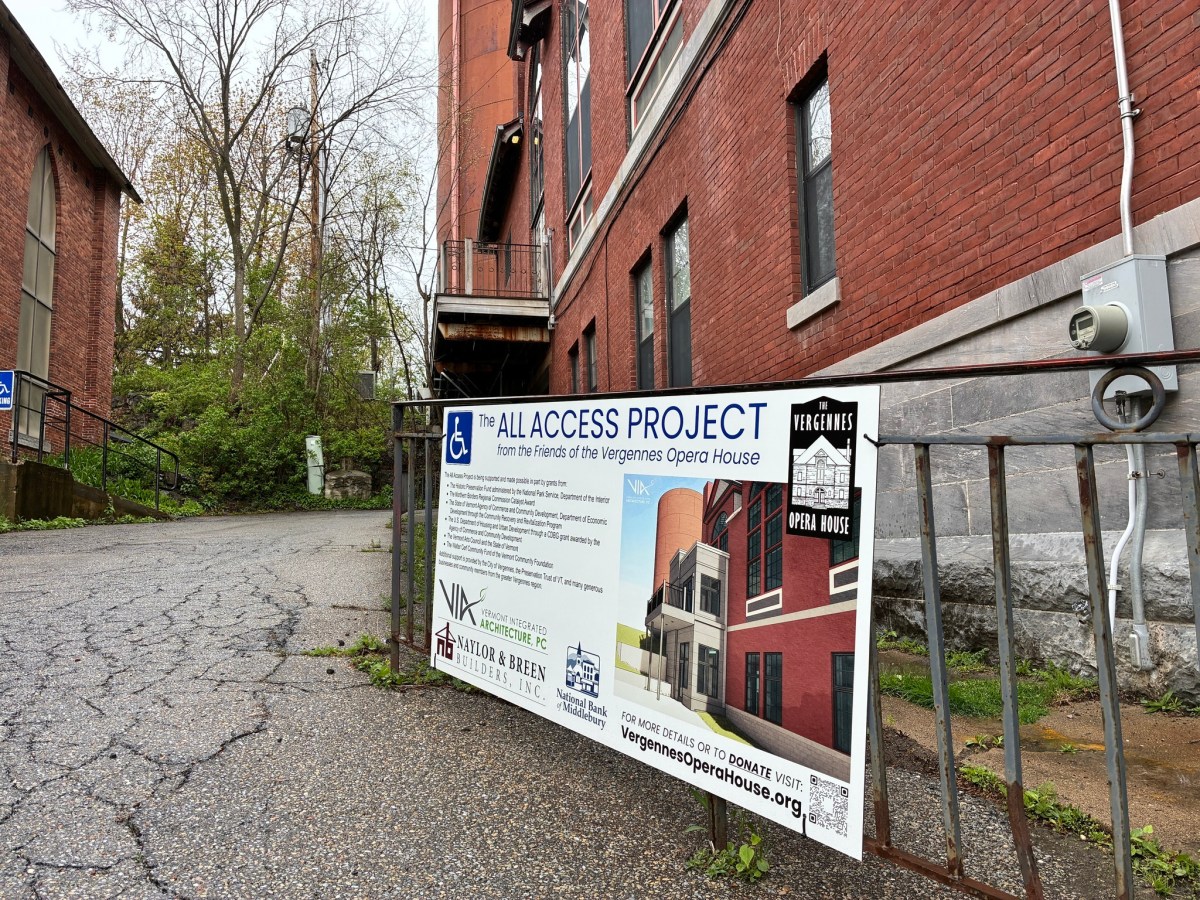
The project involves building a new elevator tower against the southwest side of the building, a better walkway from the street, and an interior lift from the auditorium level to both the stage and dressing room, which will also include an accessible restroom.
Set in downtown Vergennes — at around 2,500 people, the smallest city in Vermont — the red brick building houses the city offices on the first floor and an auditorium with a painted backdrop on the second that has long been a community hub for public and private gatherings, from musical shows to the annual town meeting.
Working on the accessibility project has made Smart keenly aware of the struggles people with mobility issues face in everyday life. They shouldn’t face barriers to accessing the opera house and city offices, she said.
“It hurts my heart even talking out loud about it,” Smart said. “I can’t believe we’ve denied people access to their own town hall for so long.”
It’s remarkable, said City Manager Ron Redmond, that the Friends have managed to raise most of the money and manage a project that will benefit everyone.
“They operate with such intention,” he said. “I’ve never seen a group of volunteers be so active, so good at management, so good at fundraising.”
And thanks to the Friends group, more residents and visitors will be able to access the space, said Redmond, who anticipates the opera house will be used a lot more.
“It’s exciting and it’s amazing,” he said.

A grand tradition
Built in 1897 for $12,000, the building has hosted debates, political rallies, weddings, graduations, town meetings, music and theater performances, and notable people such as President William Howard Taft and Tiny Tim, according to the website.
It was also where a company founded by Thomas Edison first showed moving pictures in Addison County in 1901.
By 1970, the building was rundown and closed until the Friends formed to help restore and reopen it. The leader of the effort was local resident Garry Simpson, a writer, director, producer and three-time Emmy award winner. He died in 2011 but many in town still speak glowingly of his effort to revive the building and the arts.
While project construction has temporarily closed the community space — but not the municipal offices — the Friends have moved productions to off-stage locations around the city for the 2025-26 season.
The accessibility project began in 2021 when the Friends first put out a request for proposals for architects, according to Smart. The all-volunteer group raised funds through state grants and charitable donations, but the project still faces a $300,000 shortfall. To help close the gap, the Friends have launched a buy-a-brick campaign that’s seen some creative results, according to Suzanne Rood, one of the board members.
There are quotes from Shakespeare like “To thine own self be true,” some Bible verses, and some honoring veterans. One reads “The answer to the universe is on the back,” Rood said with a laugh.
The Friends have sold about 250 bricks so far, but there’s space for 500 in the new well-lit, pedestrian courtyard in the alleyway between the Vergennes Opera House and St. Paul’s Church next door. The courtyard will provide easy access to the new elevator tower being built.
Rood is a pianist who directs the Addison County Gospel Choir and has performed at the opera house. She uses a wheelchair and is particularly pleased there will be “a discreet lift” backstage to help access the stage.
“I think it shows that the Vergennes community values including people with mobility issues and is willing to do such an enormous project in order to be inclusive,” she said.
Correction: A previous version of the story misstated the year the opera house was built.
