


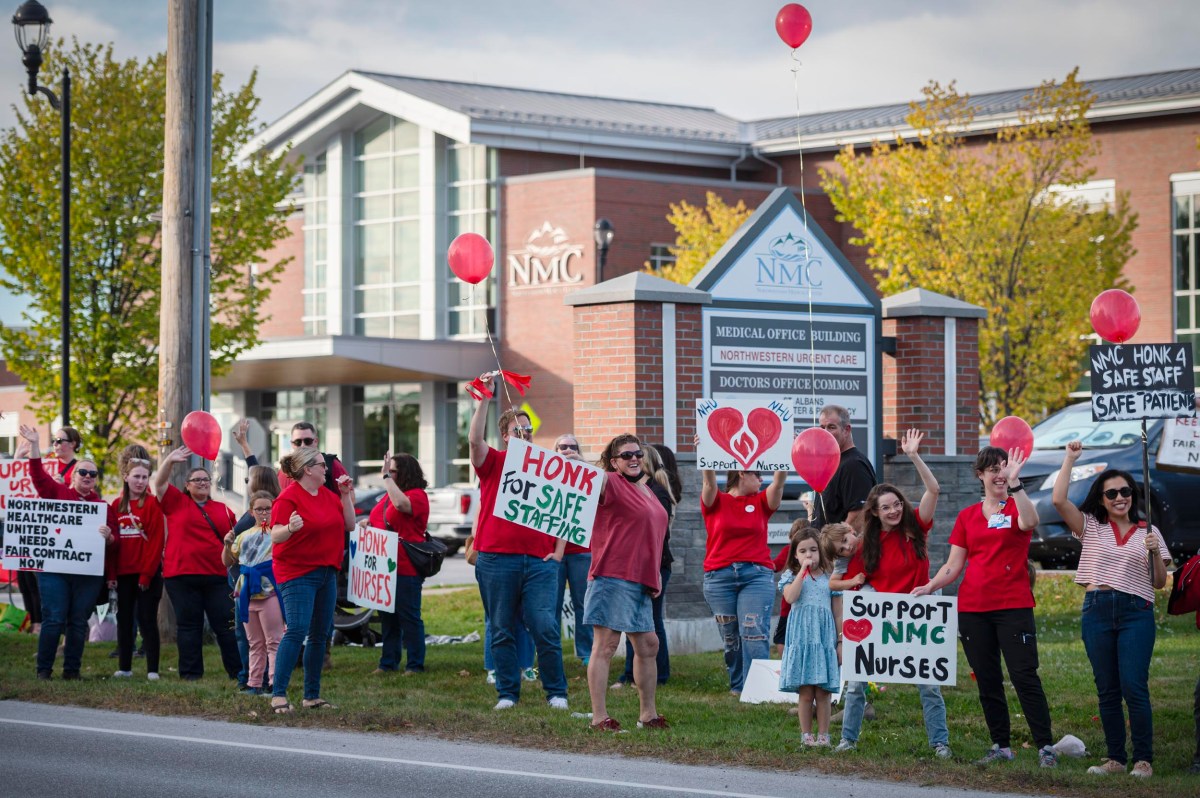
On Friday evening, dozens of Northwestern Medical Center nurses from their recently-formed union gathered with friends and families outside the St. Albans hospital to rally support in a honk and wave event. Nurses held signs and balloons as they encouraged attention to their cause from foot traffic and drivers. Many of them leaned on their horns or threw a thumbs-up in support.
In February, the nurses officially unionized and have been meeting with hospital management on a biweekly basis since May to flesh out a contract. The union is now dialing up its efforts to try to bring the hospital into an agreement by Thanksgiving.
Hospital management has yet to present an initial budget proposal, though the two sides have made progress on negotiating some concerns surrounding scheduling, parking and worker protection issues like just-cause firings.
“The membership is quite frustrated,” said Julie MacMillan, an ICU nurse at the medical center who serves on the union’s bargaining committee. “Here we are, five months in. It’s hard to bargain a contract when you don’t know all the pieces of the puzzle.”
With regard to the length of time negotiations are taking, hospital management cited the need for diligence in presenting an initial proposal.
“This being our first contract, it is important to negotiate thoughtfully and deliberately, and that takes time,” Northwestern Medical Center communications director Kate Laddison wrote in a statement.
Laddison said that nationally the average contract takes about 18 months to negotiate and that other hospitals closer to home have taken more than a year to negotiate with their nurses’ unions.
Union representatives report that the hospital has blamed the negotiations slow pace, in part, on an ongoing issue with contamination on surgical instruments in Northwestern Medical Center’s operating room, though Laddison said the issues are separate.
In August, the hospital halted surgeries because staff consistently found specks of particles in plastic-wrapped trays of surgical tools. Surgeries were routinely canceled and rescheduled or delayed as the hospital paused surgeries any time it encountered contaminated trays.
Laddison was unable to respond to a request for further details about the current status of surgeries by presstime, though she did inform VTDigger that “there’s a lot going on in that area.”
Not only did the issue stymie some progress on the contract negotiations, but it also fomented more frustration among staff.

Christine Juaire, an operating room nurse and member of the bargaining team, stressed that the operations that do occur are safe.
“Most of all, I want to emphasize that we don’t proceed with surgeries at this time unless our staff feel confident and safe in the sterility of the procedures we perform in our hospital,” she said. “We take our role in caring for our community extremely seriously.”
But the nurses also said they felt left in the dark by hospital management about how it is navigating the contamination issue, even in decisions that would affect the ability of operating room staff to perform daily operations. Several said that hospital management did not seek their input or suggestions for how to improve the problem, even though staff working in and around the OR saw areas where their on-the-floor experience might help.
The lack of communication was something that the bargaining committee expressed to management. The committee asked for staff nurses to be more formally involved in responding to the contamination problem, and for the hospital to improve its reporting on the issue to include more detailed and up-to-date information.

The hospital’s reliance on traveling nurses, over its own staff, has remained a central point of contention in the contract negotiations. According to documents Northwestern Medical Center submitted to the Green Mountain Care Board this summer, the hospital employs 100 nurses on staff and 27 as contracted nurses.
MacMillan said she often sees traveling nurses receive priority shifts, with staff nurses needing to take weekends or less desirable times. She added that in negotiations, the hospital’s lawyer often explains this situation as the result of the traveling nurses coming to the hospital under a contract, with a set of working conditions and pay that the hospital management is bound to.
“Staff nurses don’t have that, so they are at the whim of whatever scheduling practices [or] the needs of the unit may be,” MacMillan said. She described a situation that flips the industry norm, where staff nurses fill a hospital schedule and travelers are drawn on to pinch-hit and fill remaining gaps.
“It’s backwards, especially for a little community hospital,” she said.

But the reliance on traveling nurses dampens morale for the nurses who do stay: “With travelers coming and going, you don’t really feel like you build a team,” MacMillan added.
She said she is grateful to work with many of the young and traveling nurses who come through the hospital, but she wishes that the system were better set up to help them root their careers here longer term.
She cited NMC’s nursing pathway program, which financially supports employee nurse apprentices in earning their Registered Nurse licensure. “We would really like to see these wonderful young nurses who have been trained here, stay,” MacMillan said.
MacMillan sees better pay for staff nurses as the primary way to raise retention. The small community hospital, whose 2026 revenue was just set at $130.8 million by the Green Mountain Care Board, is dwarfed by UVM Medical Center, whose annual budget for this coming year was approved to be over $1.89 billion. Though the community hospital doesn’t need to compete with the state’s largest hospital, MacMillan said, the wage difference between what a Northwestern nurse is making and what a UVM Medical Center nurse makes is enough to lure many Franklin County nurses to make the roughly half-hour drive down to Burlington.
“We just want to stay a little competitive with UVM, even if [Northwestern’s administration] can come close,” she said.
It could also make staying at Northwestern a more competitive alternative for many of the traveling nurses who come through the hospital: “We’ve had travelers who have said, ‘Hey, I would love to live here, but I can’t find housing, and I can’t afford the housing that’s around. Why would I take a pay cut when I [could otherwise] just keep traveling and see the country?’” MacMillan said. In its 2026 budget narrative to the Green Mountain Care Board, Northwestern reiterated that “it is not unusual for travelers to communicate that they would be open to exploring a permanent position at NMC if affordable housing was more widely available.”
Northwestern Medical Center’s philosophy of neighbors taking care of neighbors really resonated with MacMillan, who had worked at the University of Vermont Medical Center for most of her 23-year career before she made the move to a hospital closer to home a little over two and a half years ago.
She described the feeling of community that comes with recognizing local patients as they come into the ICU across the stages of a progressive illness. Even though no one wants to be in the hospital, she said, “there is some comfort (for patients) in knowing the nurse and seeing a familiar face.”
It’s something that may cost more upfront, but MacMillan and her colleagues on the bargaining committee see the investment in nursing staff as an opportunity to save costs in the long term — both for the costs it can save from paying for traveling nurses as well as for the effect good nursing can have in preventing deeper problems like bed sores, infections or falls.
“We applaud fiscal responsibility. We also need to recognize that people come to the hospital for nursing care,” MacMillan said.
Clarification: This story has been updated to reflect the source, according to union representatives, of the claim that the pace of contract negotiations and the operating room issues are linked.
