


With few exceptions, state government employees living outside Vermont must return to the office three days a week by July 1 at the latest. If they refuse or are unable to follow the order, state leaders are directed to start hiring replacements.
Administration Secretary Sarah Clark announced the policy Friday afternoon.
“Our approach to out-of-state employees is grounded in the principle of treating all employees equally,” Clark wrote in an email to state workers.
The guidance is the latest in Gov. Phil Scott’s hybrid return-to-office plan for state workers, which is slated to begin Dec. 1. Scott and his team have said the mandate is designed to improve collaboration and camaraderie lost to teleworking and improve customer service for Vermonters.
As part of the return-to-office process, Scott created an advisory group of state leaders to hash out the logistics of the policy change. That group was tasked with how to handle out-of-state employees working for the state government, a population that’s grown since the Covid-19 pandemic normalized remote work for many.
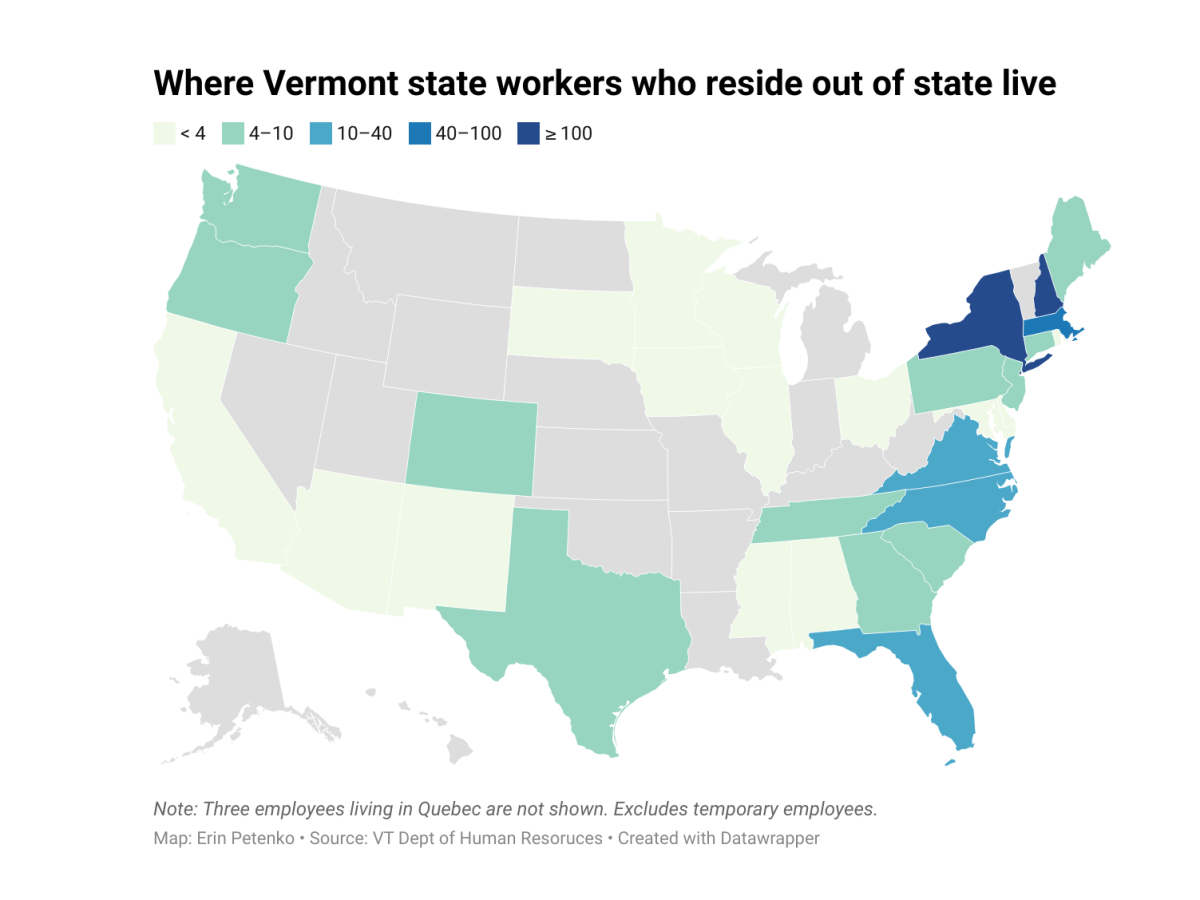
Of the 552 state employees who lived out of state as of September 2025, 433 lived across Vermont’s borders in Massachusetts, New Hampshire, New York or Quebec. But another 119 lived further afield in states like Florida or North Carolina. As of last month, state employees reside in 31 different states and one Canadian province.
The Vermont State Employees’ Association, the union representing nearly 6,000 state workers, has strongly opposed the in-office mandate, citing state surveys showing a huge majority of workers value teleworking and believe it positively impacts their performance.
The mandate has galvanized state workers, more than 3,500 of whom have signed a petition opposing the order.
Steve Howard, the state employee union’s executive director, said Friday he and state workers are skeptical of Scott’s rationale for the mandate.
“What is it that is so overwhelming it requires him to ignore the data from his own surveys?” he said, adding that forcing workers back to Vermont would only worsen the state’s housing crisis.
The state’s new guidance gives employees living out of state until June 30, 2026, to comply with the three-day minimum, although those already capable of returning to the office must do so by Dec. 1. Employees are instructed to communicate in writing by Nov. 21 whether or not they will comply with the order and whether they need to change residency to do so.
The hiring of new out-of-state employees who work remotely is generally banned under the directive.
State leaders are instructed to start recruiting new employees to replace out-of-state workers who won’t meet the requirements by Dec. 1. Individual agency and department leaders can decide whether to terminate out-of-state workers who won’t meet the hybrid plan or allow them to telework during the replacement hiring process.
Only if a hiring process does not yield a qualified candidate can state managers request permission to extend existing employees’ telework agreements. Those exceptions “will require a rigorous approval process and will need to be reviewed annually,” according to the guidance.
The Scott administration’s plan outlines a few exceptions to the mandate, including those with military spouses who are relocated, those with court-ordered arrangements and those who relocate due to personal safety.
