

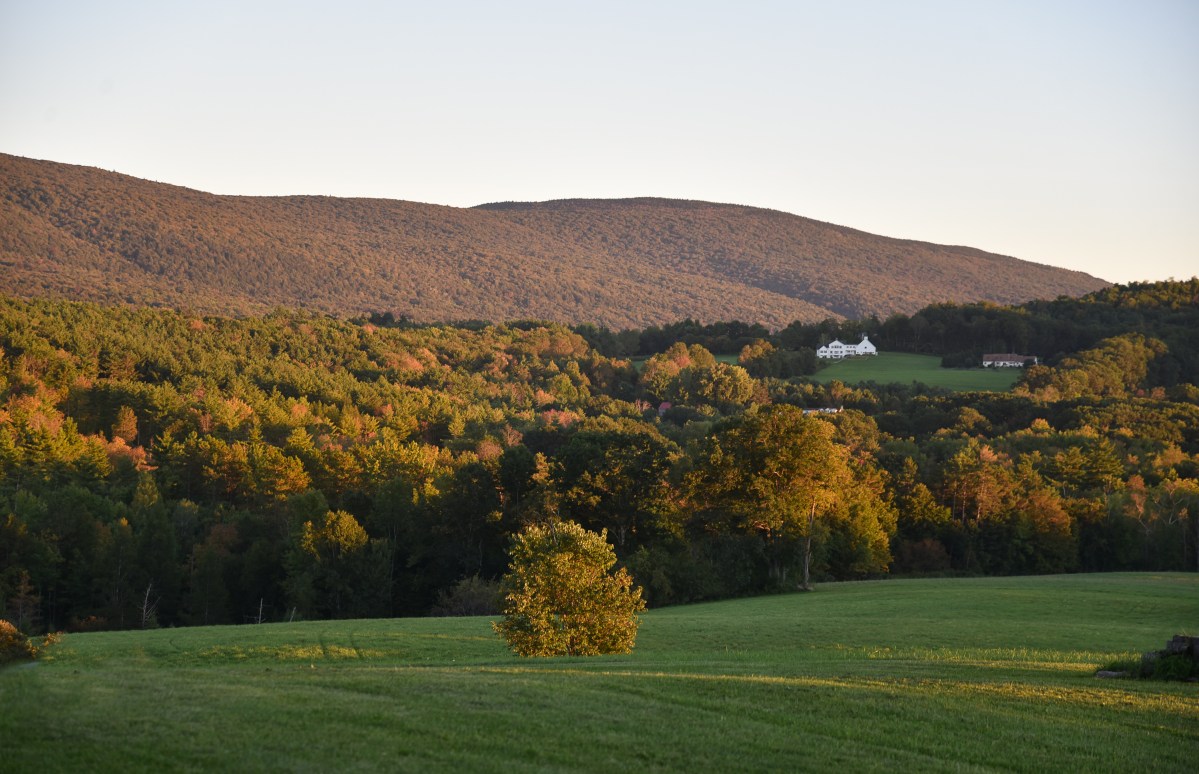
The Public Utility Commission gave the green light Monday to an 80-acre industrial solar field development on a sloping hillside of sprawling meadows, thick forests and agricultural fields in Shaftsbury.
Neighbors of the project and environmental advocates in southern Vermont have vehemently opposed the project first proposed in 2023 due to the potential environmental and aesthetic harm to the land. Multiple organizers said they are likely to appeal the commission’s decision to award VT Real Estate Holdings 1 LLC — also known as Shaftsbury Solar — a certificate of public good.
Alongside consideration of local impact, the commission’s decision in favor of the Connecticut developer, Freepoint Solar, owned by Freepoint Commodities, was “heavily informed by Vermont’s ambitious energy policy goals” outlined in the state’s public service statute, according to the final decision, signed by Chair Edward McNamara and Commissioner Riley Allen.
“We have also considered Vermont’s role within the broader, interconnected New England grid and our reliance on that network to maintain a reliable electric grid and to achieve our greenhouse gas reduction mandates,” McNamara and Allen wrote.
The decision comes after Vermont reportedly failed to meet its carbon reduction targets this year, and a judge dismissed a lawsuit attempting to hold the state accountable for this failure.
Commissioner Margaret Cheney wrote a concurring opinion to the decision, agreeing that the project “checks all the necessary boxes” of Vermont statute, but voiced concern with the location and the tree clearing required to make way for the large-scale solar project.
While the project itself will occupy 80 acres when complete, Cheney wrote that 104 acres would be disrupted during construction, including 64 acres of agricultural land. Forty-two acres of trees will be axed, including 34.6 acres of mature trees, Cheney added.
Forests sequester carbon, so tree clearing partially counteracts the greenhouse gas benefits associated with the addition to the renewable energy grid, Cheney wrote. The power and renewable energy credits created through the project can also be sold outside the state, so “Vermont will bear the burdens of this facility but might not directly reap the environmental benefits that it provides,” she wrote.
If renewable energy development prompts deforestation and a lack of substantive benefits to Vermont utilities and customers, the commission may reconsider how they arrive at “public good” determinations for future projects, Cheney asserted.
“We should consider how to create incentives to site very large facilities away from unspoiled land and close to existing infrastructure,” Cheney wrote. “Although this goal may be best achieved through future legislative amendments, renewable energy developers should be more deliberate in identifying sites that minimize localized aesthetic and environmental impacts.”
Annette Smith, executive director of Vermonters for a Clean Environment, said the Shaftsbury project is the “solar equivalent” of the controversial, industrial-scale Lowell Wind Project over a decade prior.
While in favor of solar canopies in developed areas, Smith expressed concern about the industrial project on agricultural land increasing stormwater runoff, degrading prime soils and harming biodiversity of the area. She said the fuel energy and clear cutting of mature trees necessary for the project counteracts any positive environmental impacts.
“This is going to do nothing to reduce carbon emissions,” Smith said. “There is no need to destroy an ecosystem in order to create solar electricity for the region.”
Meanwhile, the town government and regional planning commission have taken a different stance on the project.
Shaftsbury Select Board Chair Zoe Contros Kearl wrote in a Friday statement that the proposed construction has been “painfully contentious,” but that the board hopes residents will focus on the solar project’s positive impacts for the town now that it has been approved.
“The Town will benefit from this project in numerous ways — including increased funding for our elementary school, substantial property tax contributions that will make a real difference in our annual municipal budget, and the funding of a new brush truck for our Fire Department,” Kearl wrote.
Bennington Regional Planning Commission Planner Callie Fishburn wrote in a Thursday statement that the Shaftsbury solar project’s approval will further the region’s renewable energy goals. The commission is requiring the solar developer to manage the concerning impacts of the projects, Fishburn wrote, “including in the areas of aesthetics, preservation of agricultural soils and damage to infrastructure,” Fishburn wrote.
Steve Collier, general counsel for the Vermont Agency of Agriculture, Food and Markets, said that “solar projects raise substantial — and sometimes competing — interests,” but a certificate of public good requires long-term protection of agricultural soils, which the developer agreed to and should be followed.
“Renewable energy is important and beneficial. Preserving agricultural land and our ability to grow food is critical,” Collier wrote. “We are concerned about the ongoing loss of farmland and believe Vermont needs to thoughtfully use and maintain it.”
Jim Porter, director for public advocacy for the Department of Public Service, wrote in a statement Friday that the department found no engineering problems or aesthetic concerns with the project, as the developer plans to implement mitigation measures recommended by the department and neighbors to the project.
The solar development aligns with the present and future energy service needs and conforms with the Vermont Comprehensive Energy Plan based on expert testimony provided by the Department, Porter wrote.
Judith Schwartz, a Bennington resident and environmental journalist who wrote a commentary on the Shaftsbury Solar Project, opposes the idea that deforestation is necessary for renewable energy development.
As a result of the Shaftsbury solar project development, a piece of southern Vermont’s wildlife corridor between the Taconics and Green Mountains will be lost, and threatened beech and white ash trees will be axed in the process of constructing solar fields, Schwartz said.
Tony Eprile, Bennington resident and Schwartz’s partner, said the pair are not against solar but think renewable energy should be planned in already developed areas in order to mitigate environmental impacts. He also expressed concern that the solar energy created will add to the grid rather than replace fossil fuels, feeding a “bottomless demand for energy” created by data centers and Artificial Intelligence technology.
“Green energy is a very pretty term for somewhat less damaging energy sources,” Eprile said. “There’s no way that you can produce solar panels without doing some environmental damage.”
Kit Ausschnitt, a neighbor and intervenor to the project, noted that the company lawyers wrote in July that the economic viability of the project hinged on the Public Utility Commission making a swift decision, citing changing tariff policies and $20 million of federal solar subsidies that the developers could lose.
In a letter to the Public Utility Commission, Ausschnitt expressed concern that the developers may abandon the project after it’s begun if it’s rendered financially unviable, meaning the natural environment would be already tampered with and “no economic benefit can flow to the community, the State and the people of Vermont.”
Ausschnitt said he is in favor of ambitious renewable energy goals, but the push created by the Legislature to develop renewable energy at the expense of forests and agricultural land is “counterproductive.”
“It’s just a beautiful natural area.” Ausschnitt said. “They’re going to destroy lots of habitat and create all kinds of environmental damage and flood risk in an area that is already prone.”
Freepoint Solar’s lawyers did not respond to a request for comment.
