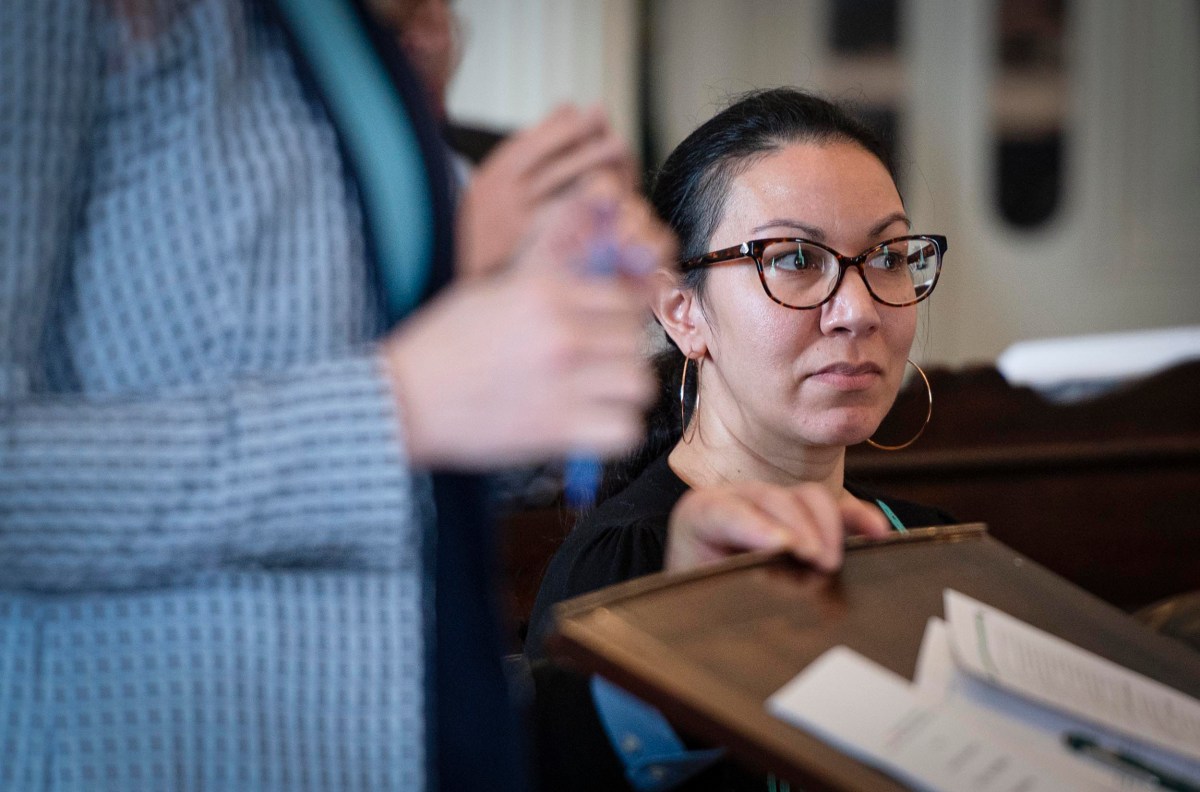
You may have noticed, though probably not: the House streams its party caucuses, but the Senate doesn’t.
That’s a change this year. What happens in weekly lunch-hour caucus meetings? The parties discuss their priorities for the week and strategize. Sometimes things get feisty, either internally or lashing out across the aisle. Once or twice a session, it can make the news, but mostly, it’s mundane.
Why the change? Sen. Kesha Ram Hinsdale, D-Chittenden Southeast, the majority leader, assured me it’s not that interesting, and she’s heard no complaints about the switch.
“I made the call that, you know, if the press is there, great, they’re welcome to report out what’s said. But the actual burden of video taping, it is a new one,” she said, “and not one that I felt like we had the staff capacity to maintain in a way that was quality.”
Last year, Senate Dems streamed weekly from the legislative lounge. Now, they’re stationed in the Pavilion, Room 267.
And the Republicans? They’ve never streamed. Minority Leader Sen. Scott Beck, R-Caledonia, said he has no intention of changing that. Nor would he share where the GOP meets, except to say it was outside the Statehouse.
“If a reporter made a request to attend an off-site meeting, I would relay that request to the caucus,” he said, asking me if I was making such a request. For the moment, my answer was no.
I did, though, stroll over to the Dems meeting. Senators walked in lunch in tow, still muttering about this morning’s floor session.
The spiciest chatter concerned the $77 million Gov. Phil Scott and many lawmakers want to use to buy down property taxes this year. Some Democrats, including Sen. Ruth Hardy, D-Addison, argue a chunk of that money should be saved for the future, else lawmakers create a funding cliff that spikes property tax rates next year.
“I just think that we, collectively as a caucus, should have talked about this,” Hardy said of the buy down money and the party’s budget priorities.
Those present said that how to use the $77 million remains an open question for the Finance Committee to solve. But Senate President Pro Tempore Phil Baruth, D/P-Chittenden Central, cautioned his colleagues about saving money for next year. Doing so, he warned, could make the Senate look like it was raising property taxes more than the House and governor.
“It’s not an academic discussion,” he said, “This is very much a live political discussion, and we are in a very weak position if we decide we’re going for higher tax rates.”
—Ethan Weinstein
In the know
The Senate voted Tuesday to condemn “the manner and circumstances” of the arrest of Mohsen Mahdawi, a Palestinian activist and yearslong Upper Valley resident, by federal immigration agents in Colchester earlier this month.
Senators advanced a resolution about Mahdawi’s arrest on a 24-5 vote, with the “nays” all coming from among the chamber’s 13 Republicans. The measure, S.R.13, also called for Mahdawi — who’s been detained for more than two weeks at Northwest State Correctional Facility in St. Albans Town — to be “immediately released” as his case proceeds in federal court, adding that he also should “be afforded due process.”
The vote comes a day before a hearing is scheduled in Mahdawi’s case when a judge in Burlington could rule on whether the federal government must release him.
The Senate resolution is slated for a final vote Wednesday, and is expected to pass. Its lead sponsor, Windsor County Democratic Sen. Becca White, was with Mahdawi in Colchester shortly before he was arrested by masked, armed agents at an appointment for U.S. citizenship.
Read more about the floor debate on the Senate measure here.
— Shaun Robinson
On the move
The House on Tuesday approved an amended version of S.36, a Senate bill that was originally largely focused on addressing increasing the length of stay at residential treatment facilities that the state’s Medicaid program would pay for someone with a co-occuring substance use and mental health disorders.
The bill the House passed continues to require that the length of stay covered shall be what is prescribed by a health care provider employed by the residential facility. It also repealed a sunset on when a person deemed incapacitated through intoxication or withdrawal can be kept overnight in a state prison for their own safety.
The House version continues with both actions, but also requires additional reporting from the state Department of Health and Mental Health on their efforts to expand the overnight space available outside of prisons — now called “public inebriate” beds. It also changes the term to “persons who are incapacitated.”
The amended version now also asks the Agency of Human Services to present proposals by the end of the year for reforming how the Human Services Board — which oversees appeals regarding eligibility for a variety of support programs including, Medicaid and housing and food assistance — operates to ensure consistent and respectful treatment of people who come before it.
The amended version will now return to the Senate for its consideration.
— Kristen Fountain
Visit our 2025 bill tracker for the latest updates on major legislation we are following.