


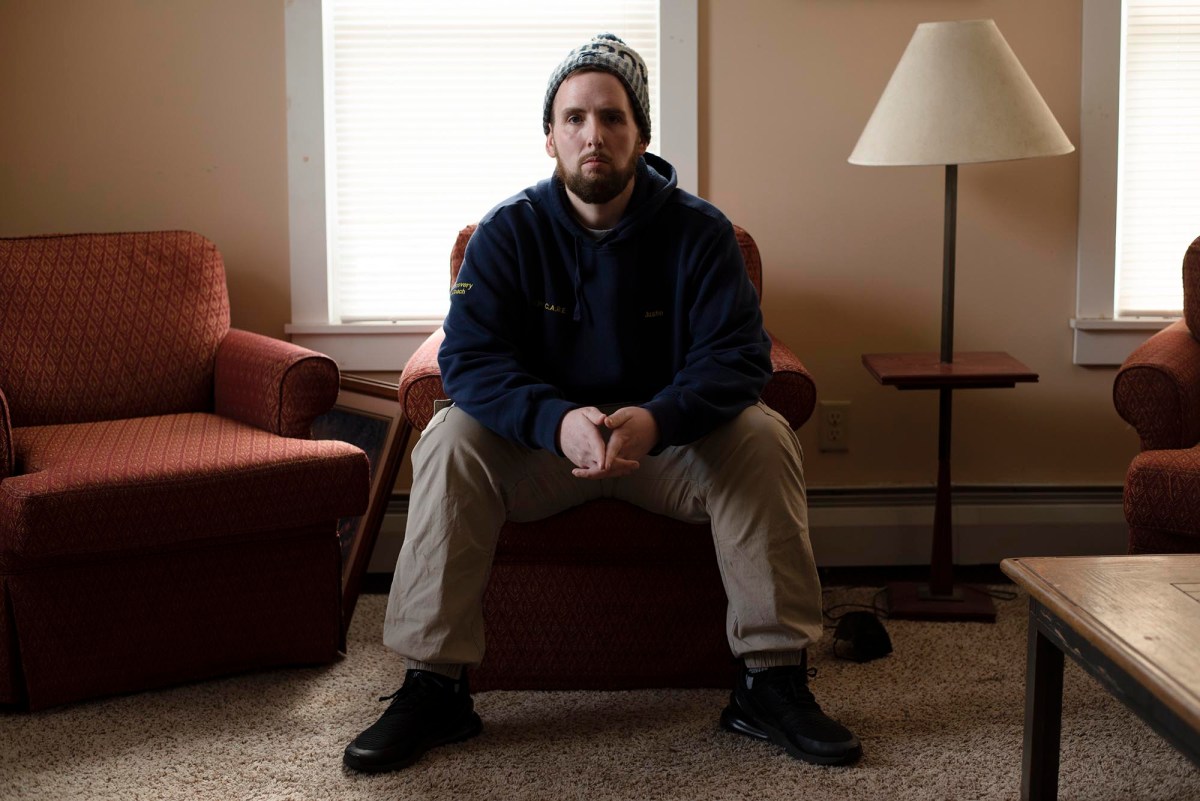
Ask Justin Johnston why he recently joined the support staff of the Brattleboro Police Department and he’ll rewind some quarter of a century to the day its officers took him into custody at age 11.
Johnston was 3 when his father died, leaving his mother to juggle two jobs, two children and an unwanted yet unrelenting dependence on alcohol. Finding himself uprooted from Florida to Ohio to Vermont, the schoolboy arrived in Brattleboro to his first stirrings of adolescence — and, feeling lonely and lost, sparks of anger.
“My mom had called the police because I was out of control,” the now 39-year-old recalls. “I picked up some object and went to throw it at the wall.”
What he hurled he can’t remember. The fact it hit her he can’t forget.
Johnston marked his 12th birthday in the first of several foster and group homes.
“I started smoking weed,” he says today, “and eventually, you do it so much, you have to find a way and a means to get it.”
Johnston befriended and began working with drug dealers. At 17, he was convicted and jailed for selling crack cocaine. He’d graduate high school at Southern State Correctional Facility in Springfield, then move in and out of prisons in Massachusetts, New Hampshire, New York and Kentucky. Arrested for dealing heroin just before turning 30, he finally landed in a federal penitentiary in Pennsylvania.
Johnston can detail every moment of his descent into drugs and despair. But now sober for a decade, the newly hired recovery specialist for the police department’s Brattleboro Resource Assistance Team would rather share how he — and others — can rise above.
‘What’s wrong with me?’
Johnston never had an easy childhood, which went from bad to worse when, as an elementary schooler, he discovered the truth about his father.
“For most of my life, I had thought he died in a car accident,” he recalls. “And then I found an article in my mom’s bedroom and learned that it was by suicide.”
The resulting questions swarmed Johnston as if he had struck a hornet’s nest.
“Why didn’t he love us enough to not do this?” he remembers thinking. “What’s wrong with me?”
With his mother often away working a double shift, Johnston had few people other than his younger sister to ask. And so he sought validation from other boys in their rough-and-tumble neighborhood.
“I might not have a car or a big house with a swimming pool or ever invite you on a family vacation, but I can show up at the party with alcohol, I can get you marijuana, I can get you mushrooms,” he recalls thinking. “I wanted to show that I had something to offer, that I could fit in, that I could run with the crowd.”
And from himself.
“It might have started with fun,” he says, “but it eventually became a way to numb myself, to just ignore the world, to be lazy, to ignore responsibilities and what my future might look like.”

‘It never felt like a real punishment’
At 17, Johnston was convicted of a felony drug charge and incarcerated a half-hour north of Brattleboro in Springfield.
“It never felt like a real punishment that was deterring me from making bad decisions,” he says of his years in state prison, “because I was around all of my friends, hanging out, playing cards, eating food, watching sports.”
Industrious, Johnston also sold tobacco and unnamed “illegal substances” and ran sports betting and gambling operations “to keep me surviving and sometimes living so well I was sending my mother money.”
Returning home, Johnston met his partner, Deidre, who later became pregnant. He was at her last prenatal appointment when, on the run from probation and parole, he was seized and sent back to jail before his daughter’s birth in 2009.
Johnston boomeranged in and out of prison, all while banking up to six figures dealing drugs. By 2011, someone invited him to try a few blueberries — not the fruit, but the street name for oxycodone pills.
They melted his pain like hot cobbler with ice cream.
Johnston began seeking and selling opioids locally, not knowing an aggressive marketing push by pharmaceutical companies was leading to a rise in substance use disorders and overdoses nationwide.
‘I might as well do everything now’
“I kept telling myself, ‘I’m not a junkie, I’m not an addict, I’m just having fun, hanging out, this isn’t a big deal,’” Johnston recalls.
Then news of an “opioid crisis” — former Vermont Gov. Peter Shumlin dedicated his entire 2014 State-of-the-State address to the topic — sparked a clampdown in prescriptions.
“I got to a breaking point where I could not find them anymore,” Johnston says. “I remember vividly sitting in a car with somebody who happened to say, ‘Well, I do have these bags …’”
Johnston opened one and inhaled the heroin powder inside.
“Maybe I can just do this a day or two until I find more oxy,” he thought amid a rush of pleasure.
The backdraft hit seconds later.
“I said to myself, ‘You’re doing heroin — your life’s over. I might as well do everything now.’”
Sniffing that initial half-bag grew into snorting up to 100 bags of the drug a day. In between, he smoked crack cocaine morning to night.
“Over time, the money I had saved up just dwindled down,” he says. “I lost the apartment, I sold my motorcycle, I crashed all my cars into trees or signs.”
It was just the beginning — the beginning of the end.

‘A minnow in an ocean full of sharks’
One evening in early 2014, Johnston was walking his dog when he passed out. Authorities, finding him and one of his drug stashes, sentenced him to 28 months at the Schuylkill Federal Correctional Institution in Pennsylvania.
It was nothing like state detention.
“I would have been known locally as one of the bigger dealers, so that can inflate your head and make you think you’re the man,” Johnston says. “Then I went to federal prison and realized I’m just a minnow in an ocean full of sharks.”
One of his first Pennsylvania cellmates was a man with Mafia ties who was convicted under the Racketeer Influenced and Corrupt Organizations Act, better known as RICO.
“In for double life, plus 80 years,” Johnston recalls. “I’m meeting Mexican cartel members and blue-collar crime guys in a culture that forces people, out of survival, into being violent. That’s one thing I’m not. I desperately wanted to avoid prison politics and drugs so I didn’t end up in a maximum-security penitentiary. I thought, ‘How can I avoid going to the rec yard to fight a gang or race war?’”
Johnston’s answer: Stop using drugs and stuff his day with classes. In a substance use course, he learned about post-acute withdrawal syndrome.
“It started to make sense where all my emotions were coming from, why one day I just wanted to lash out and others I had a vision of a real future. My brain was healing. I said, ‘I’ve got to give myself some time to get through this.’”
‘They had every reason to suspect’
In the movies, a reformed inmate exits a dark cell into the blinding shine of promise and potential. But returning home in 2017, Johnston was enveloped by fear and cravings for a fix.
Signing up for opioid dependence treatment at the Brattleboro Retreat, he met a volunteer peer coach who introduced him to the nearby Turning Point of Windham County recovery center.
“I felt hope and safety and connection to people who understood me,” he says. “I could see a future. I could see brighter days.”
Then that September, his sister died of an opiate overdose at age 28.
“My mom and I sat with her as she took her last breath,” he recalls. “In that moment, I made a promise that I was going to do everything I possibly could to break this cycle. I didn’t know if I would really be able to keep it, but I knew every day I was going to try my hardest.”
Johnston renewed the vow a year and a half later when his mother died of cancer at age 58.
Going on to have a son with his partner, the father of two became a recovery counselor. He soon found himself working alongside the same police who once arrested him.
“As a predicate felon who had no job history and had done very little positive at this point in my life, they had every reason to suspect I might go back to my old ways,” Johnston says.
Instead, police hired him to serve as a community resource specialist under a new effort to put more social workers and unarmed support staff on the streets.
“This young man has shown what can be accomplished by someone who can get their life together,” Brattleboro Police Chief Norma Hardy said at a recent town selectboard meeting.
A decade clean from heroin, Johnston sums up his status: “Not selling dope, selling hope.”

‘We need to change the norm’
Today, Johnston works in a town where county records show a statistically higher rate of hospital visits for opioid overdoses compared to the rest of the state, according to the Vermont Department of Health.
Caught between calls for a police crackdown and pleas for public compassion, Johnston wants the community to find common ground in the concept of “compassionate accountability.”
Johnston demonstrates this strategy through his job. He talks with people struggling with substance use about treatment options, transports them to rehabilitation centers and connects them to social services as part of the town’s Project C.A.R.E. (Community Approach to Recovery and Engagement) — all with the understanding that continued illegal activity could lead to police action.
“I think it’s more harmful to sit back and watch people die slowly,” he says, “versus help them be accountable to themselves and others for the best shot at a happy and healthy life.”
That’s not always easy. Johnston notes several dueling challenges: How can society respect people’s autonomy to make their own decisions and, at the same time, recognize the fact addiction hijacks a brain? How can a community aim to help everyone as well as afford sufficient resources for sober living and co-occurring substance use and mental health conditions?
“I support all pathways to recovery, including harm reduction,” he says, “but it’s unrealistic to think a majority will live a long, happy, healthy, dignified life sustaining daily fentanyl use.”
For all his firsthand knowledge, Johnston is still learning. Take his recent introduction to college courses. One social service teacher extolled the benefits of evaluating clients through a formal and formulaic survey of their biopsychosocial history.
“I found myself always challenging what was being taught,” he recalls. “Why would I ask somebody 80 questions in a row when I could have a conversation and get what I need out of a real connection? For too long, someone has sat across a desk and made you feel like they’re only there to diagnose and fix you, not to understand you, not to really listen to you, not to meet on that very human level. We need to change the norm.”
He’s starting with himself.
“I view recovery not as just being sober, but working every single day to show up for myself, my family and community, to be honest, to have integrity, to challenge my irrational thoughts and form new ones, all while recognizing I’m not perfect,” he says. “I’m going to have bad days. And when I do, I’m going to give myself some grace. If I can be hired by police, somebody might see that and think, ‘Maybe my past isn’t going to hold me back forever.’”
