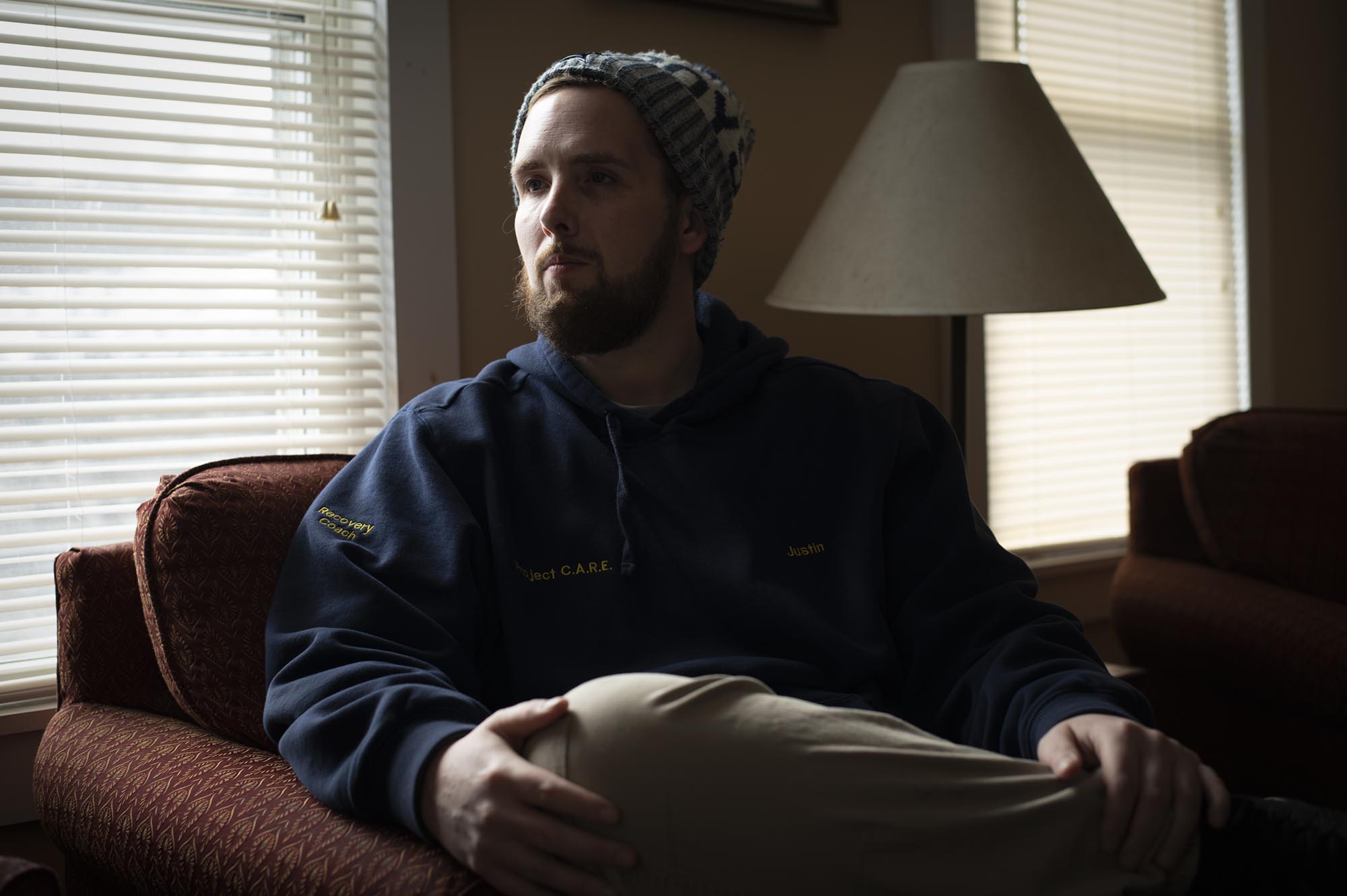
BRATTLEBORO — Justin Johnston has been a peer counselor at the local addiction recovery center for more than four years. His job involves training volunteers, overseeing the building’s safety and maintenance, coordinating the center’s outreach at local homes and coaching people in recovery.
Johnston, 35, started out as a volunteer at the Turning Point Center of Windham County. He soon realized he could make a living out of helping people, just like the center did for him.
Turning Point, Johnston said, put him on a path to recovery from cocaine and opiate use after he had served time in federal prison. He said the center helped him create a better life, which he initially didn’t know how to do.
“When I came home, I had no direction, no skills and no recovery, but I was abstinent the whole time in prison,” he said. “Turning Point gave me purpose and made me feel valued, no matter what my past looked like.”
Because he sees his job as a mission, Johnston hasn’t looked for employment elsewhere — even though he doesn’t get paid much and has no benefits. And some workdays can be traumatic, such as when clients die from a drug overdose.
To get health care, Johnston and his family — including his fiancee and their two children — rely on Vermont’s Medicaid programs. He loves his job but also desires financial security and better social-safety nets for his family.
“At times, this can be a struggle,” Johnston said at the center one January morning, after he had shoveled the building driveway and checked in a guest.
Dozens of other recovery coaches around the state are in the same situation: performing a stressful, lifesaving job that doesn’t compensate well because recovery centers have limited money.
Now, recovery centers are asking the state to increase their yearly funding in order to sustain their work, starting with providing workers better pay and offering job benefits.

Wanted: job benefits
Last fall, the Vermont Recovery Network (now Recovery Partners of Vermont) conducted a survey to assess the needs of recovery centers throughout the state. The results, based on the responses of 11 out of 12 centers, showed that their biggest “unmet needs” were “benefits for staff” and “management positions.”
Only two centers said they offered some type of health care coverage. None offered retirement benefits, according to the survey results shared with VTDigger.
A year ago, the Turning Point Center of Addison County began giving staff members $300 a month in their health reimbursement accounts. The benefit was made possible when the center’s new executive director, Jennifer Mayhew, decided to take a lower pay rate during her first year in the position.
This year, Mayhew is seeking other funding sources to continue providing staff with the health care stipend. “I’m really struggling for a way to do that every year,” she said.
As a person in recovery herself, Mayhew said her job is “perfect” for her despite the center’s financial difficulties.
Center executive directors made an average of $28 an hour, half the rate of their counterparts at community mental health centers, said Gary De Carolis, director of Recovery Partners of Vermont. Other recovery center staffers received anywhere from $13 to $26 an hour.
“Quite the bargain from my perspective,” he said, given that the work of recovery centers “saves hundreds of lives a year and supports thousands of other people in recovery rebuild their lives.”
The bulk of recovery centers’ funding comes from the state government, which De Carolis said provides each center about $110,000 a year. Their other funding sources include federal grants, foundations, municipal governments, fundraisers and individual donors, the survey shows.

High staff turnover
Being unable to offer competitive pay, not to mention benefits, has made it hard for Vermont recovery centers to attract and retain workers, executives said.
Staff turnover became especially pronounced during the first months of the coronavirus pandemic, when some people stayed home to protect themselves or family members from the virus. Others quit working to take care of young ones when child care centers closed or to assist children who were learning remotely.
The Turning Point Center of Windham County was one of the hardest hit by staff departures during this period, according to the Recovery Partners of Vermont.
When the pandemic hit Vermont in March 2020, the center had 17 full-time or part-time staff. By August, it had only eight people, including a new hire, the center’s records show.
Like many employers, it had a difficult time finding new staffers during the pandemic. The need for paid workers became even more acute because its team of volunteers shrank to eight during the public health emergency, half of its pre-pandemic size, said Executive Director Suzie Walker.
“We had very few responses to job postings during the pandemic,” she said, “and a few very promising prospects could not join our team due to the modest hourly rates and lack of benefits.”
The center’s employee numbers got back up to 16 in February, but Walker said it’s common for her to lose staffers to other local employers that can offer better compensation. She joked that in the Brattleboro area, Turning Point has “become a workforce development” center.
“The hard part is that we’ve invested tremendously in training and onboarding a staff person who may not stay for more than a year,” she said. “The good part is that trained peers with lived experience are making an impact in other venues.”
Walker, who has led the center since 2009, said recovery centers have now become a crucial part of local communities. She said they need financial support to thrive, such as providing staff with ongoing training, updating technological equipment and improving data-tracking systems.
Recovery coaches also need access to counselors, executives said, so they don’t suffer secondary trauma or burn out from work. Recovery centers currently don’t provide their staff with professional mental health support.
Request for more funding
Each recovery center receives $106,000 a year from the state in base funding — the same amount since 2019, said Daniel Franklin of the Vermont Association for Mental Health and Addiction Recovery.
Recovery center workers and their allies are now asking the state for an additional $45,000 a year in base funding for each center. That essentially would make permanent the amount each center received as a one-time bump this fiscal year.
But Gov. Phil Scott’s budget proposal to the Legislature for fiscal year 2022-23 — which starts July 1 — doesn’t include any increase in the centers’ basic funding, so Franklin said he is helping lobby lawmakers for the raise.
The proposal has received support from the House Committee on Human Services, according to a Feb. 23 memorandum from committee chair Rep. Ann Pugh, D-South Burlington, to the chair of the House Committee on Appropriations.
The memo cited the “expanded capacity” that recovery centers have experienced since the pandemic started and which is expected to continue.
“Frankly, even $45,000 is only the beginning of creating equity for recovery centers and the peer workforce,” said Franklin, vice president for advocacy and community relations at his organization, whose work includes training and certifying Vermont recovery coaches.
Besides state appropriations, he said Vermont needs to invest in general recovery services through resources such as opioid settlement dollars and Medicaid.
The recovery centers’ funding request comes as Vermont is reporting its highest number of opioid overdose deaths among residents. Through the first 11 months of 2021, 181 Vermonters died from an accidental opioid overdose. That represented a 15% increase over the deaths in all of 2020, which was the previous record.
The Vermont Department of Health recognizes that recovery center staffers need better compensation, along with other workers in the state’s substance use treatment and recovery field.
“Everyone in our whole field is really struggling with finding workforce and the pay, at all levels,” said Cynthia Seivwright, director of the health department’s division of alcohol and drug abuse programs, which works with recovery centers. “We will not be able to recruit people to come into our field if we don’t have competitive wages.”
She said state leaders are aware of the problem and are currently discussing solutions.
State funding decisions rest with the governor and the Legislature, which is currently in session and discussing the annual budget bill.
“I think as a state, we owe them to at least give them a decent wage with benefits,” De Carolis said of recovery center staffers, “so they can continue to do this work and have a life themselves.”
Johnston, meanwhile, plans to work with the Brattleboro recovery center as long as he can. When he feels down about the pay, lack of benefits and work stress, he said he remembers the organization’s bigger purpose of improving and saving lives.
His own younger sister, Ashley, died of an opioid overdose at age 28. She died in late 2017, around the time Johnston became certified as a recovery coach.