

For schools unfortunate enough to test positive for polychlorinated biphenyls, or PCBs, Vermont’s first in the nation school sampling program has been a nightmare. Just look at North Country Union High School, which began the school year in tents after testing detected high levels of the toxic chemicals in the school’s primary academic wing.
Three years ago, lawmakers set aside $32 million for PCB mitigation and remediation, half of which was earmarked for Burlington High School. That money is all but dried up.
Now, as part of his recommended budget, Gov. Phil Scott is asking for another $9.5 million to go toward the costly process of dealing with PCBs in school buildings across the state.
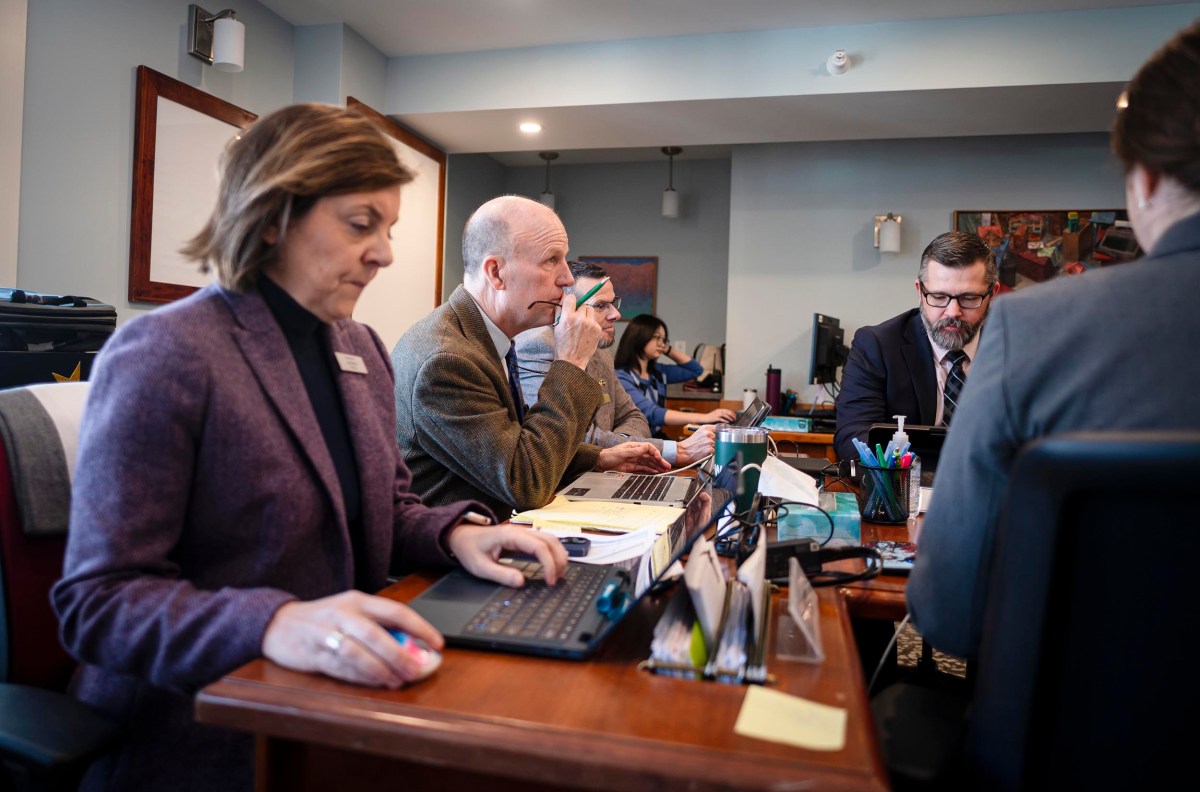
That figure is “a meaningful amount of money,” Matt Chapman, director of the Department of Environmental Conservation’s Waste Management & Prevention Division, told lawmakers in the House Education Committee Wednesday. “But I don’t know that it’s going to cover everything.”
A lack of funding has constrained the ability of the state to continue testing new schools for PCBs, and the new money will mainly target six schools with the biggest PCB problems, according to Trish Coppolino, a senior program manager with the department.
The one-time injection of more cash is intended to give the Legislature time to focus on the “larger policy decisions” around education governance and the financial future of public education, Chapman told lawmakers.
Part of the ongoing stress on schools caused by PCB testing is a requirement from the U.S. Environmental Protection Agency that schools deal with the toxins within a certain number of years.
Yet with everything at the federal level so uncertain, Rep. Peter Conlon, D-Cornwall, who chairs the education committee, asked state leaders about the future of the EPA itself, and what that means for PCBs.
“I think EPA is comfortable allowing materials to be left in place for a reasonable duration, and I think that that part is a conversation with the school,” Chapman said. “As far as the larger issue of where EPA is at, I mean, I think the members of the committee’s understanding and guess is probably as good as mine.”
— Ethan Weinstein
In the know
The House Energy and Digital Infrastructure Committee heard Wednesday from Rep. James Harrison, R-Chittenden, and Rep. Mark Higley, R-Lowell, who each introduced two bills that would roll back existing climate policies in Vermont.
Harrison proposed H.16, a bill that would repeal the Affordable Heat Act, which set up but stopped short of implementing a clean heat standard. If lawmakers choose not to move forward with a clean heat standard (and the political dynamics don’t favor forward movement), the law, left standing, would require fuel dealers to register with the state.
He also proposed H.52, a bill that would alter the state’s landmark climate law, the Global Warming Solutions Act by stripping it of the provision that allows entities to sue the state for failing to reduce emissions by its established deadlines.
Higley’s H.62 went a step further, proposing to repeal the Global Warming Solutions Act altogether. His other bill, H.65, would walk back an existing rule, which aligns Vermont with California and many other states, to phase out gasoline-powered vehicles by 2035.
While it’s unlikely that most of the bills would move forward in their current form, Higley and Harrison thanked Rep. Kathleen James, D-Manchester, the committee chair, for hearing them; in past sessions, similar legislation has been left on the wall, they both said.
“We believe in giving everybody a seat at the table,” James said.
— Emma Cotton
Vermont Lt. Gov. John Rodgers’ chief of staff, Elizabeth Brown, resigned from her post last week — and has been replaced by James Ehlers, a close Rodgers adviser, the lieutenant governor told VTDigger Wednesday morning.
Rodgers said Brown, who was appointed chief of staff in mid-November after Rodgers was elected, resigned last Friday so she could focus on a consulting job she’d been holding at the same time.
“She decided that it was too much,” Rodgers said Wednesday, characterizing Brown’s departure from the office as “very amicable.”
Read more about the personnel change here.
— Shaun Robinson
Hundreds of Vermonters joined a protest against the Trump administration on the steps of the Statehouse on Wednesday — part of a national movement to resist President Donald Trump’s policies since he came into office two weeks ago.
The protest movement, titled 50501, is a decentralized initiative to bring protests to every state capitol in the nation. Vermonters arrived at the Statehouse in Montpelier with signs, flags and chants, despite the blustery 13-degree weather. Read more about the protest here.
— Erin Petenko
Election section
The House Government Operations Committee voted 9-1-1 to find that Rep. Jonathan Cooper, D-Pownal, was “duly elected” in the Bennington-1 House race.
The committee’s report will now go before the entire House for a vote.
Cooper’s election victory against Republican Bruce Busa was brought into question when it was discovered about 40 Pownal voters were placed in the wrong legislative district and received incorrect ballots.
“I couldn’t be more proud of the work that we did. This is a massive lift. This is an extremely important decision we’re guiding here,” Rep. Matt Birong, D-Vergennes, the committee’s chair, said before Wednesday’s vote.
— Ethan Weinstein
