



Samn Stockwell is a Barre city councilor for Ward 3, one of the hardest-hit neighborhoods in the floods of July 2023. Walking around her neighborhood as the waters receded, she remembers seeing yards and front porches filled with mud.
“They were staring in that state of shock that you sometimes see in people who survived a great tragedy,” she said.
Stockwell is running for mayor of Barre City in the May 14 election, in a race that has come to be defined by the city’s response to last summer’s catastrophic flooding. Barre was arguably the hardest-hit community in Vermont, with more requests for federal aid to individuals and households than any other ZIP code. City officials say the floods have also exacerbated a longstanding shortage of housing in the city.
Running against Stockwell is Thom Lauzon, a local accountant and property owner with a lengthy track record in city politics: He served 12 years as mayor before winning the Ward 1 City Council seat in 2018.
At first glance, the two councilors-turned-mayoral-candidates agree on the most important items on the next mayor’s to-do list: encouraging new housing development and shepherding existing projects, pushing for ways to mitigate the city’s flood hazard, improving city infrastructure while contending with its massive flood-related budget hole.
Yet this year’s annual city government elections have developed a different type of battle line. Outgoing mayor Jake Hemmerick described it as a divide between the “new blood,” which includes him and Stockwell, against the old guard that includes Lauzon.
Three seats are up for grabs on the City Council, too. In Ward 1, former school board member Sonya Spauling is vying for an open seat against local Rotary Club president Eddie Rousse. Ward 2 pits incumbent Michael Boutin against Amanda Gustin, the chair of the Barre Democratic Committee. Ward 3’s race is between incumbent Michael Deering and Jeremy Spiro-Winn, a member of the city’s homelessness task force.
The ballot also features two charter changes that could have long-lasting effects on the city’s elections: a measure to allow 16- and 17-year-olds to vote, and a measure to permanently move Town Meeting Day elections to May. Typically held in March, this year’s elections were delayed to give Barre time to review its flood funding.
“I think a lot hinges on this election,” Hemmerick said.
Troubled waters
Barre City, population 8,500, sits nestled in a valley along the banks of the Stevens Branch, a tributary of the Winooski River. It’s no surprise, then, that a large swath of the city is in a federally designated flood zone. Stockwell said she’s met homeowners who have lived through three different floods.
It’s hard to measure the full scope of the most recent flood, but there are several indicators that hint at the level of damage the city has suffered. One is that the 05641 ZIP code, which includes Barre City and parts of Berlin, had $4 million in individual and household aid awarded from the Federal Emergency Management Authority, the most of any ZIP code in Vermont.
That damage has set off multiple and cascading issues for the city’s finances and well-being. Residents have been forced to leave their homes or contend with expensive repairs. The flood also hit multiple city properties, including the police department and the public works garage.
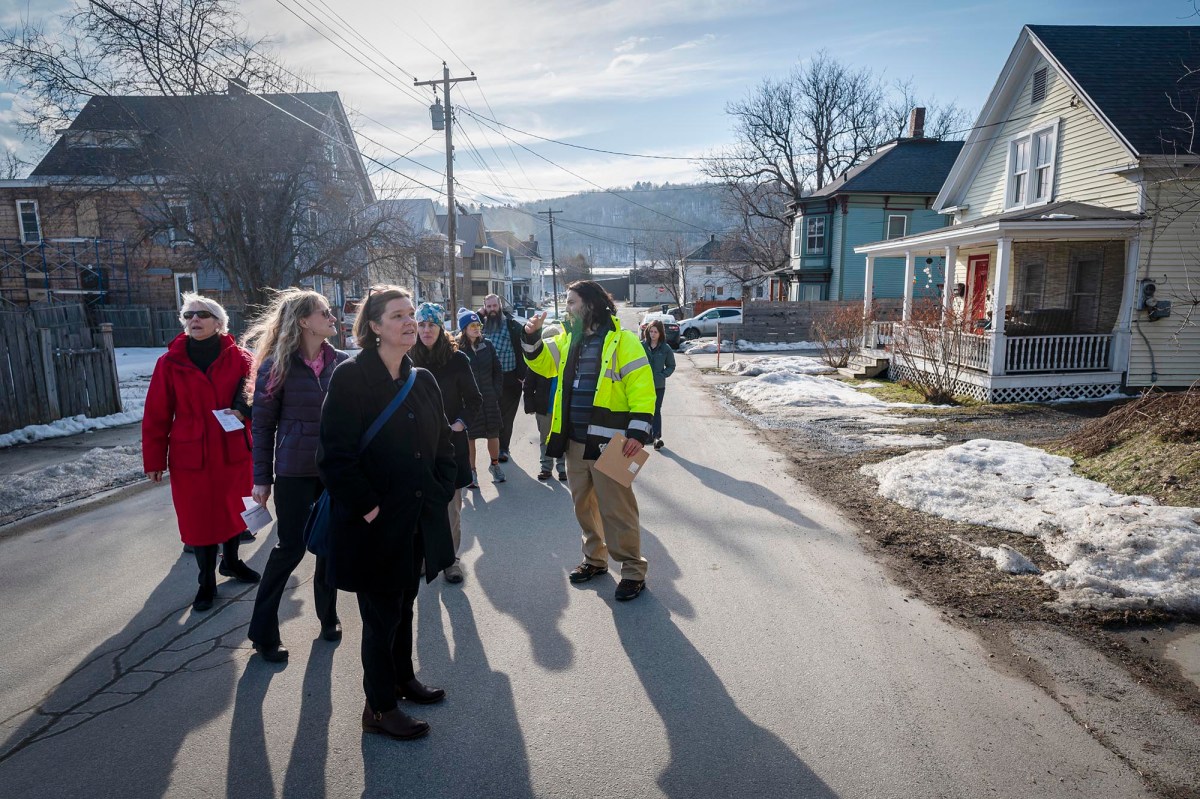
City officials took legislators on a tour of the most affected areas in February. At the time, the city’s North End neighborhood showed signs of continued repairs and still-vacant properties. A peek into the former Salvation Army store revealed that its walls and floor were covered with mold.
The North End has become a touchpoint in the candidates’ views on how the city should approach rebuilding and new housing. In October, Gov. Phil Scott announced a plan to completely redevelop the North End with multi-story apartment buildings and green space.
Lauzon, a developer who hasn’t been directly involved in the proposal, wants to move the project along as quickly as possible. He pointed out that the City Council has already missed state officials’ suggested deadline, March 31, for putting a revised plan forward.
Stockwell is not opposed to the plan, but said she’s concerned about making sure that current North End residents have a say in how it should look. As a board member of the Central Vermont Habitat for Humanity, a home-building nonprofit, she’s discussed the project as a series of duplexes and triplexes.
“It’s a great opportunity for people who need homeownership … to be affordable,” Stockwell said. “And I think that really helps stabilize communities.”
Lauzon was critical of the City Council’s slow progress on other development opportunities, like the Prospect Heights project, which he is developing along with the Barre Area Development Corporation.
He also had harsh words for outgoing mayor Hemmerick, who he said stymied an idea for the City Council to meet on off weeks to discuss housing projects. “I don’t know why, but the mayor was resistant to that,” Lauzon said.
For his part, Hemmerick argued that Lauzon was only trying to advance his own interests as a property developer, and that there was not enough staff time for Lauzon’s idea. Hemmerick developed an entire presentation to demonstrate the progress the city has made on housing projects, to counter the idea the council had moved too slowly.
The outgoing mayor has endorsed Stockwell because he believes she puts the interests of the average Barre resident above those of the wealthier ones.
“With Thom, I think it’s mostly about himself, and what deals he can make, and who he can power broker with,” Hemmerick said.
Asked about his own interests in furthering certain Barre projects in Barre, Lauzon at first shot back with a broader point: “I drive down the same roads everyone else does,” he said. “My property taxes will be lower if we’re successful.”
Pressed on his specific role as a developer, Lauzon countered that he’s more in the “maintenance trajectory” of his career. Barre City records show Lauzon, or companies he is an agent of, owned at least $8 million in property as of September. But he said he only has one ongoing project, a deal he’s closing on a former Salvation Army property.
He said that he gives back to the community as well, through “quiet” actions like donating to the Barre Community Relief Fund after the flood.
“I could go through a list of individuals that we’ve helped personally. I’ll never do that, because it diminishes the gift,” he told VTDigger.
A murky future
Touring the Department of Public Works garage in February, legislators could see how high the floodwaters reached: A waist-height line of mud was visible on the side of a wall.
But the garage has issues far beyond the flood damage, city officials said. City vehicles are wedged together in the too-tight garage like a game of Rush Hour. During the flood, employees scrambled to get valuable equipment uphill and out of danger.
Stockwell said that “even in the 20th century, people looked at that garage and said, ‘that doesn’t meet our standards.’”
“It’s gonna be really hard for anyone to feel valued, who works in that environment,” she said. “And those are great guys. They’re invisible in many ways. You don’t see them out at 3 a.m. — you just hear them. They’re the ones doing that work.”
The public works garage is one of many points of city infrastructure that both Stockwell and Lauzon agree is in need of long-deferred maintenance. But the city is contending with one of the worst budget crises in modern memory, with a triple hit to its finances: additional expenses from flood repairs, a loss of revenue from sales and property taxes, and the expense of preparing for another potential flood.
The city narrowly avoided a massive hole in next year’s budget thanks to a $1 million plug from the Legislature. But Lauzon doubts that help is coming again.
“We haven’t felt the financial ramifications yet,” he said. “We will, and they’re going to be very difficult.”
Barre has granted 68 property tax abatements for flood-related damage, according to city manager Nick Storellicastro. It has also agreed to buy out five properties, three of which suffered landslide damage, with a combination of state, federal and local funds.
Lauzon wants to make fixing the city’s road a priority in the coming year. He believes flood damage has worsened what was already a bad situation, pointing to the sluggish pace of the paving budget in recent years.
But in order to cover those costs, voters might have to be willing to accept some tax increases. Lauzon said there was no “paving fairy” that could come and fix the situation.
“The only two choices are smoother roads and higher taxes — absolutely, I mean, the money has to come from somewhere — or deteriorating roads,” he said.
Stockwell said that the property reassessments next year could also prove a shock for residents.
“My concern is, residents on a fixed income, how can we ensure they can continue to afford their homes?” she said.
Sea change
Stockwell has noticed the influx of a new mindset in Barre in small ways. Although the elections are nonpartisan, she said more “forward-thinking” people are showing up to honk-and-waves for her campaign and other similar candidates.
“And they are younger people, and they are newer residents, and that just seems exciting,” she said.
But that wave of migrants has sometimes caused divisions, both ideological and personal. The city’s diversity and equity committee nearly tore apart in 2022 over its members’ divided views on abortion rights and the purpose of their work.
In April 2023, Fox Market, a queer bar in East Montpelier, announced it would expand into Barre. Six months later, Barre’s planning commissioner, Raylene Meuiner, got into hot water over a harassing phone call she made on her podcast to Fox Market co-owner Olivia Dunton. The city council voted to remove Meuiner shortly after.
These shifting dynamics have formed the backdrop over the two charter items that would change the way the city holds elections. The first, which would allow 16- and 17-year-olds to vote in local elections, has split the candidates.
Lauzon said that it felt hypocritical to allow young people to vote when they still weren’t able to run for office. “It just didn’t feel good to me,” he said.
Stockwell said she was personally in favor of extending the right to vote, but she believed that the residents of Barre should make the final decision.
The second charter change would move Town Meeting Day elections to May permanently. The city council, including Lauzon, voted in favor of including the item on the ballot because Storellicastro told them it would help city staffers have more time to prepare the city budget.
“When we’re building the next year’s budget, we’re two months into the current fiscal year with just little to no data. And so we’re doing a lot of guesstimating,” he told VTDigger.
But Stockwell said it was more important to keep turnout as high as possible. Only 23% of voters turned out for the March election, which included votes on the presidential primary and the school budget.
“I think splitting it into two different elections, you’re going to lose even more voters,” she said. She added that holding two elections could double the expense.
Lauzon said that despite his city council vote, he’s not really in favor of moving the election date. He only voted for it because Storellicastro’s argument “made him think.”
“At the end of the day, again, I will likely vote to retain the current voting schedule,” he said.
Lauzon lamented that this year’s elections have become so contentious. He said he had his “fishing reel” ready if he loses and retreats from city politics.
“There’s not much left for me to prove. I really, really just want to help,” he said.
Along with her work in social services, Stockwell is a published poet and has taught poetry and English at several local colleges. She said her poetry has given her a unique lens to view politics and policy.
What makes good poetry is the “ability to go deep” into feelings, she said. That has helped her to connect with residents who have lost their homes to flooding or can no longer afford their homes.
“Just getting people to understand other people’s experience is really useful,” she said.
