



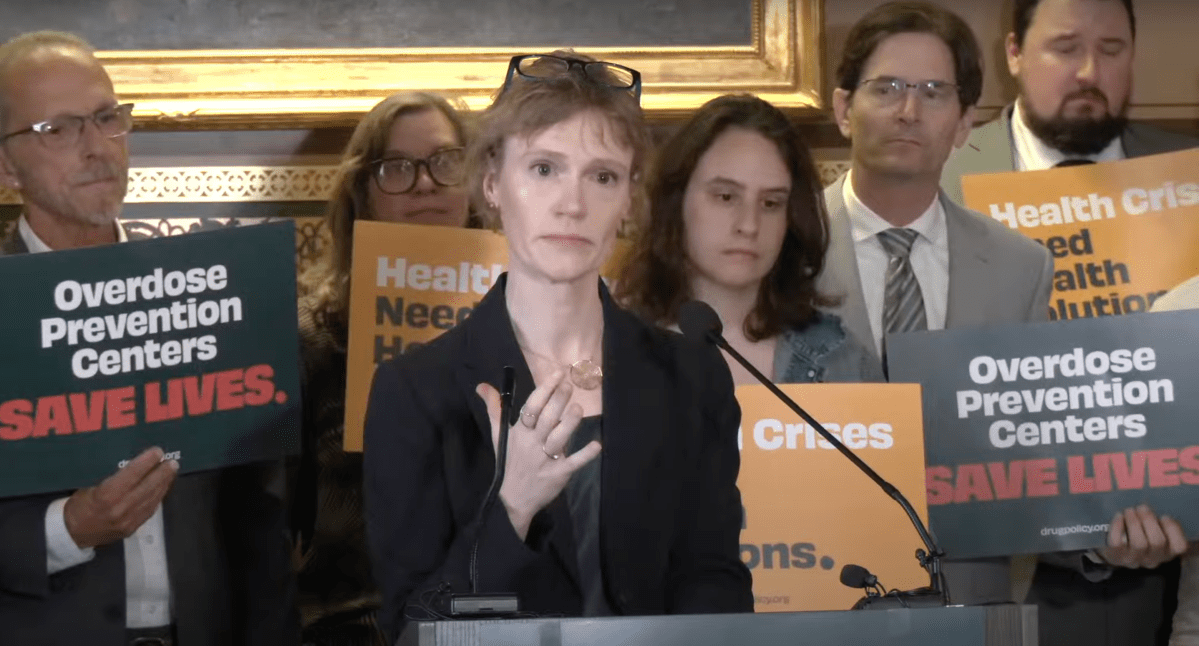
Over the past five years, Elissa Johnk, the lead minister at the First Congregational Church of Burlington, has borne witness to Vermont’s overdose crisis.
Johnk hosts services as ambulances drive by multiple times an hour. She has found people passed out on church property. She has held burials of overdose victims in front of their children and in front of their parents. She has learned how to distinguish someone on a bad trip from someone who needs immediate medical attention. She’s learned “what bone looks like when it’s been eaten away by animal tranquilizer,” she told listeners Tuesday in the Vermont statehouse’s Cedar Creek Room. “And how to treat it.”
Johnk’s remarks were part of a last-minute effort by advocates to urge lawmakers and Gov. Phil Scott to pass into law H. 72, a bill that would lay the groundwork for the creation of an overdose prevention center — aka safe injection site — in Burlington. As Vermont weathers a crushing opioid abuse crisis and rising overdoses, proponents of the bill say that a staffed, secure site could ensure that people do not endanger themselves by using alone.
Legislators have nearly finished their work with H.72. The House passed it in January, the Senate passed an amended version last week and on Tuesday, lawmakers in the House approved the Senate’s amendments.
Grace Keller, an advocate and recovery worker, said that in the past she heard skepticism about on-demand treatment, syringe exchanges and the overdose-reversal drug Narcan.
Now, “we know those things as ubiquitous. We know them as the tools that we have in our toolbelt,” Keller said. “The day is going to come when we’re going to think that way about overdose prevention centers.”
The bill would create a legal framework for overdose prevention centers in Vermont and would allocate $1.1 million from settlements with drug companies to fund a pilot program in Burlington.
It would also direct the state’s department of health to hire an outside entity to study the pilot’s impact on overdoses, deaths, crime, emergency services, treatment and recovery, and syringe litter in the area.
Gov. Phil Scott, however, has made no secret of his opposition to the bill. The governor “remains opposed to the unproven injection sites,” spokesperson Jason Maulucci said Tuesday in an email, “and believes we should instead be investing those precious resources on more proven harm reduction, prevention and treatment methods.”
Could the legislature override a gubernatorial veto? Nothing is certain, but signs appear favorable: in January, House lawmakers approved the legislation by a 96-35 vote, and last week, the Senate passed the bill by 21 to eight. Both votes exceed the margin of two-thirds necessary for a veto override.
To advocates, the passage of the bill is long overdue.
“Not having an overdose prevention center puts the burden on all of us,” Johnk said Tuesday. “And we are not able to hold it.”
— Peter D’Auria
In the know
State budget writers have decided against a contentious cap on the number of households that can access Vermont’s motel voucher program for unhoused people during the winter months. But as lawmakers finalize plans for next year’s spending, advocates continue to prepare for new limits to a program that currently shelters the bulk of the state’s unhoused residents.
House and Senate budget writers finished hashing out their differences over next year’s budget midday Tuesday, passing H.883, the “Big Bill,” out of a committee of conference. Among the most disputed sections was the future of the emergency housing program.
— Carly Berlin
As debates about regulating hunting and trapping in Vermont have become increasingly polarized, the conversation this legislative session has focused on S.258. That bill would significantly tweak Vermont wildlife management by adding two new members to the Vermont Fish and Wildlife Board. The bill would also ban the controversial practice of hunting coyotes with hounds.
The bill cleared the Senate in March with enough votes to override a likely veto from Gov. Scott, but it appears support is waning in the House, where it’s currently in the hands of the Energy and Environment Committee. On Wednesday, Rep. Amy Sheldon, D-Middlebury and the committee’s chair, indicated that the House may not have enough votes to override a veto.
“We’re not going to move it if it doesn’t look like it has a future,” Sheldon said in an interview on May 1.
Read the first of a two-part VTDigger series here.
— Emma Cotton
On the move
In the last week, three of the legislative session’s biggest climate bills passed out of their second chamber, and are likely to head to the governor’s desk soon.
Those bills include S.213, which would establish a new state permitting system for building in river corridors, S.259, which would require big oil companies to pay for damages from climate change in Vermont and H.289, a bill that would update the state’s renewable energy standard by requiring utilities to make a quicker transition to renewable energy.
— Emma Cotton
The Senate on Tuesday approved H.871, a bill that will continue the process of establishing a state aid for school construction program.
The Vermont Agency of Education estimates the state’s schools need more than $6 billion in construction over the next two decades, a number widely considered a lowball figure.
If passed, the bill sets up a summer working group to draft legislative language in time for next year that would renew state money for school buildings for the first time since the Great Recession.
That working group, if established, will have many big questions to answer, chief among them: how should the state prioritize its limited financial resources, and where should the money come from?
The Senate amended the House’s version of the bill, so H.871 will require further approval before going to the governor’s desk.
— Ethan Weinstein
Lawmakers in both chambers agree that they want to crack down on retail theft — but are taking different approaches to do so. On Tuesday, the Senate also advanced its version of H.534, a bill that would levy escalating penalties on someone who’s convicted of shoplifting multiple times.
A person would face misdemeanor-level penalties for a first and second offense of stealing $900 or less of merchandise, but would be charged with a felony starting at a third such offense.
That’s different from the House’s version of H.534, which would let prosecutors aggregate the value of multiple thefts and charge a felony if the combined figure is more than $900 — provided that the thefts occur within the same two-week period and within the same county.
Senate President Pro Tem Phil Baruth, D/P-Chittenden Central, said on the floor Tuesday that he and his colleagues on the chamber’s judiciary committee took their approach after hearing concerns about the House’s proposal from the Vermont Office of the Defender General.
— Shaun Robinson
Meanwhile, the House on Tuesday passed S.220, a bill that would protect library patrons ages 12 and up from having their library records disclosed to parents or guardians against their will. Currently, those protections only apply to those 16 and older.
S.220 would also require public libraries — and school boards — to establish procedures for reviewing potential objections to the materials in their collections. Such policies, for schools, would have to prevent book removals stemming from an objector’s political or religious views, among other measures.
Ahead of the bill’s third reading, Rep. Arthur Peterson, R-Clarendon, introduced an amendment seeking to grant records protections only to those ages 14 and up. The amendment also proposed that school libraries exclude materials that are “obscene” to minors from their collections, citing a definition of the word in criminal law.
On the floor, some lawmakers connected the latter to book bans that have been reported nationwide which they said are fueled by culture wars, a characterization that Peterson rejected. After close to 45 minutes of debate, members voted his amendment down.
The bill will now head back to the Senate to consider changes that the House did make.
— Shaun Robinson
Also on Tuesday, the Senate passed H.614, which creates a new category of crime called land improvement fraud to address ongoing cases of timber theft, as well as H.847, which creates a peer support provider and recovery support specialist certification program within the Vermont Secretary of State’s Office of Professional Regulation. The chamber gave preliminary approval to, H.81 , which would require manufacturers to give loggers and farmers in the state the ability to repair their equipment independently.
— VTD Editors
Visit our 2024 Bill tracker for the latest updates on major legislation we are following.
What we’re reading
As UVM starts disciplinary proceedings for protesters, some lawmakers call for amnesty, VTDigger
Art exhibit documents the Covid-19 vaccine experiences of Black Vermonters, VTDigger
Independent schools rebuff school districts’ request for a tuition break, Seven Days
