


A proposed state constitutional amendment to set qualifications and removal procedures for elected county officials has reached a dead end in the Legislature.
On the Senate floor Wednesday, leadership moved to send Proposal 1 back to the Government Operations Committee — instead of putting it to a vote as scheduled. It was the third time in five weeks that a planned vote on Prop. 1 did not materialize.
But this time, its proponents explicitly said they were tabling the proposal because it couldn’t get enough support to clear the Senate. It needed the backing of two-thirds of the chamber, or 20 votes, to move forward.
“The will was not here in the Senate to advance (Prop. 1) to the House,” Sen. Phil Baruth, D/P-Chittenden Central, the president pro tempore, said before bringing the motion Wednesday afternoon.
The current version of Prop. 1 would have enabled state lawmakers to set qualifications for sheriffs, as well as state’s attorneys and assistant judges, since the Vermont Constitution is currently silent on their qualifications. Doing so would have also created a mechanism for the removal of these officeholders, including probate judges, if they failed to meet those qualifications.
Since the last legislative session, Senate Democrat leaders have been seeking measures to create more accountability and oversight of sheriffs. This came after scandals emerged from sheriffs’ departments around the state in recent years.
Among them is the case of Franklin County Sheriff John Grismore, who is charged with assaulting a detained man while he was a deputy in 2022. He is also being investigated on allegations of financial crimes.
Grismore remains a sheriff though the Vermont Criminal Justice Council revoked his police certification last year. The Vermont Sheriffs’ Association, which represents the sheriffs in each of the state’s 14 counties, has called on him to step down.
The advocates of Prop. 1 believe that sheriffs, as elected officials, can be removed from office only through impeachment — a process House lawmakers have been pursuing against Grismore since May. The proposed constitutional amendment, they say, would allow legislators to create other mechanisms for removing an officeholder in instances of misconduct.
But with Prop. 1 out of the picture, they’ll have to explore other avenues.
“It’s all but dead,” Sen. Ruth Hardy, D-Addison, who co-sponsored Prop. 1 last legislative session, said in an interview. “I’m frustrated … and I’m disappointed that an insufficient number of my colleagues will support our work.”
The Senate Government Operations Committee, which Hardy chairs, finalized the language of Prop. 1 and sent it to the Senate floor for a vote in January. Senate leadership instead moved it to the Senate Judiciary Committee for further review, hoping that putting Prop. 1 under additional scrutiny — particularly from the committee headed by Sen. Dick Sears, D-Bennington — would garner more support for the proposed amendment.

“There was a hope and an expectation that if a second committee voted it out and, just to be frank, with a different chair who’s been here longer and is more senior and has maybe more respect of other members of the Senate,” Hardy said, “we would be able to get enough votes. And that was not the case.”
She said Senate leadership, in a survey of chamber members prior to Wednesday’s anticipated vote, determined Prop. 1 could not muster the 20 votes it needed in the Senate.
They decided to send Prop. 1 back to Senate Government Operations, where it will essentially remain frozen for the remainder of this session unless it unexpectedly builds more support.
“We still have the option to bring it out,” Hardy said. “We could get it on the (Senate) floor quickly. We could move it over to the House quickly.”
In separate interviews, Sears and Baruth said the failure of Prop. 1 demonstrated the influence of sheriffs over their constituents, including the legislators in their jurisdictions. The Vermont Sheriffs’ Association has vocally opposed Prop. 1.
One of the association’s concerns is that it could lead to the removal of an elected county official without due process, because the specific qualifications for officeholders are undefined in the amendment and left for future Legislatures to create.
The sheriffs’ group also maintains that legislators can create qualifications for elected county officials without the need for a constitutional amendment — simply by crafting new laws, echoing the position of Vermont constitutional law expert Peter Teachout.
“I just think the sheriffs lobbied hard, and in some cases, there are personal friendships,” Baruth said.
“Senators tend to listen to their sheriffs, and having the strong opposition from the sheriffs hurt,” Sears said. “You have groups coming out against it. That’s part of the legislative process.”
Another factor, Sears said, was the opposition of former Sen. Jeanette White of Windham County. “A lot of people respect her and her opinion,” he said. “I think that also hurt the effort to get to 20 votes.”

White, the previous longtime chair of the Senate Government Operations Committee, spoke before that committee and in Senate Judiciary about her reasons for opposing Prop. 1. They included her belief that, to promote oversight and accountability of elected county officials, the Legislature should first try to create mechanisms in state law rather than change the state Constitution.
Prop. 1’s proponents, however, have repeatedly said their due diligence has shown that only a constitutional amendment would allow the Legislature to create meaningful checks and balances. They’ve said they believe the sheriffs opposed the measure in order to maintain their existing power and influence.
Teachout, a professor at Vermont Law and Graduate School, told VTDigger that two senators reached out to him in the past month to get his take on Prop. 1. He said one was Sen. Christopher Bray, D-Addison, who contacted him in January; the other was Sen. Randy Brock, R-Franklin, the Senate minority leader whom he spoke to on Tuesday.
Teachout is not in favor of Prop. 1, as his testimony in Senate Government Operations showed.
The Department of State’s Attorneys and Sheriffs supported Prop. 1 on behalf of the state’s attorneys. The Vermont Association of County Judges, which represents assistant judges, had not taken a position on the proposed amendment. Nor had the state judiciary, which represents probate judges in the Statehouse.
On Wednesday, White welcomed the news that Prop. 1 had failed to gain the needed votes. She acknowledged that, besides testifying in the Senate committees, she also voiced her issues with the proposal in private conversations with senators.
“I never asked anybody to vote one way or the other,” she said in an interview. “I just gave what I thought was good information.”
White confirmed that the Windham County Sheriff’s Department once hired her for a monthslong project several years ago, but she underscored that her vocal opposition to Prop. 1 was not done on behalf of any group.
“I do not get paid by anybody to do any lobbying or anything else,” said White, who left the Senate at the end of the 2021-2022 sessions. “I have a job, and that has nothing to do with this.”
Windham County Sheriff Mark Anderson, president of the Vermont Sheriffs’ Association, said his group has been a proactive and outspoken advocate for professional accountability, though it has differences with some legislative leaders on how to achieve the same goals.
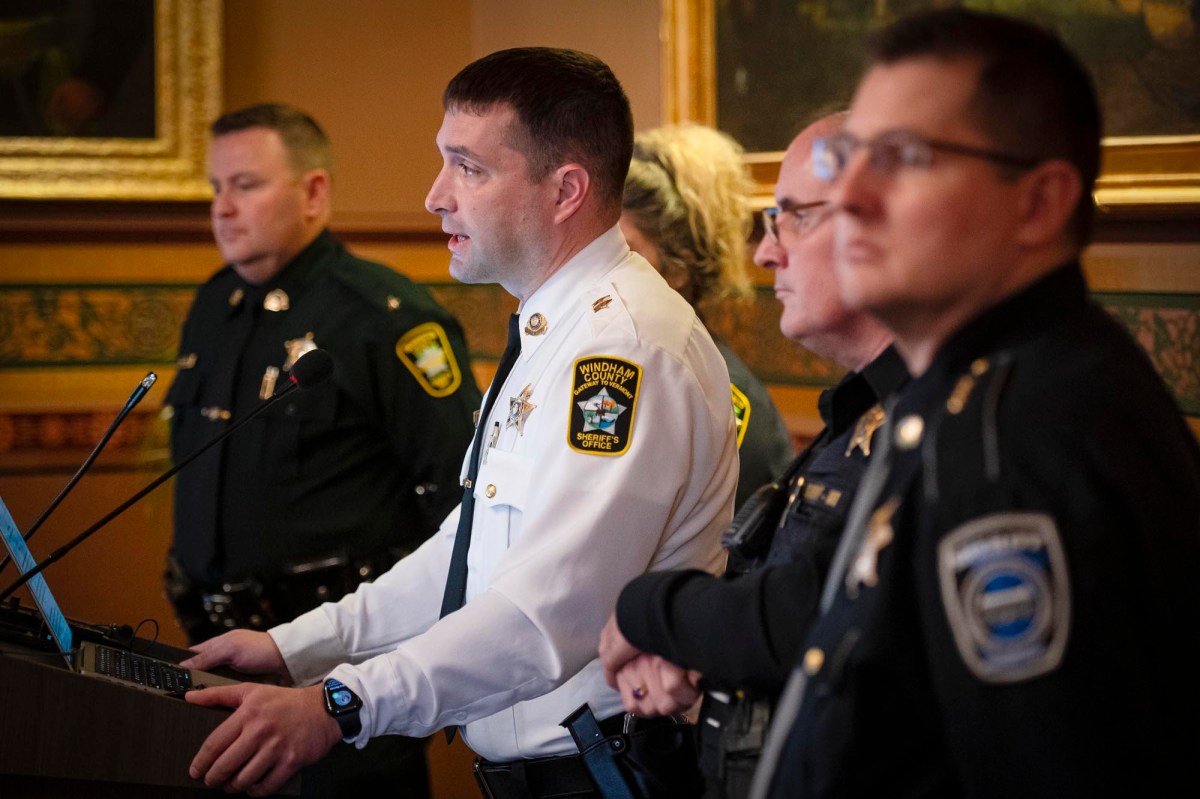
“We agree with Senator Sears, Senator Hardy and other legislative leaders that professional standards for our sheriffs should be exemplary and that these isolated instances have negatively impacted the greater good,” Anderson said in an email Thursday.
“The Vermont Sheriffs’ Association is committed to continuing our work in a collaborative manner with legislative leadership to implement Act 30, offer high quality training, and to responsibly and practically enhance our profession,” he said, referring to a law passed last year that was partly aimed at improving spending and auditing procedures at sheriffs’ departments.
Because state senators can only introduce constitutional amendments at designated four-year intervals, the next time another proposed amendment could come is in 2027.
“It will add years to our ability to address this problem,” Baruth, the president pro tempore, said from the Senate floor on Wednesday. “I regard that in some sense as a personal failure.”
But he doesn’t characterize the failure of Prop. 1 as a win for the sheriffs.
“I don’t think the sheriffs did win,” Baruth said in the interview. “I think it made them look as though they were protecting themselves at the expense of their communities. And I think in that way, everybody lost.”
