



Meg Mott was a political theory professor at the former Marlboro College when, relocating to Putney in 2008, she received an invitation to run for Town Meeting moderator.
“I was once very suspicious of Robert’s Rules of Order,” said the 67-year-old, who recalled living in a yurt as her wife built their goat farm. “Was it just patriarchy or white supremacy or heteronormativity? I had all my big words.”
Then Mott gaveled in her first gathering in 2015.
“I came to realize that communities were lost if they stopped listening to each other,” she said in a recent interview. “In these times, we need to be more careful that we do not engage in viewpoint discrimination.”
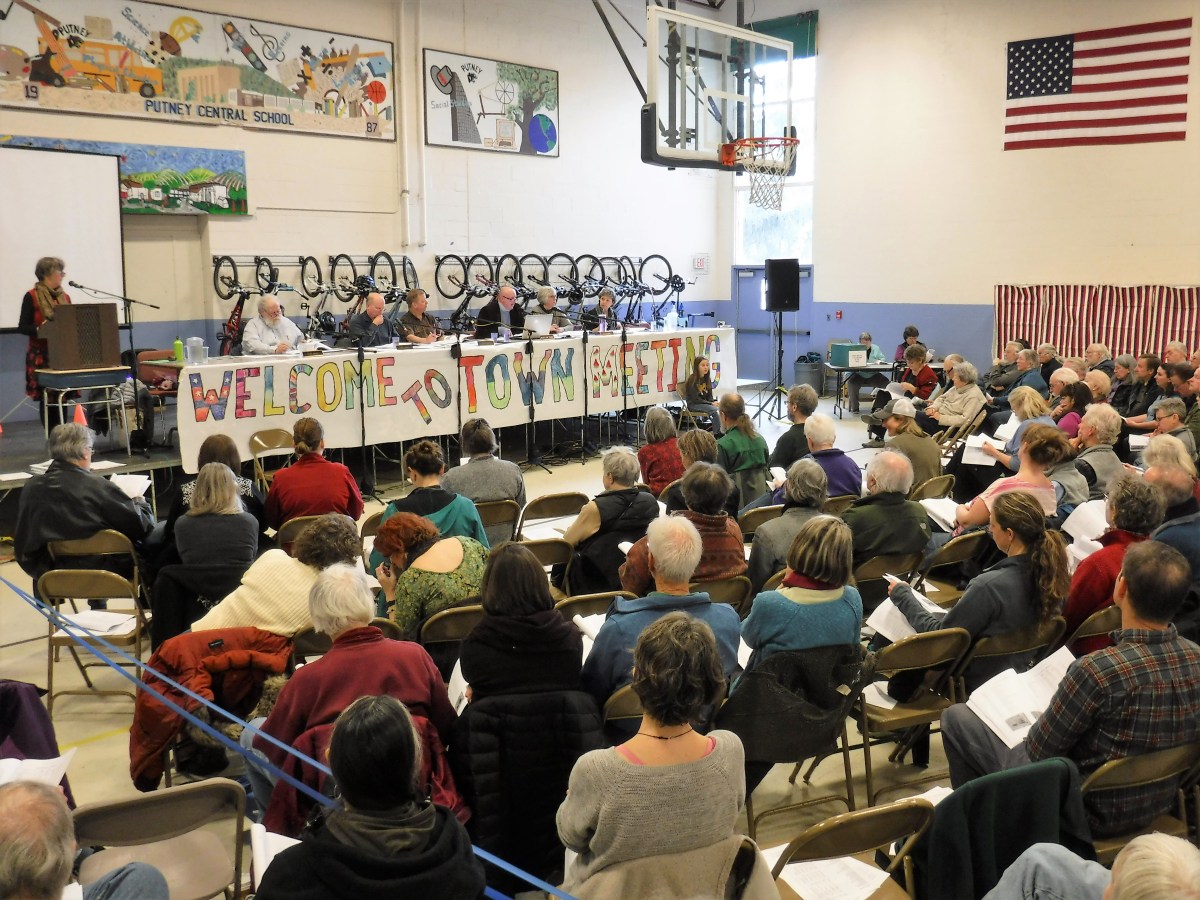
Mott, set to moderate her 10th annual meeting this first Tuesday in March, taps the Robert’s Rules book of parliamentary procedure, the U.S. Constitution and several other founding documents as she aims to promote common-ground conversations in an increasingly polarized world.
“I am very interested in people not dissing one another, not villainizing one another, not dehumanizing one another,” she said. “In a democracy, better decisions will be made if you have lots of people around who don’t think the same way and can check each other’s opinions.”
People who attend Mott’s “Civics for the 21st Century” programs for the Vermont and New Hampshire humanities councils witness how she encourages people who disagree over hot button issues to discover what’s motivating each other — not to change opinions, but instead to better understand them.
“I think of it as opening up the argument pool,” she said. “We need to weigh and consider. If we don’t, we’re just going to be competing with each other in little narrow echo chambers.”
Mott’s interest in civil discourse sparked in high school when she read about the late attorney and civil rights activist Clarence Darrow, who defended labor leaders, war protesters and, most famously, Tennessee teacher John Scopes, who broke a 1925 state law with his classroom lessons on the scientific theory of evolution.
“I thought, ‘A person could make some great cases using constitutional language to change things,’” she said.
Mott was working at the now-closed Marlboro College when she wrote a 2014 series of essays for the Washington Post expressing concerns about federal Title IX changes that allowed school disciplinary panels to hear student allegations of sexual assault.
“Unlike criminal courts, where you have the right to face your accuser, these panels hear the details away from the ears of the alleged offender,” she wrote in one.
That can help a victim, the teacher said. But she asked if it could hinder a person being charged from receiving their Fifth Amendment right to due process.
“I wondered, ‘Have people given up on the Constitution?’”
The rules were later amended to offer more balance. But Mott continues to see and voice other inequities, even when it’s not considered politically correct. She recently asked why her local elementary school was flying a LGBTQ+ pride flag — a seemingly inclusive act she noted could appear exclusionary to individuals or institutions not granted similar permission.
“Once you put up one,” she said, “you’re obligated to consider others.”
Mott finds irony in the fact that residents of a state that promotes diversity, equity and inclusion sometimes forget that people within specific minority populations don’t all carry the same banner.
“If everyone thinks that if you’re a member of whatever group, therefore you abide by the rest of the orthodoxy?” she said. “I’m never going to say yes to that.”
That goes for Vermonters as a whole, Mott adds. The state made national news in 2020 when it was the first to declare Joe Biden as its presidential winner. What’s less remembered is that Donald Trump received 30% — or nearly one of every three — Green Mountain votes.
“If you’re not talking to everybody who’s part of your constituency, you’re going to come up with distortions of what you think people need,” Mott said. “If we only have progressive voices, just as other parts of the country only have conservative voices, then people don’t consider alternate viewpoints, biases get reinforced and policy tends to be more exclusive.”
Mott has a quick answer to a question she often hears: When does free speech become hate speech? She notes Robert’s Rules says a meeting participant “must avoid personalities” and can’t “attack or question the motives of another member.” But that person also “can condemn the nature or likely consequences of the proposed measure in strong terms,” the book adds.
“My job as moderator, then, is to help a voter voice their condemnation without crossing over into unprotected speech, such as threats or fighting words,” she wrote in a VTDigger commentary titled “Honoring the Right to Be Rude Serves Our Democratic Republic.”
In an earlier essay, Mott questioned calls to immediately point out perceived hate, suggesting that labeling someone with a term like “racist” can shut down rather than start up mutually illuminating conversations.
“Clearly, all Vermonters suffer when our communities are intolerant of racial, ethnic, or cultural differences,” she wrote. “The question is: how do we build trust? Rather than stand up to fear and hate, I believe we need to sit down and listen.”
Mott went on to share her own experience in another piece titled “Why One Vermont Lesbian Is for the Protection of Religious Liberties.” In it, she recalled speaking with a former neighbor who was Christian and opposed same-sex unions.
“After one of our energetic disputes, he published a pamphlet that included both his arguments against gay marriage AND a beautiful description of our outside wedding ceremony,” she wrote. “Yes, he was against same-sex marriage AND he loved the girls next door. Those two positions did not have to cancel each other out.”
Mott knows others in her situation don’t feel so forgiving. But she cautions about the potential consequences of not trying: “When victors write their opponents out of the political process, then losers are left with nothing but the tragic option of burning down the house.”
Mott is working to gather her thoughts in a coming book titled “Good Clash,” which will detail “how we can develop the cognitive, emotional and kinesthetic skills to talk to people who don’t agree with us.”
Mott believes people who express support for democracy need to remember it’s about representing an entire population, not just the subgroups they agree with.
“Democracy is not going to work if everyone’s afraid of each other,” she said. “It can get kind of nasty, but I prefer that to the idea that everybody has to think the same way.”
