


This story by Liberty Darr was first published by the Shelburne News on Feb. 22.
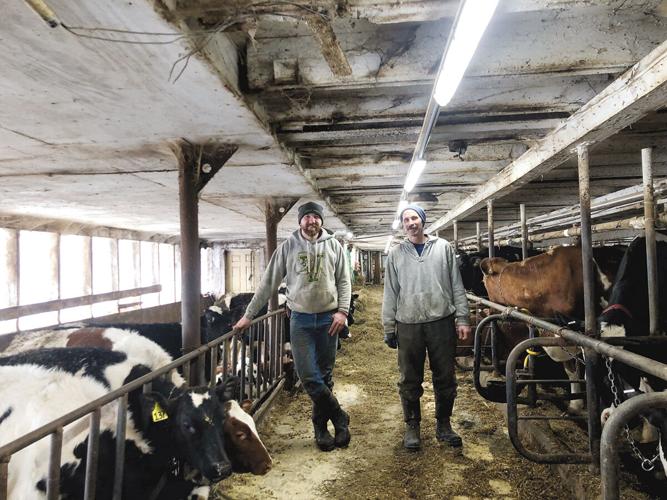
Jim Maille opened his barn door and held his weathered pointer finger in the air. “One minute,” he said, his voice soft before yelling over the sounds of machines to his youngest son Benjamin about some farm chores that they would be onto next.
For the Mailles, farm duties don’t stop for anyone. And really, it’s been that way for the last 105 years since the farm was first bought in 1919.
“It was originally 185 acres,” he said, noting that the barn where their small-scale dairy operation currently stands is the fourth iteration of the building built by his grandfather in 1939. “They lived through the depressions and the wars.”
The farm, located on Dorset Street, is a testament to Vermont’s early history, one grounded in early mornings and late nights spent milking cows — the norm for the farm that used to be just one of 4,000 such operations in the state and now stands as the last remaining family-owned dairy in Shelburne.
“I will bet at least 50 farms around us had been out in my lifetime,” he said through a distinct Vermont twang.
Maille, 63, has been at the farm for his whole life, and some of his earliest memories are marked by tractor rides with his grandfather watching sunsets over Shelburne’s expansive horizon — a much different view than those seen today.
“Mom used to tell us when we’d haul down the field as fast as we could go. She’d say, ‘Don’t you ever enjoy the sun, the sunset, or just the green grass blowing in the wind?’” he recounted, leaning against the wall of the barn. “We’re always in a hurry.”
While Maille is responsible for all farm operations, he also acts as the unofficial family historian, keeping alive the stories of the more than a century’s worth of history. While the family has made some renovations to the barn since 1939 — like redoing the stalls 20 years ago and lowering the cement floor — most of what stands today is the original makeup of what his grandfather and mother built after a couple of barn fires and a tornado took out the first three iterations.
“When they broke the cement, you could see two, three layers of cement in there,” he said. “It was wild. It’s neat to see some evidence, something other than just hearing the stories.”
Maille’s mother, Marguerite, held a deep love for the farm her father built, miraculously mustering the $4,000 deposit needed to buy the property from her parents in 1969. Maille officially became the third generation to take over operations in 2014 — or better known to Maille as “the year the price of milk was high.”
Being a farmer is something that either runs in your blood or doesn’t, he said, and “mom” certainly had it.
“I talked to an old timer, and he said, ‘You’re the last farm I would have ever put my bets on.’ Because, I mean, when they bought it back in ’69, what were the thoughts about a girl being able to grow a farm,” he said.
But growing up the work was really a team effort, although his father Joseph mainly worked in carpentry, Maille knew taking over the farm was his future path.
“Mom would make us 18-year-olds roll the bales. You couldn’t pick them up,” he said. “We all worked, all us kids.”
Although the farm has had relatively good luck this past year, the realities for a farmer are growing increasingly more difficult and expensive. As the landscape of Vermont shifts and developmental pressures to meet the demand for housing grow, the cost of everything — taxes, maintenance repairs and labor — is high.
“That’s another thought, you know, how will he continue?” said Maille, nodding in the direction of his 25-year-old son Benjamin, busy fixing a water line on the other side of the barn. “I don’t have a lot of answers.”
Shelburne is not the agricultural territory it used to be, which makes for an isolating existence for a farm that has steadily remained for more than a century and for the farmer who has seen many of his friends exit a shrinking business.
“Neighbors have helped us when they were farming, but they’re gone,” he said, speaking about the farms that used-to-be. “When I was kid, whenever we got stuck or something, we knew we could go there, and they would come and pull us out of the mud with their tractor.”
He mentioned his neighbor and friend Bernie Guillemette, who sold the last of his dairy cows last January. “We’ve worked together off and on through the years,” he said. “I would have never thought of asking him if he was still milking cows.”
“It’s also discouraging because I see all my neighbors with all nice fancy choppers and self-propelled trucks and we’re still farming like it’s the 1980s,” Benjamin said, the only one of Maille’s three kids to express an interest in taking over the farm. “We can’t buy a new tractor. His grandfather bought three, four farms in a lifetime. You can’t buy a single one nowadays.”
Stricter environmental regulations remain a growing concern for farmers like the Mailles. Although the technology for more efficient farm equipment is available, it doesn’t come without a cost. But Benjamin is excited to implement some of the new practices, especially since the farm received a $30,000 grant to buy a used no-till drill.
“He’s excited because he’s embracing the new, trying to embrace the newer technology,” Maille said. “You have to embrace the future.”
Zoning changes
As Shelburne remains in the thick of regulatory reform and as the state passes new laws around increased housing density, Maille’s wife, Sylvia Maille, has been actively attending planning commission meetings to advocate for the farm and the select few around them.
As the commission mulls changes to the Rural Resource Protection District, which encompasses conserved farmland around Shelburne Pond, there has been growing concern over the proposed increase of the 5-acre requirement to 10 acres.
“There’s nobody that can maintain 10 acres of land,” said farmer and resident Bernie Guillemette. “If it wasn’t for the LaPierres, the Mailles or me, there’d be a lot of land that would be unmaintained.”
“My husband’s family has had land in Shelburne and farmed for over 104 years. It’s sad that our family is the last family-owned operating dairy in the town. Protect us,” Sylvia Maille said. “We farm all this land; 10 acres hurts us.”
For Maille, his farm on “the other side of the tracks” in a town often characterized by $800,000 houses, will remain as long as it can with the help of his son and a few University of Vermont science students who help with milking 50 Holsteins twice a day.
“Everybody tells us we should be happy we have an opportunity to farm. Even if it’s small scale, we do have that opportunity,” he said. “We’ve come across people who say they wish they had that opportunity, but you can’t buy land anymore. I think it’s sad for the young generation.”
As the last remaining dairy in town, Maille is more matter of fact than sentimental.
“I’m too busy working to think about it all the time. We just work,” he said, a playful grin spreading across his face. “It’s neat when I listened to mom talk about what grandpa had to go through.”
