

In the past week, members of the Vermont Senate had twice expected to vote on a proposed state constitutional amendment. But the anticipated floor vote on Proposal 1 — which would enable the Legislature to set qualifications for elected county officials — never took place.
Instead, on Wednesday, one of the proposal’s sponsors asked that the Senate suspend its rules and send Prop. 1 to another committee for further review. It had passed the scrutiny of the Senate Government Operations Committee.
“We have lingering questions from senators about the proposition,” Sen. Phil Baruth, D/P-Chittenden Central, said in his request to move Prop. 1 to the Senate Judiciary Committee. “Folks wanted to be reassured, for instance, that there weren’t other constitutional avenues besides amending the Constitution.”
Some of Prop. 1’s proponents believe the sheriffs’ opposition has eroded support for it.
“I think the fact that sheriffs are actively lobbying us senators has made advancing a vote on Proposal 1 more difficult and has delayed the vote,” said Sen. Ruth Hardy, D-Addison, chair of the Senate Government Operations Committee and a lead sponsor of the proposal.
The sheriffs’ advocacy, she said, has also introduced “elements of skepticism among some senators.”
“It’s concerning to me that the sheriffs are doing everything possible to avoid accountability and oversight of their positions, especially given the recent history with misconduct of sheriffs,” Hardy said in an interview.
Sending Prop. 1 to the Senate Judiciary Committee was an unexpected twist in Senate Democrat leaders’ efforts since last session to create more accountability and oversight of sheriffs, following the scandals that emerged from sheriffs’ departments around the state.
Sheriffs, as elected officials, can be removed from office only through impeachment. It’s a process that House lawmakers have been pursuing since May against Franklin County Sheriff John Grismore, who is charged with assaulting a detained man while he was a deputy. He is also being investigated on allegations of financial crimes.
Grismore remains a sheriff though the Vermont Criminal Justice Council has revoked his police certification. The Vermont Sheriffs’ Association, which represents the sheriffs in each of the state’s 14 counties, has called on him to step down. Grismore maintains he has committed no wrongdoing and said he is being targeted for political reasons.
Prop. 1’s proponents believe that only a constitutional amendment would allow state lawmakers to set qualifications for sheriffs, as well as state’s attorneys and assistant judges. Doing so would also create a mechanism for the removal of these officeholders, including probate judges, if they fail to meet those qualifications.
The Vermont Constitution is currently silent on qualifications for these positions.
The Department of State’s Attorneys and Sheriffs supports Prop. 1 on behalf of the state’s attorneys. Department director John Campbell said it’s better to have clear enforcement mechanisms — such as suspension or removal — if an officeholder commits wrongdoing.
The Vermont Association of County Judges, which represents assistant judges, has not taken a position on Prop. 1. Nor has the state judiciary, which represents probate judges in the Statehouse.
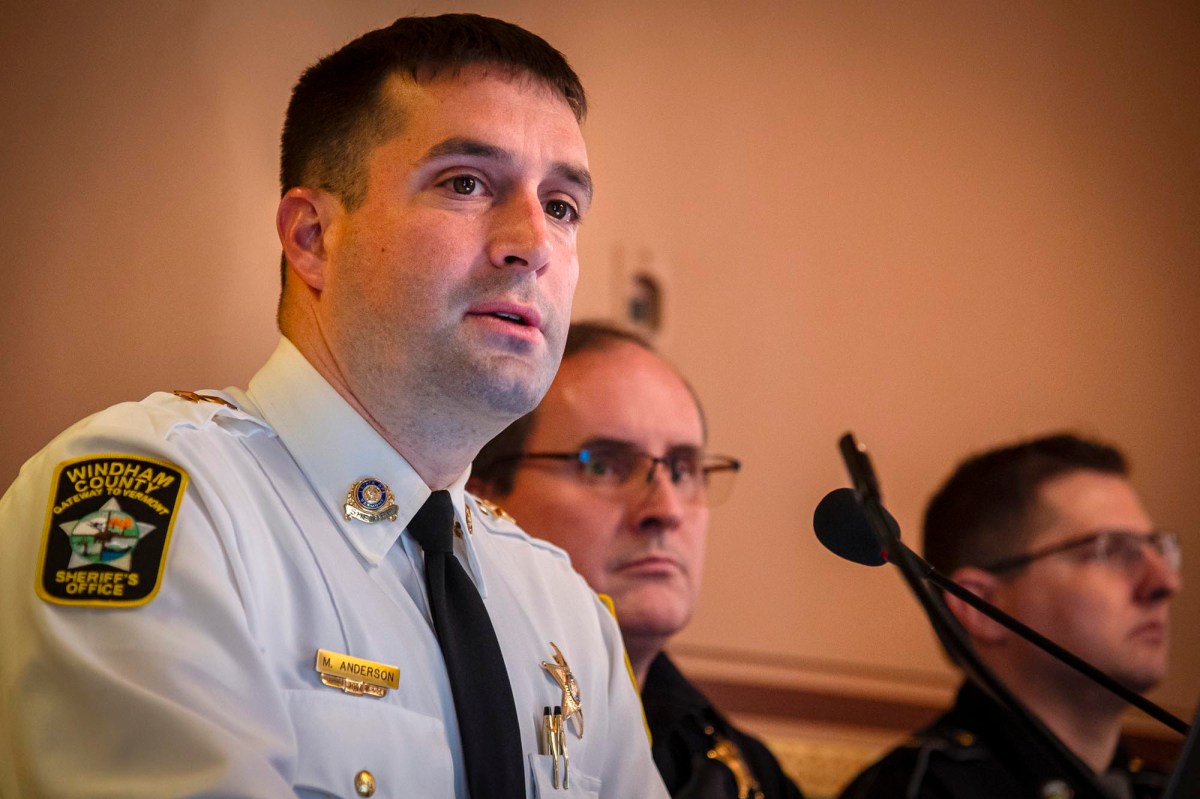
The Vermont Sheriffs’ Association, on the other hand, has vocally opposed the current version of the proposal. Windham County Sheriff Mark Anderson, the association president, said one of the group’s concerns is that an officeholder could be removed without due process, since people don’t know what qualifications a future Legislature would set down.
“I’m concerned that a political actor, upset with a person for political reasons, could cause a removal of an elected office, not because of any wrongdoing, but because a political person felt that way,” Anderson said in an interview. “It basically is a request to walk blindly into the future and just trust that things will work out. And we are asking, first, for certainty.”
He also said the sheriffs’ association believes legislators can create qualifications without the need for a constitutional amendment by simply crafting new laws, citing the testimony of a law professor who spoke before the Senate Government Operations Committee last year.
Prop. 1, Anderson said, “could offer an opportunity for good results, but it could also offer opportunity for really bad, unintended results.”
Anderson, one of four sheriffs’ association lobbyists registered with the state, acknowledged his group has been vocal with senators about its issues with Prop. 1. “We’ve had open, honest conversations with senators to say these are concerns,” he said.
Prop. 1 was originally scheduled for a Senate floor vote last Friday, then again on Wednesday. The Senate Judiciary Committee plans to begin hearing testimony on it next week.
Any state constitutional amendment must first be approved by the Senate and House in two successive biennia, meaning a general election is held in between, before the proposed amendment goes before voters.
When asked if recent events are a sign that Prop. 1 won’t succeed in the Legislature, Baruth, the president pro tempore and one of its sponsors, disagreed.
“This is our way of checking our work, dotting the I’s and crossing the T’s,” he said.
Baruth said the Senate Judiciary Committee is well respected on its take regarding how state laws interlock with the Vermont Constitution. The committee’s work, Baruth said, would address some senators’ questions about whether a constitutional amendment was truly necessary in their quest for accountability and oversight of elected county officials.
Nevertheless, Baruth didn’t want to make promises about Prop. 1’s fate.
“What I can promise you is, we believe we’re engaged in protecting the public here, and we’re not going to stop trying to get that written into the Constitution,” he said in an interview. “My hope is that it will pass.”
Sen. Dick Sears, D-Bennington, chair of the Senate Judiciary Committee and a lead sponsor of Prop. 1, said the proposal doesn’t intend to create a substitute for the voice of voters but rather to uphold the idea of checks and balances in a democratic government.
Sears said his committee plans to call back the witnesses who’ve appeared in the government operations committee and potentially solicit new testimony. His committee, he said, could add to or subtract from the previous committee’s work.
To pass in the Senate, Prop. 1 needs the support of two-thirds of the chamber, or 20 votes.
“I’ve heard that we’re close but not there,” Sears said.
