

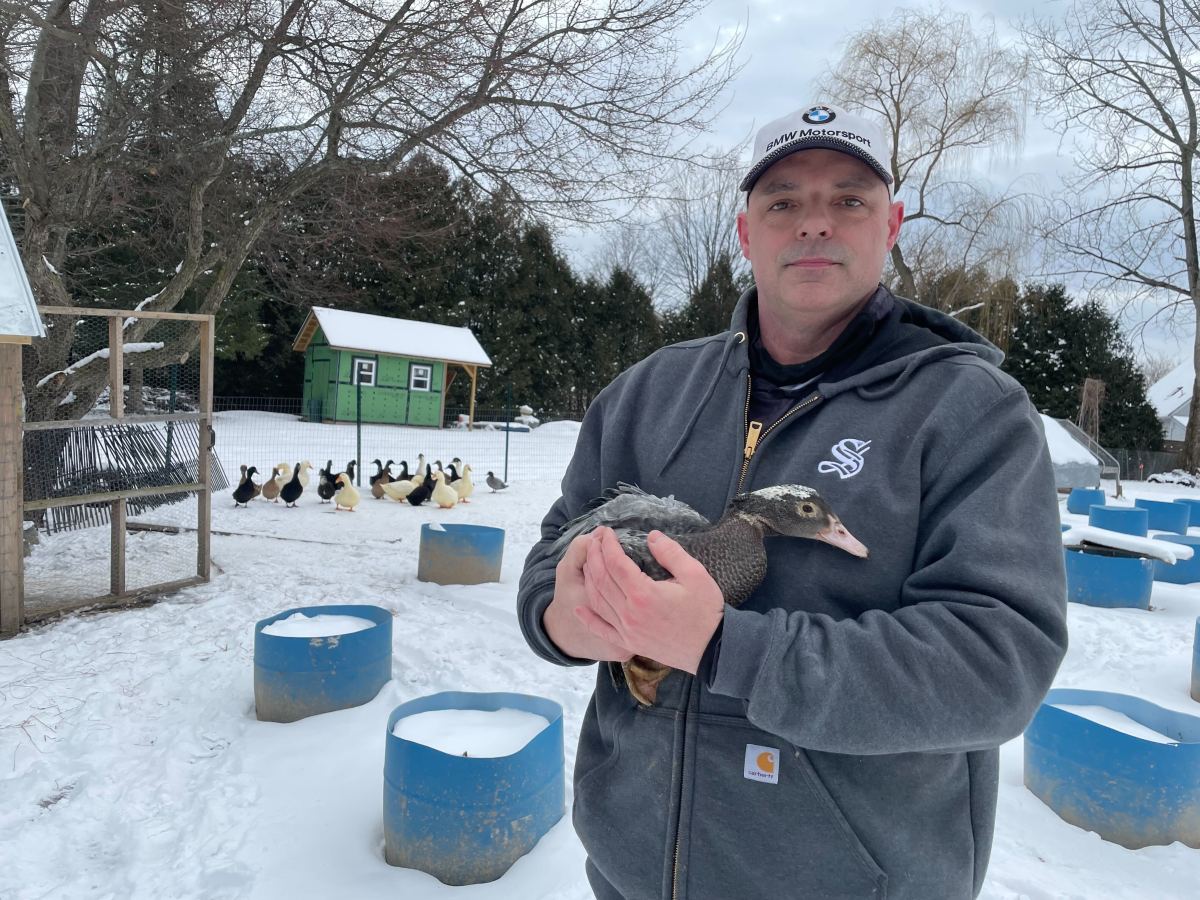
What began as a dispute among neighbors over an Essex Junction man growing cannabis and raising ducks in his half-acre yard has escalated into an effort to create a new state law limiting where cultivators can grow cannabis outdoors.
“I did an incredible amount of work to be in compliance with state laws around farming and agriculture,” said Jason Struthers, standing in his backyard last week among about 70 snow-covered blue bins where he grows adult-use cannabis. “I don’t want to be a bad neighbor.”
Despite obtaining state approval, Struthers has faced complaints from neighbors about noise, smoke and odors. These have led to visits from police and fire officials, the city trying to shut down the operation, and an ongoing state environmental court case. Last year, the city ruled that Struthers could continue growing cannabis but could no longer have ducks at the property.
Now, two state representatives, Karen Dolan, D-Essex City, and Lori Houghton, D-Essex Junction, have introduced a bill, H.549, which would prohibit outdoor cannabis cultivation in densely populated areas that are served by municipal water and sewer and have 500 or more persons per square mile.
Struthers sees the bill as yet another attempt to shut down his farm. In introducing the legislation to her colleagues on Jan. 3, Houghton did cite his operation.
Essex Junction, which recently became a city, continues to grow and is expected to become more dense, Houghton said during her testimony. “That, with some of the issues associated with outdoor cultivation like being able to see into the cultivation site, noise, odor, lights, it’s just causing a lot of conflict within the community,” she said.
“This is not an anti-cannabis bill,” Houghton told VTDigger in a brief email, “it is simply asking the state to consider density when issuing outdoor cultivator licenses.”
Initially sent to the House Energy and Environment Committee, the bill has recently been reassigned to the Committee on Government Operations and Military Affairs.
Raj Chawla, the Essex Junction City Council president, said the state has asked communities to host cannabis cultivation but hasn’t provided guidelines as to where it would be appropriate. The proposed bill, he said, “seeks to set some kind of standard for where in a community you would say cannabis cultivation is appropriate and where it is not.”
“Is it appropriate in a rural area in Charlotte? Is it appropriate in the Old North End of Burlington or in a lot adjacent to a school? Is it appropriate in the Laurel Hill neighborhood of South Burlington or in a community with property lots that are less than a tenth of an acre?” he asked.
But an organization representing Vermont cannabis growers is concerned about the bill’s potential impact.
“There is substantial belief that this would impact the hundreds of outdoor and mixed use licensees that are currently operating across the state and it would be materially detrimental,” said Geoffrey Pizzutillo, co-founder and executive director of the Vermont Growers Association.
Pizzutillo said he believes this case involves a “vocal few” municipalities, including Charlotte and Shelburne, that want to narrow the possibilities for cannabis cultivation. But when creating public policy, he said, it is important to be “more inclusive” and “less reactionary.”
“We hope that this piece of legislation lies in committee and doesn’t grow legs,” he said.
Complicating matters in Struthers’ case is the fact that he’s both growing cannabis and raising ducks — and there’s conflict between state and local laws governing both practices, as first reported by the Essex Reporter.
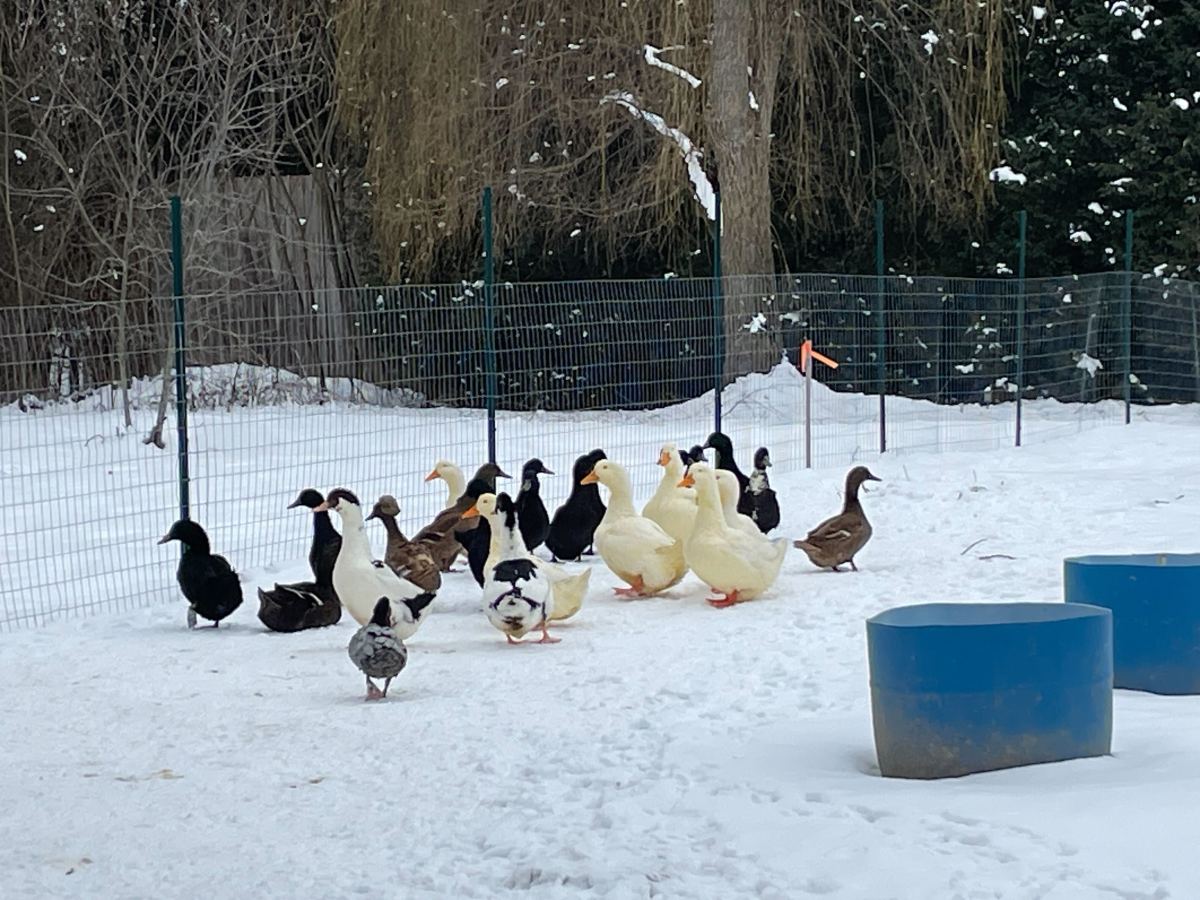
Struthers lives on a dead end street with 17 homes, within a mile of the Essex High School and the Essex Early Education Center. Last week he showed a reporter his half-acre property, which is marked on two sides with cannabis growing signs. Parts of the fence accessible from the street have black sheeting so people walking or driving by can’t see in. Twenty-five adult ducks were in an outdoor pen and five juveniles were indoors, Struthers said, explaining that he sells the ducks and the eggs and uses the manure as fertilizer for his cannabis plants.
He said he bought a few ducks on a whim at the Champlain Valley Fair in 2021. Later, he obtained a farm determination letter from the state in May 2023. That means, state officials confirmed, that he does not need a license to farm in Vermont, which includes raising poultry.
Act 65 legalizing cannabis in Vermont also extends farming benefits to outdoor cultivators such as Struthers. He obtained a Tier 1 adult use cultivation license from the Vermont Cannabis Control Board in July 2022 for his business TrichomeVT. This happened before the city formed its cannabis control board and limited cannabis cultivation to areas zoned agricultural.
Essex Junction, however, prohibits residents from “raising, keeping, or harboring of livestock, wild animals or other domesticated farm animals for personal use or commercial purposes” in most zoning districts, including the one where Struthers lives. A city ordinance allows residents to seek a permit for four chickens in their backyards but not ducks.
Some neighbors have grown increasingly opposed to both Struthers’ cannabis plants and his ducks — and have sought to shut down the operation. They said the yard is a complete mess, that they’ve reported the noise, the trash and the “ungodly smell” in the summer from cannabis plant remnants being burned and from rotting duck carcasses they said Struthers tossed in the compost.
After several hearings the city’s Development Review Board concluded last year that it “lacks the authority” to regulate Struthers’ cannabis farm but ruled that Struthers’ ducks had to go. Struthers has appealed that decision to the state environmental court.
“I’m not opposed to a farmer doing his thing, I’m just opposed to him doing it here,” said next-door neighbor Stephen Wille Padnos, who has also appealed the city’s decision. He said he’s worried this case could set a precedent and allow anyone to start a farm despite local land rules. The smells and mess from Struthers’ operation has made it hard for his family to enjoy their own backyard and pool in the summer, he added.
Struthers said he has done everything by the book and beyond. For the past year he has been replacing the quackers he sells with a quieter variety — the Muscovy.
He said he definitely feels targeted but intends to fight for his right to farm in what is an agricultural state. “While I do empathize with the feelings of others, my rights don’t end where the sensitivities of others begin,” Struthers said.
Houghton said it is far too early in the process to determine whether the bill will pass muster but that further testimony is expected.
“There are real conflict points between dense housing areas and outdoor cultivation that makes it difficult for the city to achieve both state goals,” she said in an email.
