




From the school districts most advantaged by the latest changes to education finance to those on the opposite end of the spectrum, everyone, it seems, is having a uniquely difficult budget season.
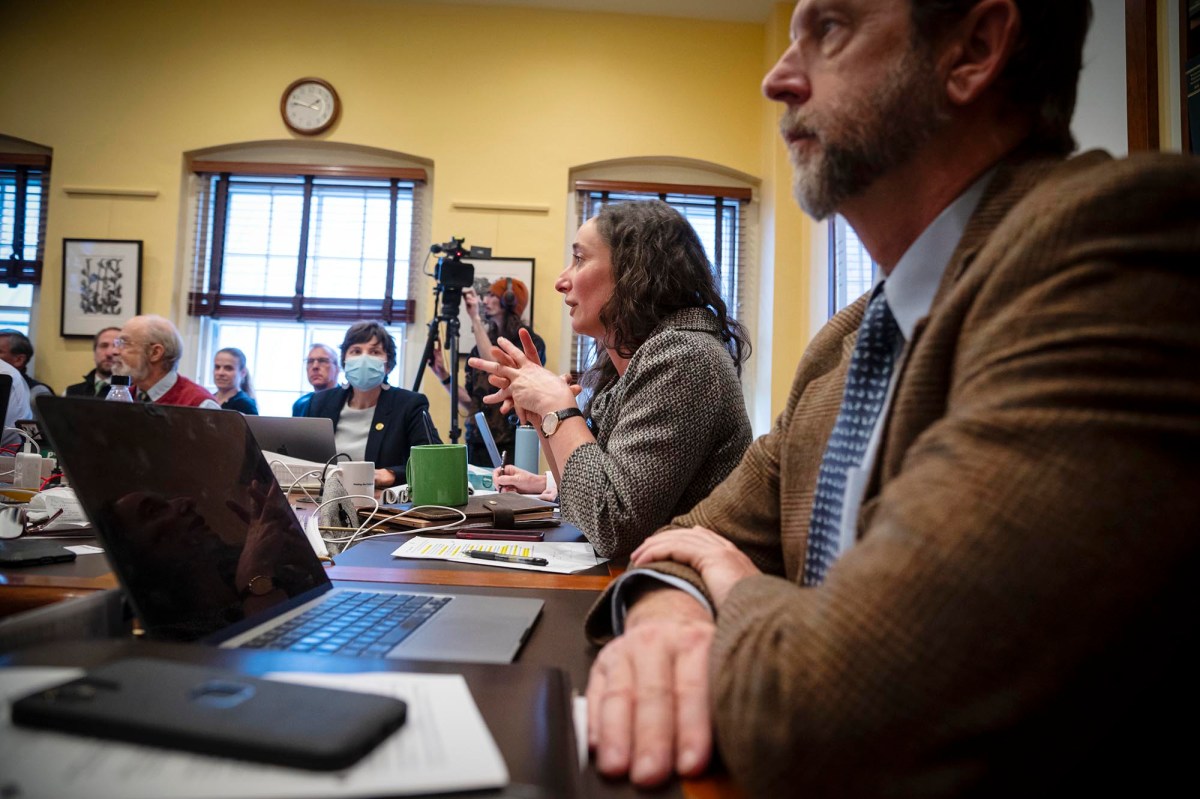
In what Rep. Emilie Kornheiser, D-Brattleboro, chair of the House Ways & Means Committee called “deep listening,” lawmakers took rapid-fire five-minute testimony from about two dozen school and state education officials Thursday. It came in a joint hearing with the House Committee on Education, the Senate Committee on Education and the Senate Committee on Finance.
Ryan Heraty, superintendent of Lamoille South Supervisory Union, did not hide his disdain for the latest changes resulting from Act 127, which sought to change the education spending formula to direct more resources to schools with higher-need students, calling the law “one of the most detrimental and dangerous pieces of legislation in recent history.”
The brouhaha followed last week’s letter from the chairs of two key committees chastizing school districts for excessive spending. That missive focused on Act 127’s “5% cap,” which allows districts to increase per-pupil spending by up to 10% while passing on only a 5% increase in homestead property tax rates to taxpayers.
Even in districts that stood to gain the most from Act 127’s new pupil weights, the pressures on school budgets — health care costs, salaries, the end of federal dollars — have negated any benefit from the new weights, leaders said.
“We approached this budgeting season with some … trepidation but also hope,” Elaine Collins, superintendent of North Country Supervisory Union in the Northeast Kingdom, told lawmakers. “If any district in Vermont should benefit from weights, it’s a poor rural district like North Country.”
At first, the district expected to be able to lower tax rates for its communities, she said, by passing a budget that didn’t add new programming. But once the Common Level of Appraisal adjustment was made for each town, any tax savings disappeared.
“It is a miracle if we’re going to pass school budgets this year,” Collins said. “It’s a mess. And it’s a mess, I think, not of the schools’ making.”
Education — especially with the increasing responsibilities placed on schools — is expensive, and schools are increasingly forced to address the severe behavioral needs of students, according to educators.
Before serving as superintendent, Collins worked as principal of Newport City Elementary School. In her first year, she said the school registered 890 uses of restraints, escorts and seclusions — when a school staff member physically directs, immobilizes or isolates a student.
“Nobody was learning,” Collins said.
Six years later, Collins said, that number was below 50.

“The cost of remediating that system was adding lots of extra supports, doing lots of professional development and tweaking systems and refining systems. And it was expensive,” she said. “It’s not sustainable for us to do this in education unless we find other revenue sources or other ways of funding our schools. Our local taxpayers can’t afford it.”
In Winooski, a district with the most to gain from Act 127 because of its economically disadvantaged and English language learning students, its leaders said the law may be creating further inequity — the opposite of lawmakers’ stated goal.
The 5% cap in particular “turns Act 127 on its head,” said Robert Millar, Winooski School District board chair.
Winooski, with the highest proportion of English language learners in the state, saw an increase in pupil weights. With the increased tax capacity, its school district didn’t expect to hit the 5% cap, according to Millar.
“We analyzed several districts’ public statements and charts from public board meetings and came to the concerning conclusion that many are increasing (their) budgets beyond the normal expected inflation increases in order to take advantage of Act 127’s 5% tax rate cap,” Millar said. The result, he suggested, would be increased taxes on Winooski residents, despite lower per pupil spending.
Norwich’s school district stood to take the hardest hit from Act 127’s readjustment of pupil weights. Given the leeway of the law’s 5% cap, the district decided to include funds to improve ailing infrastructure in its budget — new boilers, an upgraded heating system.
But once the district received lawmakers’ letter concerned about the use of the cap, board members nixed most of the additional funds for capital projects, Garrett Palm, the Norwich school board chair, said.
Because Norwich only makes up about a third of a cross-border district with Hanover, New Hampshire, it has to make larger budget cuts to reap the same tax effects, its leaders explained.
“I consider myself an optimist,” Palm said, but with Act 127 and education costs pressure, he’s concerned Norwich might not have a school in the next decade. “I’m having a hard time staying positive.”
How lawmakers could respond to feedback from the field remains to be seen. So too does the exact extent of tax hikes, which rely on warned school budget data not yet collected by the Vermont Agency of Education. Next week, the agency expects updated figures, which will add more clarity to the currently chaotic outlook.
“The data gathering process is like the most essential piece of us figuring out any of this,” Kornheiser said.
