




This commentary is by Curt Lindberg, chair of the Waitsfield Conservation Commission and a member of the Vermont Biodiversity Alliance.

Like others attuned to the natural world in Vermont, I’ve noticed Japanese knotweed — identified by scientists as one of the world’s most troublesome invasive species — lining many of the state’s rivers. After the December flooding I headed out to sites along the Mad River in Waitsfield to see what I could learn about how water features in its spread. Two questions accompanied me: What actually happens in a high-water event to cause the dispersal of knotweed? And what can we do to stem the spread?
Here’s what I discovered. Rushing water had washed soil away from under the banks of sites covered with knotweed. The water broke off parts of the underground material of the plant — rhizomes and roots — and sent it down the river. In some cases entire banks and their knotweed collapsed into the river, sending more of it downstream. I’d learned from Brian Colleran, an invasive species ecologist who studied knotweed dispersion in Vermont after Hurricane Irene, that this happens because knotweed has a very simple underground structure that does not bind to soil like the roots of native trees and shrubs that are deeper and more complex.
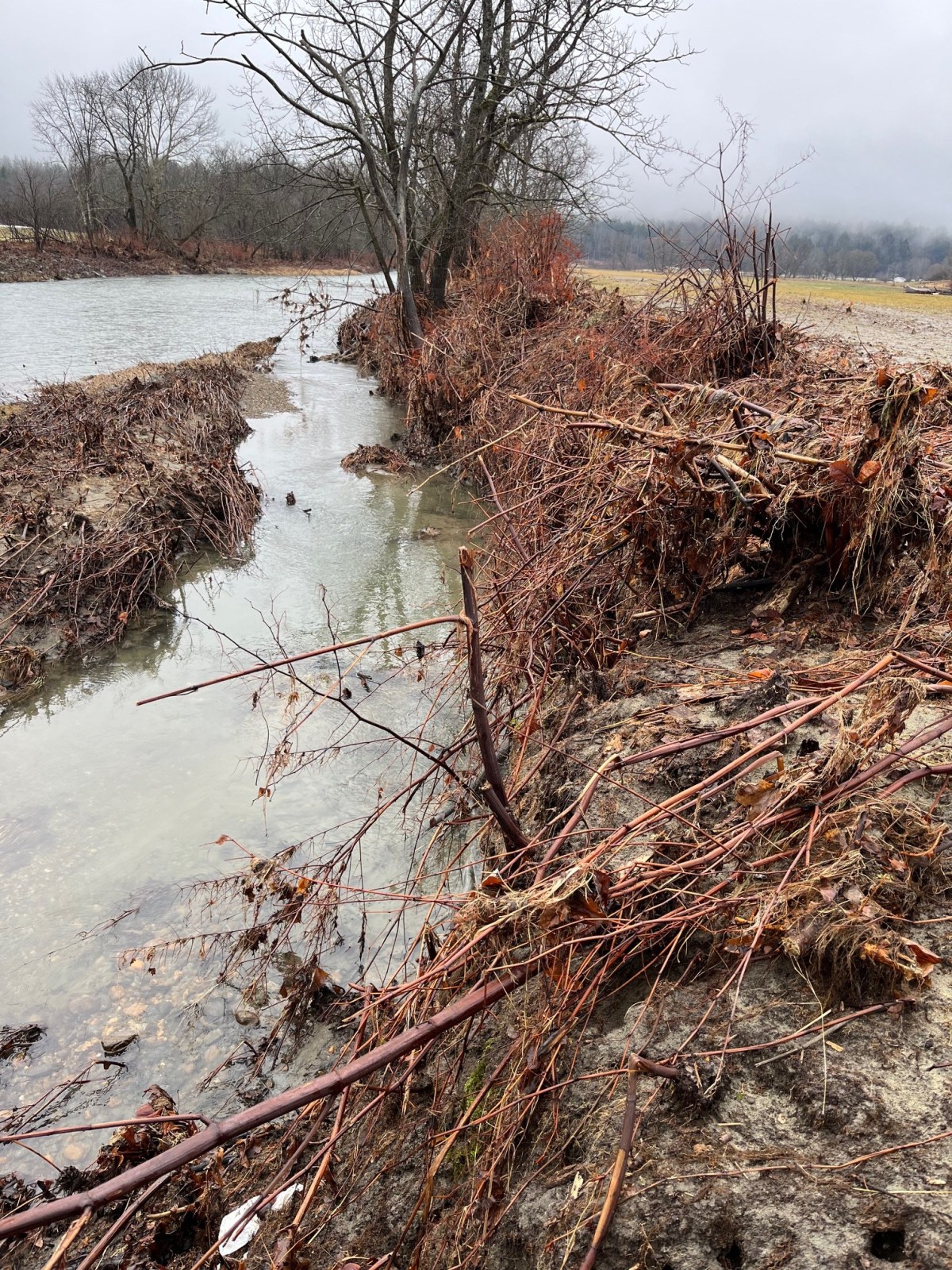
Knotweed material was deposited on riverbanks and in floodplains along the Mad River as water levels dropped. In twelve Waitsfield locations I visited, I found 148 propagules — vegetative structure that become detached from a plant and give rise to a new plant — littering the earth. There were short rhizomes and root segments and one rhizome 12 feet long. And this isn’t the full story. There are undoubtedly propagules buried in sediment left by the flood that won’t be exposed until springtime growth.
This picture left me fearful that if nothing is done we’ll see another eruption of knotweed in the Valley and more damage to our local ecosystem. These aggressive, fast-growing plants outcompete trees and shrubs and form dense monoculture stands. These stands cause riverbanks to become unstable, increase erosion and degrade water quality. Loss of native vegetation reduces biodiversity in plant and animal communities. E.O. Wilson, one of the world’s preeminent biologists and conservationists, has taught us that invasive species are the second leading cause of species and biodiversity loss.
As climate change triggers more frequent and intense flooding, a positive feedback loop is created.
With some relief, I recalled a practical strategy promoted by ecologists — early detection and rapid response. It is recommended as a first line of defense in the battle against invasive species. Fortunately, there is a crew of dedicated area residents already working to control knotweed in the Mad River Valley that can be activated to carry out the strategy. Usually the focus is on existing stands. Here the focus will be on stopping new infestations.
This is what we’re planning to do:
- Map the knotweed depositions along the riverbanks and floodplains in Waitsfield. I’ve started this using the free iNaturalist app. I set up what’s called a project. This automatically captures all observations of knotweed made by anyone in town.
- Volunteers from the Mad River Valley Knotweed Project and I will revisit these locations in the spring and summer to search for new knotweed plants emerging from sediment — the reddish young stems and leaves are a giveaway. Map these locations, too.
- Collect the above ground knotweed material over the course of the spring and summer and place it above ground on drying stacks or burn it.
- Dig up the plants found in the sediment, being careful to get all the underground material. This should be possible since we expect to find that most of it is buried in less than four inches of sediment, another finding from Colleran’s study.
- Repeat the above steps later in the year — say in the fall when knotweed is easy to find as its stems and leaves turn bright orange. This later search is important because Colleran’s research found that knotweed rhizomes remained viable for up to thirteen months after Hurricane Irene.
- Consider adding to our list of priority sites for knotweed management the source of the spread — riverbanks covered with knotweed and prone to collapse. This would involve managing the knotweed stands and planting native trees and shrubs.
I’m feeling upbeat about this project because nature will benefit in multiple ways. It seems like a good return on investment; it’s much more efficient to tackle knotweed before it becomes established.
It’s my hope that the modest actions being planned in the Mad River Valley can weaken the destructive cycle created by knotweed and frequent flooding. This hope keeps me motivated.
I hope this motivates you, too. If we can create a cascade of small actions around the state, we could make a real difference for nature in Vermont.
So, add some knotweed mapping, collecting, digging and drying to your 2024 to do list. It’s on mine. And don’t forget to invite others to help.

