

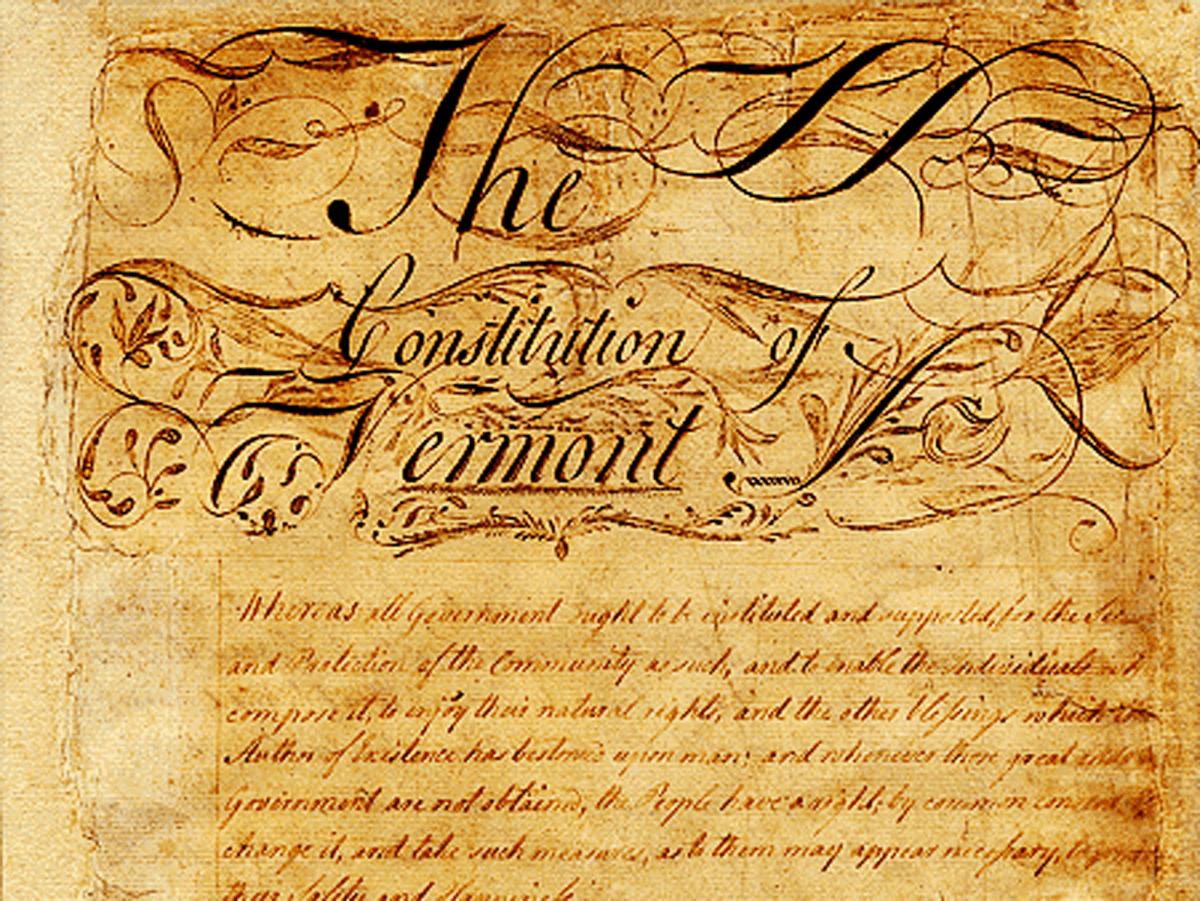
This is the second in a two-part series on the life of the lesser-known American founder Thomas Young, who played an important role in the formation of Vermont. Read part one here.
Everything changed in the spring of 1775. The long simmering dispute between the Colonies and Great Britain erupted in April into a shooting war in Massachusetts at the battles of Lexington and Concord.
Supporters found their own ways to aid the Colonies’ cause. Thousands of militiamen from around New England and the mid-Atlantic states quickly rallied to defend Boston from the British. In May, Ethan Allen led the Green Mountain Boys in the successful capture of Fort Ticonderoga on Lake Champlain.
At the same time, Allen’s old friend and mentor Thomas Young traveled from New England to Philadelphia, arriving just as the Second Continental Congress was convening. His work there would help clear a political logjam that had blocked the 13 colonies from declaring independence, and would ultimately be pivotal in the formation of a 14th state, Vermont.
Young was an invaluable fighter in the battle of ideas over the meaning of the American Revolution. He had rallied opposition to the Stamp Act, been the first to publicly propose dumping tea in Boston Harbor, and served as a vital correspondent to unite patriot groups throughout the Colonies against the Crown.
Like the men joining the militias, those gathering in Philadelphia were putting targets on their backs for British retribution, something Young knew all too well. He’d had close scrapes before, having been attacked and left for dead by two British officers in a Boston street one night.
After the Boston Tea Party, an anonymous letter had circulated around the town calling for British soldiers to kill him and 17 other revolutionary leaders on sight. That was enough to persuade Young to depart Boston with his family. Young’s wife, Mary, was said to be terrified for her husband’s safety, and he in turn was worried she and their six children would be left destitute if anything happened to him.
The family relocated to Newport, Rhode Island. “I can in this place serve the common cause of America as effectually as I have done in any part of it,” he explained. Young joined the local militia and began training with firearms. But he focused most on doing what he did best, rallying people. He incited a crowd to menace a leading Newport merchant and slave dealer. The man later complained to a friend: “It’s a pity that such a fellow should get footing anywhere, but he is playing here the same game he did at Boston, and I am fearful with the same success, as some of our popular gentlemen countenance him too much.”
But Philadelphia soon beckoned. With a population of about 40,000, Philadelphia was the largest city in America — equal to New York and Boston combined. America’s revolutionary leaders for the Continental Congress were gathering. Among the delegates were the likes of George Washington, Thomas Jefferson, Patrick Henry, and Benjamin Franklin, as well as men Young already knew from Boston, including John Hancock and cousins John and Samuel Adams.
He also met and befriended Thomas Paine, whose name would be on everyone’s lips early the next year when he published his hugely influential “Common Sense.” In the 47-page pamphlet, Paine made a clear and easily understandable case against the British monarchy and for American independence,
Young and Paine had much in common. They were both recently arrived in Philadelphia; they were politically radical egalitarians worried that the moneyed elite would wield too much power in a future America; they were persuasive writers; and as Deists, they were religiously unorthodox, believing in a supreme being that created the world and natural laws, but didn’t intervene in daily life. The two men would join forces to promote radical political changes in Pennsylvania.
Young had to support his family, so he continued his medical work, establishing a practice in Philadelphia. He also volunteered as a surgeon for the Philadelphia Rifle Battalion and was later named senior surgeon for the city’s Continental Hospital, where he treated sick and wounded soldiers.
His great passion, however, remained politics, where the key issue of the day was stalemated. Efforts in Congress to declare independence were being blocked by Pennsylvania’s cautious and conservative assembly, which had ordered the colony’s delegation to vote against separating from Britain. Taking their lead from Pennsylvania, the legislatures of Delaware, Maryland and New Jersey did likewise, stymying any move toward independence.
Pro-independence radicals, including Young and Paine, sought to remove this obstacle. They backed a slate of like-minded candidates in the Pennsylvania Assembly’s election on May 1, 1776. They fell just short of a majority, despite what they believed was strong support for independence in the colony. The problem was Pennsylvania’s election laws, which limited the right to vote to wealthier white men. The largest groups of white men who were disenfranchised included Pennsylvania’s considerable German population, militia members and many laborers and artisans, all of whom generally backed independence. With this group of strategic allies in mind, Young wrote to a newspaper that “Every man in the country who manifests a disposition to venture his all for the defense of liberty, should have a voice in its council.”
The British military unwittingly helped Young and Paine’s cause. A week after Pennsylvania’s elections, two British warships sailed up the Delaware River in an effort to intimidate Congress. The gambit backfired. The revolutionaries believed that Britain’s aggressive actions justified their resistance. Congress narrowly passed a resolution that read, in part: “It is necessary that the exercise of every kind of authority under the said crown should be totally suppressed.” In its place, Congress declared, colonies should elect governments that would act independently of the British government.
Young, Paine and other radicals took this as a cue to mobilize the people against their pro-Crown legislature, which they declared to be illegitimate, and organize a constitutional convention to create a new governmental structure for the colony. Young and others rode into the countryside to call on communities to send delegates to this convention. One opponent of independence warned a friend he might soon meet a “certain bawling New England man called Doctor Young of noisy fame.”
Future president John Adams, who wanted government in the hands of an educated elite, fretted that the delegates to Pennsylvania’s constitutional convention would be guided by a “spirit of leveling, as well as that of innovation.” His fears were realized.
Under the influence of Young and others, the convention was creating a radically democratic constitution. Among the innovations and efforts at “leveling,” delegates gave the vote to all taxpaying men, not just those who were wealthier. They also established term limits for public office and rejected the British parliamentary model of a legislature with two chambers, one representing the common folk and the other the wealthy “lords.” Instead, they adopted a unicameral system, with no “upper house” that would allow the wealthy to thwart the will of ordinary people. As evidence that this structure could work, proponents pointed to the effectiveness of New England’s town meetings and the Continental Congress itself.
In June, the besieged Pennsylvania Assembly withdrew its orders that its Congressional delegation vote against independence. Individual delegates could vote their consciences. Meanwhile, Pennsylvania’s constitutional convention urged them to support independence. Other undecided colonies were starting to back independence. When Congress voted on the issue on July 2, the Pennsylvania delegation sided with independence. Congress had unanimously approved the Declaration of Independence by a tally of twelve to zero. (New York’s delegation, which hadn’t received instructions, abstained.)
Six months later and 250 miles north of Philadelphia, another group of revolutionaries also declared independence. In January 1777, delegates at a convention in the New Hampshire Grants asserted that they were free from Britain, as well as the states of New York and New Hampshire, all of which claimed to control the area. This new political entity, the delegates declared, would “be forever hereafter called, known and distinguished by the name New Connecticut.”
The self-proclaimed government of New Connecticut petitioned Congress to be recognized as a separate state. Young wholeheartedly embraced the petition, if not the name. Here was a chance to help form another state with a strong democratic basis.
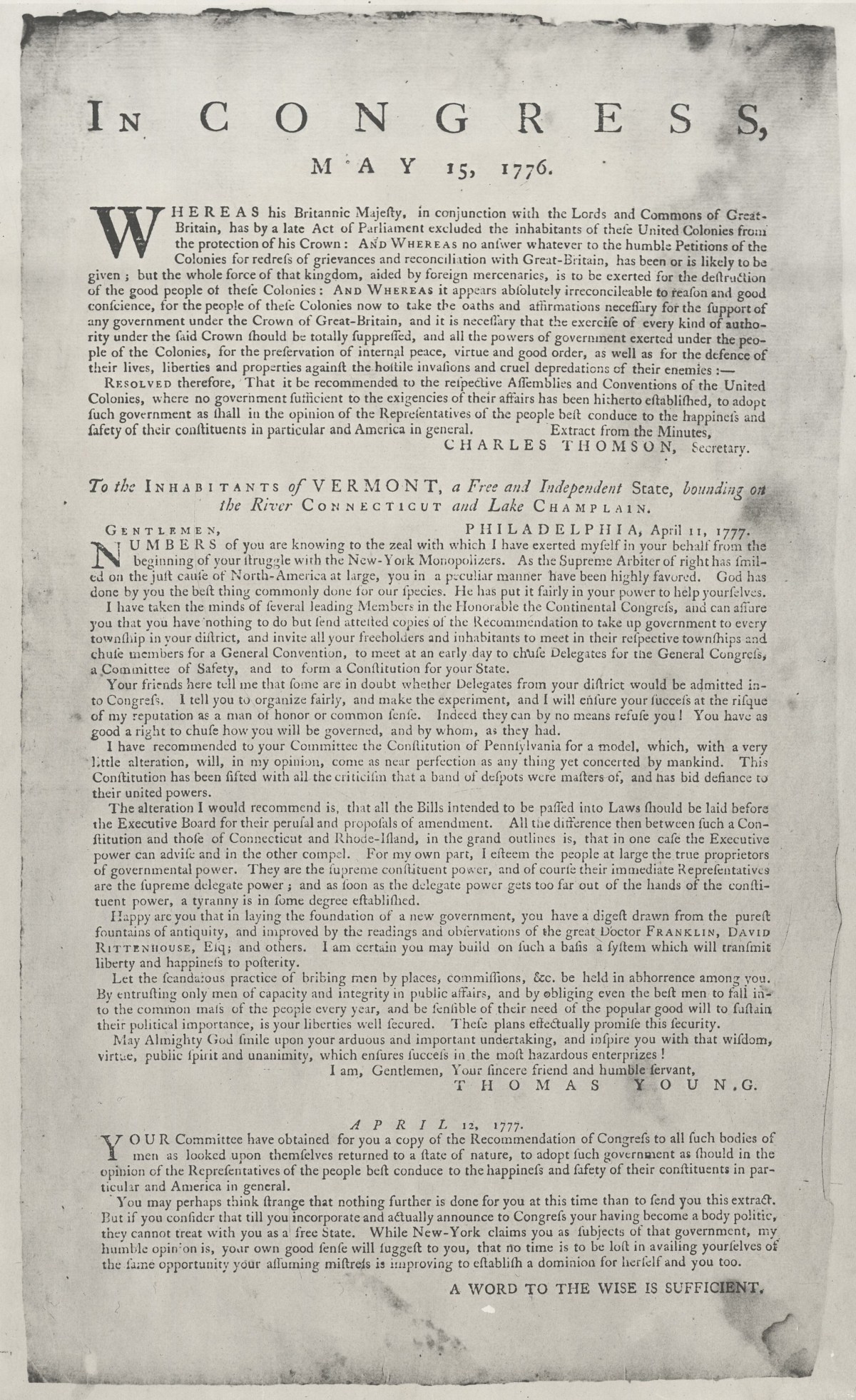
On April 11, 1777, Young published an open letter urging the people of this disputed region to form their own government, and he boldly suggested a new name: “To the INHABITANTS of VERMONT,” he wrote, “a Free and Independent State, bounding on the River CONNECTICUT and Lake CHAMPLAIN.”
Young coined the name “Vermont,” from the French for “green mountains,” as the region was sometimes known. The new name would avoid confusion with a section of Pennsylvania also named New Connecticut.
(Some people suggest the name “Vermont” is grammatically incorrect, because in French the adjective follows the noun. Therefore, “green mountain” should really be “mont vert”—“vert” being the French word for “green.” But, as University of Vermont Professor Emeritus Joseph-Andre Senecal explains, French place-naming conventions call for the adjective to come first, as in names like Beaumont and Belmont. Furthermore, the “t” in “vert” is often dropped in making compound words. Young’s coinage fits these patterns.)
“I tell you to organize fairly, and make the experiment, and I will ensure your success at the risque (risk) of my reputation as a man of honor or common sense,” he wrote. “Indeed they can by no means refuse you! You have as good a right to choose how you will be governed, and by whom, as they had.”
To further encourage Vermonters, Young included a copy of Congress’ May 1776 resolution calling for the Colonies to create pro-independence governments. Young was arguing that he was just telling Vermonters to do as Congress had asked.
When word of Young’s letter circulated, members of Congress were appalled by his interpretation of their resolution, and condemned the letter in another resolution, saying it was “derogatory to the honor of Congress,” a “gross misrepresentation” of the facts, and intended to “deceive and mislead” people. Left unmentioned was the fact that New York’s delegation was pressuring Congress not to cede land that it claimed.
But this latest resolution had no impact on events in Vermont; Young’s letter had outraced it north. Delegates at Vermont’s constitutional convention in June in Windsor were ignorant of Congress’ efforts to restrain their actions. They had only Young’s word to go by, along with another document he had sent: a copy of Pennsylvania’s constitution.
Having Pennsylvania’s constitution to borrow from was invaluable. The delegates were understandably unfamiliar with how a constitution was structured, and they were in a hurry. As they sat down to hammer out their own constitution, they were painfully aware that a British force was invading south through the Champlain Valley.
The framers of the Vermont Constitution borrowed freely from the Pennsylvania document. Some passages are indeed identical. Both constitutions formed unicameral legislatures, an executive branch that worked with an advisory council, and an independent judiciary. Both also created a council of censors to periodically review the constitution and the constitutionality of laws.
But there are also important differences. Vermont became the first state to outlaw adult slavery and removed any property requirements for voting. Its voters would also directly elect the governor, lieutenant governor and members of the governor’s council; in Pennsylvania they were appointed. (Both constitutions have since been amended numerous times, including dramatically expanding the right to vote and switching to a bicameral system with a senate.)
Thomas Young never learned of the events his letter had kicked off. While working at the military hospital in Philadelphia, he contracted an unidentified fever (perhaps typhus or typhoid) and died on June 24, 1777, at the age of 46. As he feared when he fled Boston, he left his widow, Mary, with little money to care for their six children.
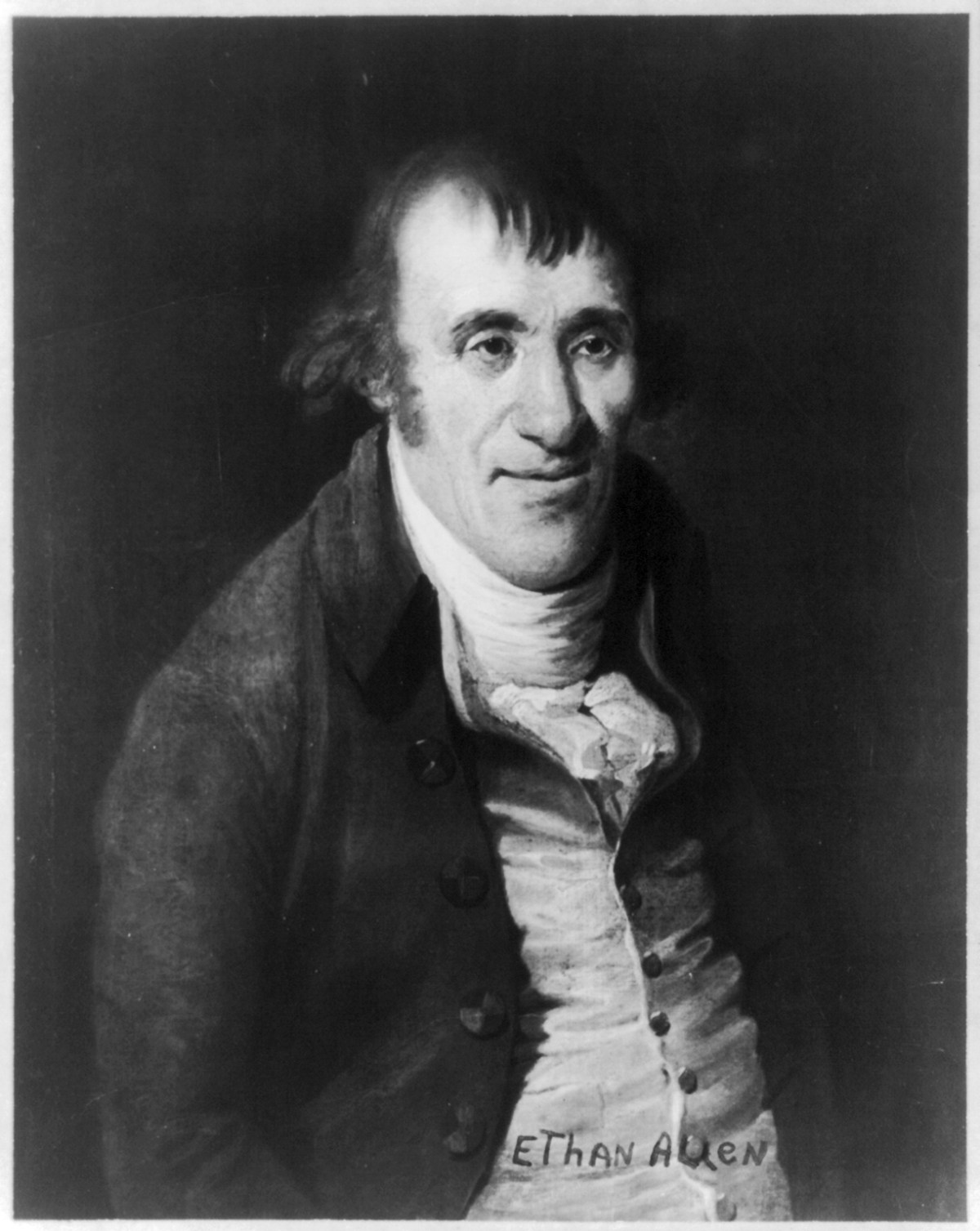
Thomas Young’s story has something of an afterlife, thanks to a friend from his days as a traveling doctor in Connecticut. Ethan Allen had spent years as a prisoner of war after being captured in a botched attempt to capture Montreal in September 1775. Sometime after his release in June 1778, Allen visited Mary Young, who had returned to New York with her children. He left with the manuscript on Deism that he had apparently collaborated on years earlier with Young.
In 1782, Allen published “Reason, the Only Oracle of Man.” The book drew sharp attacks from orthodox Christians for the Deist beliefs it espoused. Historians have long debated who was the true author of the work. Some argue the work sounds like Allen, while others suggest he lacked sufficient knowledge of Greek and Latin to have understood the book’s sources in those languages. Some believe the men shared authorship. Historians have debated why Allen never mentioned Young in the book. Some suspect he saw no need to credit his friend who had been dead five years. More charitable historians believe he was trying to protect Young’s name from the denunciations he knew the book would generate.
In 1786, nine years after Young’s death, Ethan Allen and two others called on the Vermont Legislature to honor Young posthumously “for the decided part which he took in our favour in the most critical moments as respected the existence of this state, having pointed out the system to be pursued to establish government by a separate jurisdiction & to whom we stand indebted for the name of Vermont.”
A fitting tribute, they said, would be to grant some undeveloped land to benefit his widow and children. The Legislature took no action on the request. The state to which Doctor Thomas Young had helped give life declined to acknowledge his role in that birth.

