

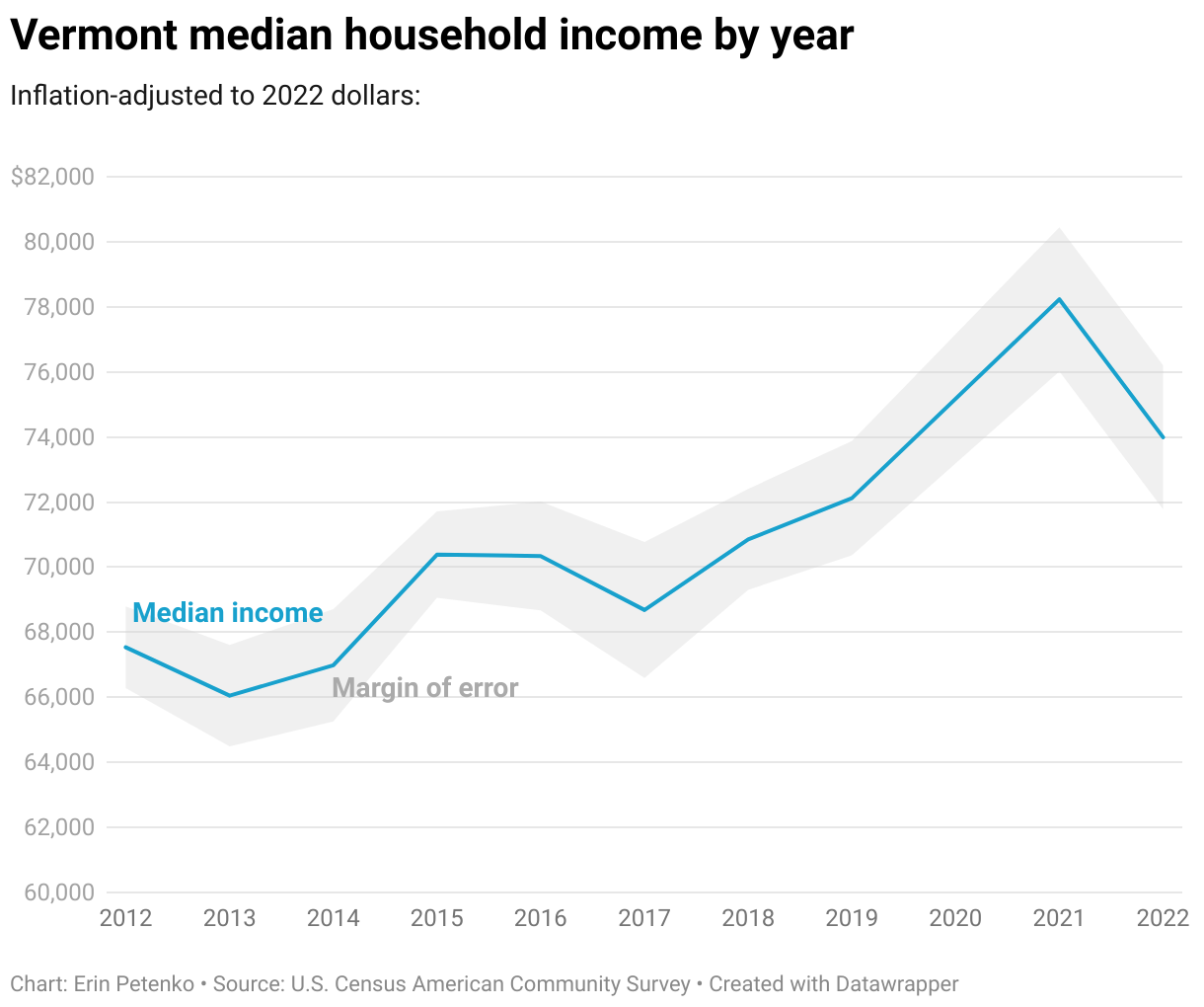
The latest income figures from the U.S. Census Bureau reflect a reality of Vermont life, particularly since the start of the Covid-19 pandemic: People might be earning more, but things are getting more expensive, too.
In Vermont, the median household income was $73,991 in 2022, a 2% increase from 2021 before inflation is taken into account, according to the Census Bureau’s American Community Survey.
However, when household income is adjusted to account for near-record levels of inflation, the result shows that the buying power of the median Vermont household in 2022 dollars actually declined by 5%.

Why are Vermont incomes decreasing relative to inflation? There could be multiple causes, said Kevin Chu, executive director of the think tank Vermont Futures Project.
Among them is that the Census looks at income for entire households, regardless of the household size. As more and more people live alone in Vermont, that could make it seem like income is going down, Chu said.
And while the Census household income figure includes Social Security payments and pensions, it doesn’t include certain types of windfalls like property sales or in-kind government benefits like food stamps. That could mean that older Vermonters’s financial pictures are being underrepresented, Chu said.
Still, evidence suggests that the rising cost of goods and services plays the biggest role in eroding Vermont’s income gains. Between 2021 and 2022, personal spending on all household expenses rose 8.9% before inflation is taken into account, according to the U.S. Bureau of Economic Analysis.
That’s the second-highest increase since at least 1998 — behind a 9.2% increase between 2020 and 2021.
“Affordability is top of mind for many, many Vermonters,” Chu said. “When we are looking at income, that’s what matters to the citizens of our state: What can they get in return for the income that they’re earning, and how much do they have left over at the end of the day?”
According to the Bureau of Economic Analysis, the categories that Vermonters spend the biggest chunks of their money on — essential (nondurable) goods like food and fuel, housing and health care — all saw massive increases in 2022, sometimes on top of large increases in 2021.

Some of those factors, such as national inflation and interest levels set by the federal government, are outside of Vermont’s control, Chu said. Other factors, like the cost and limited availability of housing, are part of a statewide conversation right now.
Chu has pushed for a rollback of housing regulations and other bureaucratic roadblocks that can slow the pace of new housing and push prices up. He believes it’s not only essential for helping Vermonters to afford housing now, but to make Vermont a sustainable place to live as the population grows older.
Additionally, Vermont’s population is aging. Census data shows that 22% of Vermonters are 65 years or older, up from 16% of the population 10 years ago.
“If we don’t grow the population, and it continues to age, and people exit the workforce, there’s a smaller amount of people leftover that have to foot the bill,” Chu said.
But in order to attract more people to move to Vermont, the state has to “create the capacity for that population to live here,” he said.
There’s some data that suggests out-of-state residents came to New England during the pandemic, drawn to the amenities and quality of life, said Ken Johnson, a demographics researcher at the University of New Hampshire.
Some of those migrants, coming from higher-income areas, such as Boston and New York, may have even tipped the median income of the state higher starting in 2021, Johnson said. But it’s hard to say how much that influenced the median household income in 2022 because little data is available about migration trends.
“The big unknown question is, how many of those people will likely continue to be in Vermont, and how many of them will leave?” he said.
