


This story by Frances Mize was first published by the Valley News on Oct. 26.
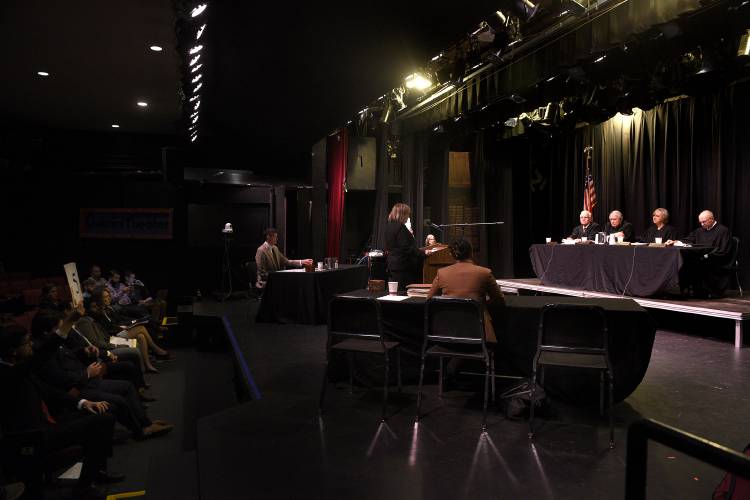
WHITE RIVER JUNCTION — The podium and raised bench on the stage at Hartford High School weren’t props in a student play. On Thursday, the judicial-looking decor was used by the real deal.
Throughout the day, the justices of the Vermont Supreme Court held a trio of hearings in front of high schoolers, faculty and staff. Once an annual event, this is the first time the state’s highest court had held proceedings in one of the state’s high schools since the Covid-19 pandemic.
“I think often whatever we’re talking about, whether it’s the legislative process or the judicial process, feels distant,” said Hartford High Principal Nelson Fogg. “Our students engage in it, but it’s always at a distance. Today it was very present.”
With defendants and prosecutors already seated on stage, a hush fell over the crowd. Clad in back robes, four justices took the stage and commanded a level of respect not always shown to those addressing a large school assembly. Due to a health issue, Associate Justice Nancy Waples attended virtually.
“Please rise for the Vermont Supreme Court justices,” the moderator said.
And all rose.
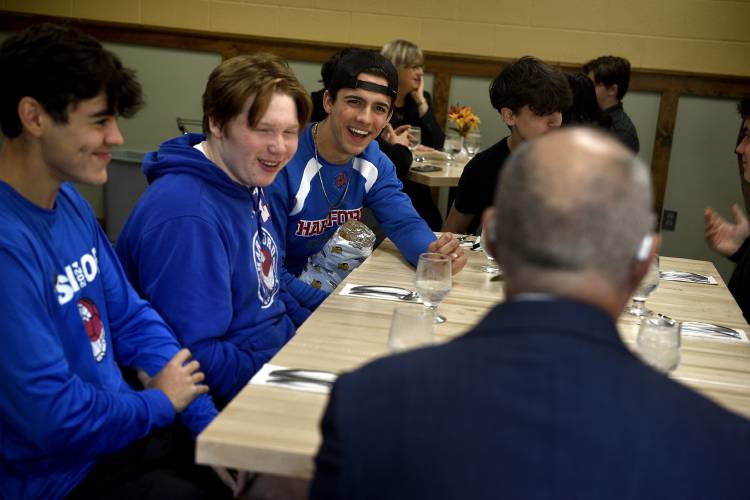
By this point in the day, the students were familiar with the justices. They’d actually just come from lunch with them, at the request of the justices themselves, who shared tables with their student hosts.
The timing for this year’s “On the Road” Vermont Supreme Court hearing, as it’s known, was particularly convenient. The court only just moved back into its Montpelier building since waters from this summer’s flooding breached the electrical and heating systems.
Catherine Bock, 75, of Charlotte, traveled south for the occasion. In the last hearing of the day, her petitioning against the Vermont Public Utilities Commission had come to a head.
Last year, Bock appealed a decision by the commission to allow Vermont Gas Systems — the only natural gas company currently authorized to operate in the state — to sign onto a seven-year contract that would pipe in “renewable natural gas” from New York’s largest landfill, Seneca Meadows in Waterloo, N.Y.
Bacteria breaking down organic waste in the landfill is used to create the methane gas.
Bock appealed the decision on the ground that burning natural gas — even if it’s “renewable” — contributes to greenhouse gas emissions, putting the proposal in conflict with Vermont’s Global Warming Solutions Act, which legally requires the state to cut emissions to 40% below 1990 levels by 2030.
She was represented in Thursday’s hearings by Bristol-based attorney James Dumont.
Cutting emissions takes a long time, Dumont argued, and burning anything that releases greenhouse gases is a step away from a quickly approaching reduction deadline.
“Resources are limited, ratepayer funds are limited, time and energy of regulatory funds are limited, and you might not get one or two bites of the apple,” Dumont said. “If we’re going to spend ratepayer money, let’s do it in a way that’s going to be effective.”
Vermont Gas should instead invest the money into non-emitting heating and energy reduction methods, like insulation and heat pumps, he said.
“But isn’t the utility (under the Global Warming Solutions Act) obligated to do something in order to reduce greenhouse gases, and this is a start?” asked Justice William Cohen.

Matthew Greer, a lawyer with Burlington firm Sheehey, Furlong & Behm, represented Vermont Gas Systems. He argued that renewable natural gas is better than many fossil fuel alternatives.
“One molecule of renewable natural gas supplied under this contract would otherwise be one molecule of fossil fuel gas if (Vermont Gas) didn’t engage in this contract,” Greer said.
The back and forth was perhaps most relevant for the high schoolers in the audience, who will bear the brunt of the impacts of climate change as the planet continues to warm in the decades to come.
But even more immediately, the hearings were a chance for students to get up close to litigation in real-time.
Nathaniel Flockton, 15, is a sophomore, but he’s thinking ahead to college already, tallying up possible career paths and slashing others. He plans to major in mechanical engineering and minor in film studies — but he hasn’t totally ruled out a career in law.
“I find it interesting,” Flockton said. “So it’s good to know, that this is something I could be interested in.”
