




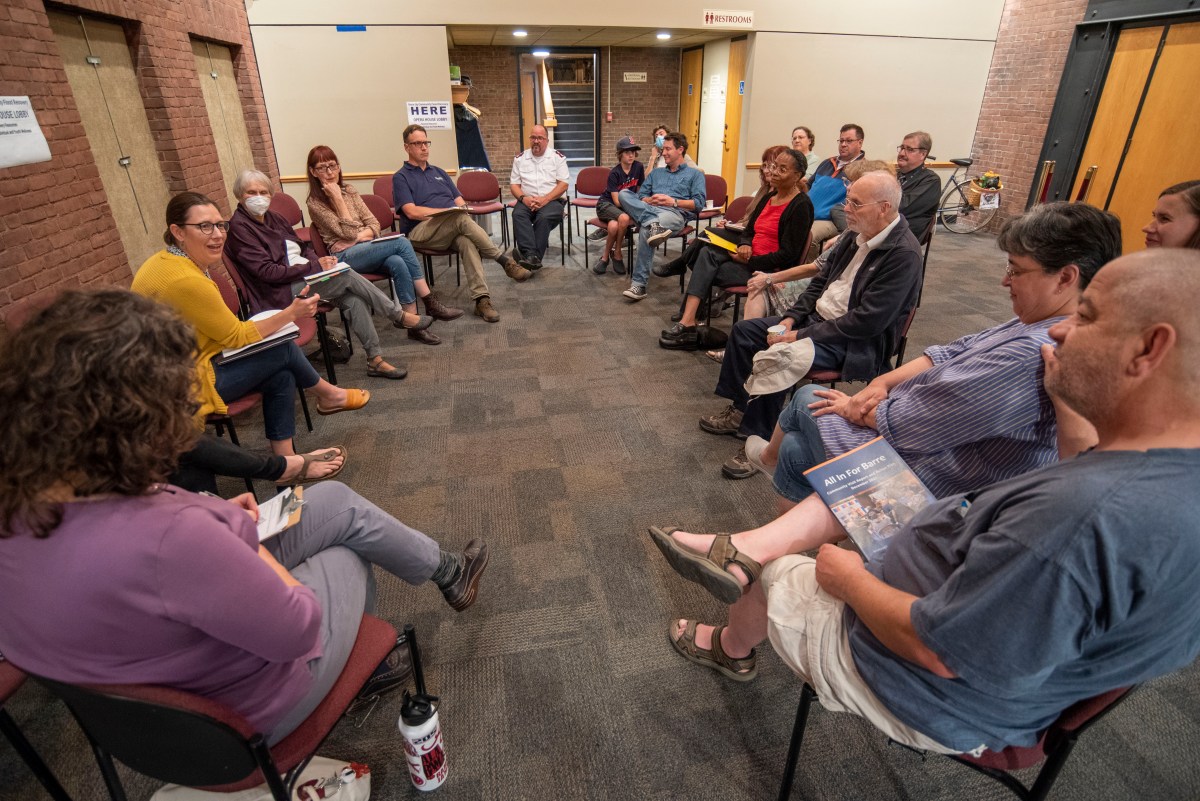
A few dozen Granite City residents, community leaders and officials gathered in the Barre Opera House on Wednesday night to discuss how to rebuild and recover following July’s historic flooding.
At the event, facilitated by the Vermont Council on Rural Development, residents and local leaders often celebrated the city’s volunteer efforts in the days and weeks following the flood — while also acknowledging that the work had, in many ways, only just begun.
“The amazing thing was, seven o’clock Tuesday morning, how many people were out on the street with a shovel — and knew what to do with it as well. It was just incredible,” said Rev. Earl Kooperkamp of the city’s Church of the Good Shepherd. “We really put our muscles and our sweat into it. Now we’re going to use our heads. In some ways, this might be the harder work.”

Though it is Washington County’s most populous municipality, Barre City is geographically quite small: about four square miles. With few places to spread out, the community must now wrestle with how — and whether — to rebuild in areas that will be increasingly prone to flooding. To add to its troubles, Barre also must now contend with a secondary effect of heavy rains: the growing problem of landslides.
“I wasn’t exactly affected by the flood — other than that I have a four-foot sinkhole in my backyard,” Barre resident Chrysta Murray said Wednesday night.

This summer’s natural disaster has wrought devastation, particularly in the city’s working-class north end. But preexisting and longstanding problems plaguing Vermont at large and Barre in particular will make it that much harder for the city and its residents to be made whole. The city, which already had one of the highest poverty rates — and tax rates — in the region, is beginning to feel the financial strain of July’s events. (One resident pointedly complained about a recent hike in the city’s water utility rate.) Labor shortages and the cost of materials, meanwhile, are expected to slow down efforts to rebuild.

But top of mind for the majority of the people who attended on Thursday night: Vermont’s housing crisis. And when Seth Leonard, who facilitated one of the evening’s break-out sessions, asked the audience what, in terms of housing, the city lacked, one man in the crowd offered a simple answer: “Enough.”
In a municipality of about 8,500 residents — which is widely considered one of the last bastions of affordable housing in the region — city officials recently estimated that over 500 housing units have been impacted by the flood. Shawna Trader, the executive director of the Rainbow Bridge Community Center, an LGBTQ+ nonprofit that played a key role in Barre’s volunteer response in the aftermath of the flood, referred to a “Barre diaspora,” and noted that many were now couch surfing with friends and family.
“Community takes care of itself,” she said.
But others are even worse off.
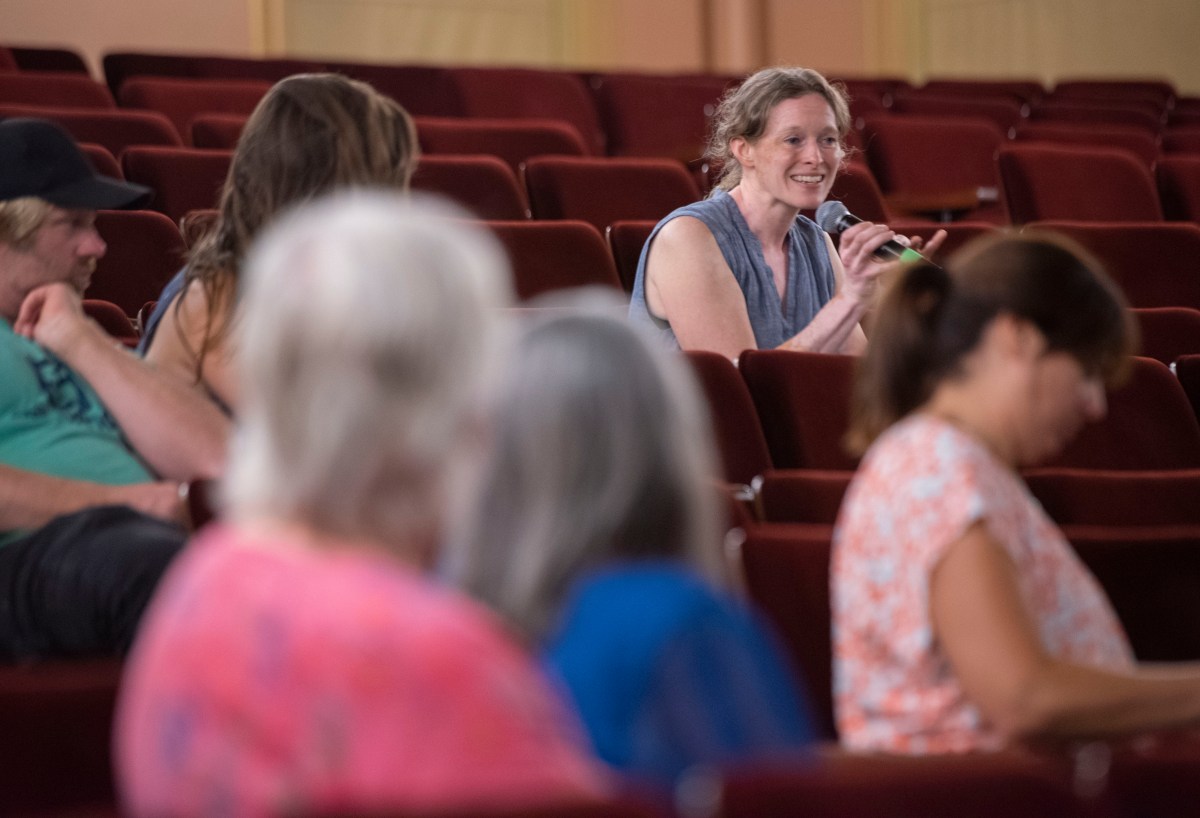
“We had an 80-year-old woman sleeping on our front porch for about a week around Labor Day — and had nowhere to send her,” said Rev. Rae Fraumann of the city’s Hedding United Methodist Church. Nevermind affordable housing, Vermont doesn’t even have enough emergency shelter for those in need, they said. And some people have nowhere to fall back on, they said, including many who are “Vermont born and bred.”
“Are we going to ask them to leave the state so that they can find safe housing? Is this going to be the answer to the question? You need to move out?” Fraumann said. “You need to leave behind the community you grew up in — because we can’t provide affordable housing for people who’ve lived here for generations?”

Fraumann added that the church hadn’t been able to take in the elderly woman sheltering on its porch because it had already taken in a family with three children. That family had been seeking housing for roughly a year.
A little over half of Barre’s households rent their homes — much higher than the state average of just shy of 30%. And a number of people on Wednesday night also called for tighter regulations on landlords. One woman, who declined to give her name to a reporter but said she worked in emergency housing in the area, referred to an unnamed property management company that “owns half the town” that she said was steadily increasing people’s rent. And state grants that are helping landlords build new units, she noted, don’t require rentals to remain affordable in perpetuity.
“We’re talking about building new houses and increasing the housing stock in this area, but we’re not talking about protecting that housing and making sure it stays affordable,” she said.
The Vermont Council on Rural Development is planning a follow-up community conversation on Oct. 18, also at the Opera House.
Correction: Amanda Gustin was misidentified in a photo caption, and, due to an editing error, Shawna Trader’s name was briefly misspelled.
