


This story, by Corey McDonald, was published by the Stowe Reporter on Aug. 31. An earlier version was published by the Shelburne News on June 8.
Jim Westphalen is up on a wintery Saturday morning, driving through Sheldon, Vermont to photograph an old 19th-century cow barn — all that’s left of a once thriving farmland built along the old Missisiquoi railroad line that was destroyed by a fire.
The camera pans over him setting his tripod up in the middle of a snowy expanse to capture a still image of the weather-worn building. In the freezing cold, he takes as much time gazing at the structure than he does staring through his camera lens.
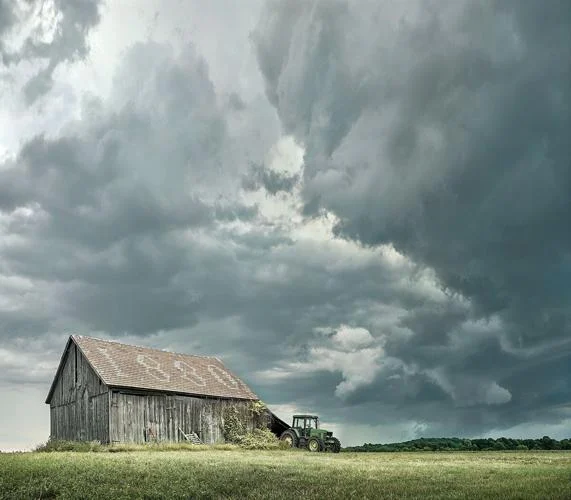
This is what Westphalen has been doing for the past four years now: driving endlessly to find the old prairie churches, the paint-peeled barns, the old ranch homes with sagging porches and concaving, weather-battered roofs, and the one room schoolhouses.
“It’s impossible not to see the beauty in decay,” he said.
Now, in his first foray into filmmaking, Jim Westphalen, a Shelburne resident since 1996, has taken what began as a curiosity — photographing those old rural structures just off in the distance — and turned it into a call to action.
His film — “Vanish: Disappearing Icons of a Rural America” — chronicles his journey of discovery and reportage on the slow decay of America’s history. Part wistful, part sobering reflection of the country’s rural past, it features beautiful, wide-angle shots of rolling clouds over expansive landscapes, of wintery landscapes and thunderstorms off in the distance.

A former commercial photographer by trade, Westphalen began seeing “a disturbing trend” as his curiosity grew — the long-forgotten structures of time gone by. So, he set out to document these places — first through the still images of his camera, and then, as the vision for his self-funded documentary evolved, through stories of the families who once lived on these properties.
He hopes it serves as a call to identify and preserve these places, and to preserve local history.
“I loosely started documenting them not really intentionally knowing that, okay, this is a body of work that I’m going to make into an entity in and of itself,” he said. “But as the body of work grew, I realized that there was a mission statement here, and there was a mission in general.”
‘That’s our rural heritage’
There were only a handful of run-ins with the police during the making of the film, Westphalen says — with at least one caught on camera. It was something he had to prepare for, since what he often found himself doing was technically trespassing.
Whatever it took to get him a great shot — or, he said, one step closer to interviewing the people who could give him a glimpse into the history behind the old structure.
Westphalen’s documentary was originally supposed to be short — 20 minutes to a half an hour, he said, “but I kept on gathering more and more stories and things that I felt like I’ve got to include.”
It features several interviews with current and former property owners throughout the state — the Glendale Farm in Cornwall; the Mansfield Valley Poultry Farm in Stowe; and the Myrick Farm in Bridport, for example — each sharing stories of the life and spirit that surrounded and filled the properties.
The documentary “reminds us that we’re living in a dynamic landscape and there are buildings that are here for a generation or generations which are no longer here and provide a sense of the bones in the landscape,” Thomas Denenberg, the director of the Shelburne Museum, said in the film. “This idea has a kind of ghost-like quality — we know there was a building there and know it’s gone (or) we know there’s a building that has a potential to be gone. It reminds me of the small town I grew up in (where) people always used to say ‘Oh, you make a right turn where the barn used to be.’“
It’s hard not to feel dispirited through the film. Westphalen admits that there’s “this sadness I feel — not only for yet another piece of American history that gave way to time, but for the people themselves, the people and families that built their lives around these structures, for their hopes and for their dreams.”
“I’d shake my head and wonder — am I the only one who cares about this?” he says in the film.
The film, in part, shows the decimation of the economic viability of local farming in the state and country. In 1969, there were more than 4,000 dairy farms in Vermont. Now there are less than 600.
“These small family farms are sadly becoming a thing of the past,” Westphalen says in the documentary. “The simple fact is either they have to figure out innovative ways to compete with the big guys, or abandon what might have been generations of farming.”
But it also features hopeful efforts to preserve this history — including the rehabilitation work of the Hathorne School in Bridport, part of the land purchased by Erin Connor and her family, who then worked thousands of hours to restore the historical site first built in the 1860’s, as well as the relocation of New Haven’s historic train depot.
In April, the Middlebury Town Hall Theater and Edgewater Gallery hosted the Vermont premier of the film, playing to a sold-out house.
A second showing was added for June 17, the film was selected for the Middlebury New Filmmakers Film Festival set for Aug. 23 through Aug. 27 — and now, the film will screen at the Stowe Cinema on Sept. 2, running in tandem with his solo exhibition the same week at the Robert Paul Galleries.
His film “is not only a call to action to preserve (these buildings), but for people to kind of sit up and take notice for what we have right now. Because it’s not going to be here long.”
“That’s our history, and that’s our rural heritage as Americans, in Vermont and across the country,” he said. “Once we lose that history — some of that is recorded, but it’s the local stuff that you lose, and the local stuff that nobody will know was ever there.
“You’ll just see an empty field and not even wonder what was there.”
Jim Westphalen’s documentary, “Vanish: Disappearing Icons of a Rural America,” will screen Sept. 2 at 6 p.m. at the Stowe Cinema 3Plex, with a filmmaker Q&A to follow. A reception following the film will be held at the Robert Paul Galleries, where Westphalen’s solo exhibition, “Vanish,” is up for the month with more than 20 works on display.
