


Nearly all of Vermont’s hospitals are seeking double-digit percentage increases in income from patient services for 2024 over 2022, setting the stage for a likely battle with health care regulators.
Hospital representatives and patient advocates told the Green Mountain Care Board on Wednesday that its budget decisions this year would have a profound impact on both groups.
For members of the state board, those are refrains heard regularly at the outset of its annual public review of revenue, expenses and healthcare prices for Vermont’s 14 non-federal hospitals. This year, as in the past two years, it is certainly true.
Mike Del Trecco, head of the Vermont Association of Hospitals and Health Systems, said the 2024 fiscal year budgets submitted for approval were carefully crafted to include only what hospitals need to meet an unprecedented combination of challenges.
“These budgets are about supporting our organizations so they’re here for Vermonters today and well into the future,” Del Trecco said.
The majority of hospitals are projecting revenue growth from patient services in the coming year that far exceeds the benchmark set by the board, which the hospital association tried in vain earlier this year to change. The hospitals said the board’s two-year, 8.6% revenue growth target was unrealistic in the post-Covid-19 pandemic environment.
As a group, the hospitals ended 2022 with more than $60 million in operating losses, and “those challenges have trickled into 2023,” Del Trecco said in opening remarks.
The difficulties include high inflation in the cost of materials, particularly pharmaceuticals, and labor costs due to ongoing local shortages of nurses and other staff, Del Trecco said. He also cited “mental health and long-term care systems that are broken,” leading to long and costly delays in transferring patients from the hospital to those settings.
The proposed two-year growth in patient-related income ranges from a low of 7.2% at Gifford Medical Center to a high of 28.4% at Porter Hospital. The state’s largest hospital, the University of Vermont Medical Center, is anticipating the need for a 23.8% hike.
For Gifford, that means a jump in operational revenue from around $58 million in fiscal year 2022 to just under $62.2 million projected for fiscal year 2024, almost $4.2 million. For Porter, the difference is a roughly $28 million increase. For UVMMC, the corresponding dollar figure increase in projected income is from around $1.49 billion in 2022 to around $1.85 billion in 2024, a difference of over $356 million.
The hospitals’ 2024 fiscal year begins Oct. 1 of this year, and board decisions must be made by mid-September. The Green Mountain Care Board will hold public hearings over the next two weeks and is accepting public comment on the 2024 budgets through Aug. 25 at noon.
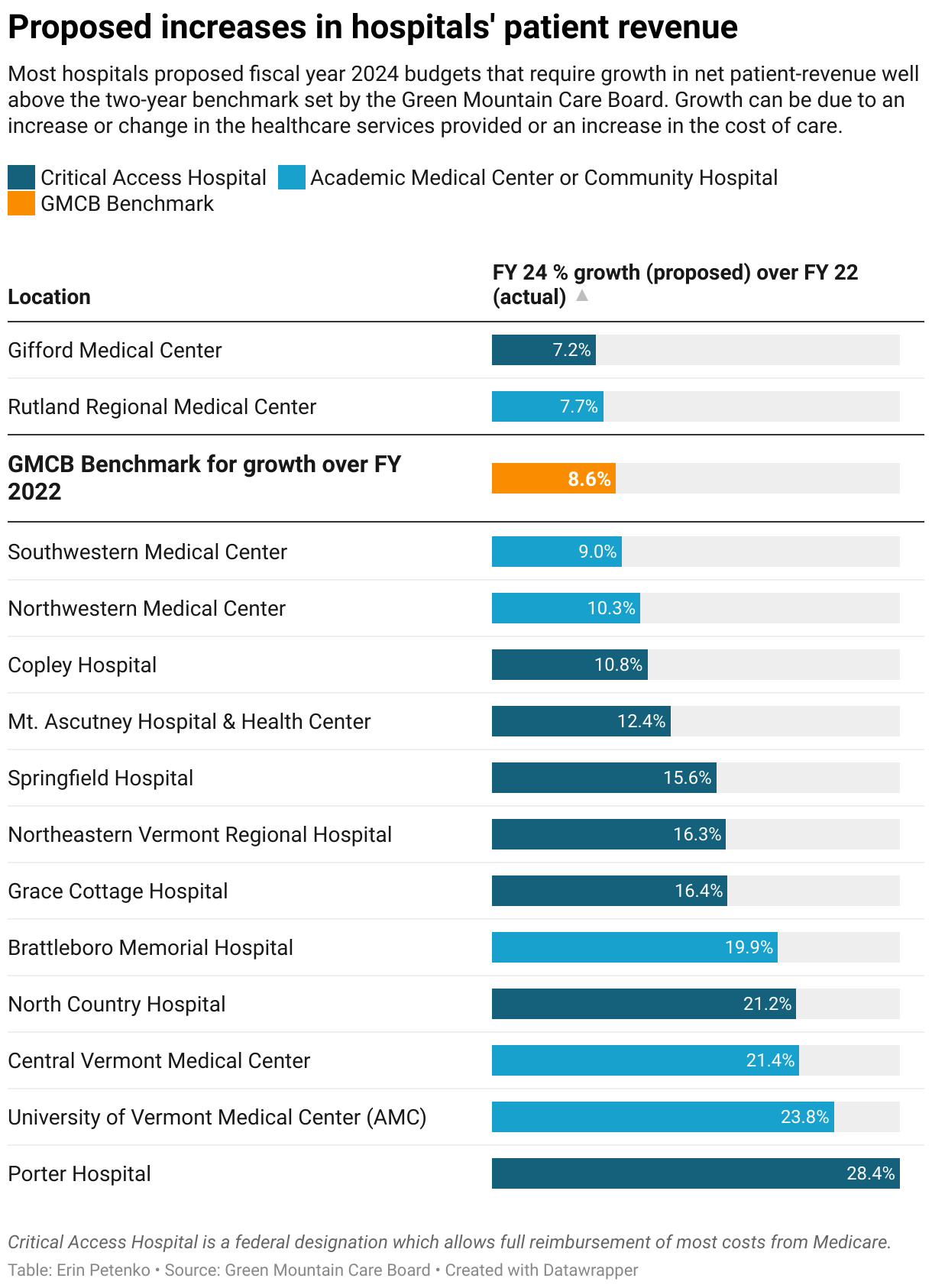
All but two hospitals submitted patient service income projections that exceeded the board’s benchmark. Growth in operational revenue can come from a combination of increasing volume, adding new patient services or additional providers and from increasing the cost of those services.
What portion of the growth is related to what factor differs greatly from hospital to hospital and discussing those factors is a primary focus of the hearings.
For example, at Brattleboro Memorial Hospital’s public hearing held Wednesday, its chief financial officer, Jennifer Griffey, explained that the 2022 revenue was unusually low. The number reflects a loss of income from having to close an operating room during the Covid-19 Omicron variant surge due to staff illness. The projected percentage increase in patient revenue in 2024 compared to a more normal year would likely have been much smaller, she said.
However, of the three hospitals showing the greatest increases — all members of the University of Vermont Health Network — two, the University of Vermont Medical Center and Central Vermont Medical Center, have also proposed double-digit increases in the price of services to commercial insurers to boost income.
On the consumer side, the last several years have brought extreme increases in the cost of health insurance, which have made higher quality plans unaffordable for many Vermonters, said Mike Fisher, who leads the Office of the Health Care Advocate at Vermont Legal Aid.
“We all know that we need strong hospitals in our communities,” Fisher said in his opening remarks to the care board. “A great, high quality local community hospital means little to me if I don’t think I can afford to go.”
As a result of the higher premiums, some people go without insurance, but more frequently they are forced to purchase plans that require higher deductibles and copayments, which cause people to delay or forgo needed treatment, he said. That trend is clear both in the results of health insurance surveys performed by the Vermont Department of Health, and in the increase in calls to the Vermont Legal Aid offices, he said later.
“We hear clearly from Vermonters that they choose not to follow medical advice because they have to make an economic decision, not a healthcare decision,” said Fisher.
A significant factor in those insurance rate hikes — “maybe the most significant factor” — are the hospital service price increases that the Green Mountain Care Board has continuously approved, he said.
Although the tensions facing board members as they consider the hospital’s proposals are similar to previous years, there are several important differences.
First, new appointments to the board in 2021 and 2022 have created a majority that appears willing to take more aggressive regulatory action. In fact, the board has already signaled in recent insurance rate decisions that it anticipates cutting hospital commercial charges in half.
Second, even before its membership changed, the board and its staff were working to alter its methods for evaluating and regulating hospital budgets.
Some of those changes involved securing greater financial resources in the state’s budget for the board to hire analysts capable of bringing national and regional comparisons to bear during the review. Those improvements are going into effect this year and next. Additionally, the budget of the Brattleboro Retreat is also newly subject to review, though later in the year.
However, a more significant shift would likely require legislative approval that has not yet been forthcoming.
In the last legislative session, the board sought backing for a broader purview that would allow it to regulate the full range of hospital operations, and allow it to take a greater role in planning and retaining a statewide distribution of healthcare resources. The Senate approved the change, but the House would only approve a study of the concept.
In the meantime, both new board members — Owen Foster, the board chair, and Dave Murman, an emergency room doctor at Central Vermont Medical Center — asked the advocates what they thought the board should do in the case of hospital managers who, year after year, report higher operational expenses than their national and regional peers.
The hospital association’s Del Trecco suggested the board should approve the needed revenue increase, but work with hospital executives to create a plan for long-term expense growth containment.
Unsurprisingly, the consumer health care advocate had a different point of view.
“The board’s role in our view is to put real pressure on hospitals to say, ‘I’m sorry, the pressures on the community, the pressures on costs, are too much,’” Fisher said.
