

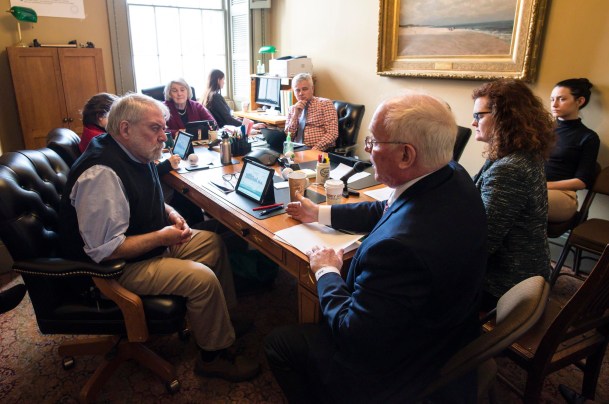
Members of the Green Mountain Care Board had one goal for this year’s legislative session. The five-member body regulates hospital growth, but it sought the power to set entire hospital budgets.
The care board argued that setting budgets with an eye toward the overall needs of the state would protect everyone, including hospitals, from financial ruin. The Vermont Senate agreed, but House members said the Agency of Human Services, not the Green Mountain Care Board, should set the direction for Vermont’s health care reform efforts.
The two chambers found a compromise this week. S.285 gives the Green Mountain Care Board more than $4 million to come up with a “patient-focused, community-inclusive plan” for setting hospital budgets. The bill also directs the Agency of Human Services and the care board to work together on a new proposal that may, but not necessarily, include the budget-setting authority the board wanted.
There’s only one problem with the bill: It does nothing to deal with Vermont’s soaring health care costs, at least not in the short term. The transformation of S.285 is a symptom of a larger problem with Vermont’s health policy.
“There doesn’t seem to be any leadership from the executive branch,” Bill Schubart, former UVM Medical Center board chair and occasional VTDigger columnist, told the Green Mountain Care Board last week.
Health care policy in Vermont is whatever emerges from that vacuum, it seems. In the case of S.285, regulators at the Green Mountain Care Board got the blessing of legislators a couple of years back to assess the financial health and longevity of hospitals in Vermont. The result of that effort was a February 2022 report that concluded Vermont’s hospitals are growing faster than payers, insurers and the state can accommodate.
S.285 would have filled the void by letting regulators outside of the Scott administration have the power to set the course of health care policy in Vermont. Not surprisingly, hospitals did not like the idea.
Devon Green, lobbyist for the Vermont Association of Hospitals and Health Systems, argued that the board’s proposal amounted to rationing that would have intensified the mass exodus of health care workers from the field for fear of losing their jobs. Hospitals are already struggling and cannot afford to change how they operate without significant financial support.
That’s how S.285 came to include provisions that spell out that hospitals must be involved in studying options for controlling their own budgets. Rep. Anne Donahue, R-Northfield, alluded to reassuring an executive in her district that hospitals will have a chance to offer input on the plan.
Donahue acknowledged that S.285 is a first step on the issue of hospital budgets.
“We’re not putting decision-making yet in terms of the results” of the Green Mountain Care Board engagement study, she said. “But we need to start it faster.”
Lawmakers plan to adjourn later this week, and S.285 is on its way to the governor’s desk. This summer, hospitals and regulators will again begin the annual budget process.
In short: Same song and dance, but this time with funds earmarked for a brand-new report.
