


On the night of July 10, as rain fell and rivers rose across Vermont, state officials got a false alarm that the Marshfield Dam had partially collapsed.
They called the dam’s owner, Green Mountain Power, which inspected the facility and found nothing wrong. State and the utility leaders said they had not identified the source of the alarm, but by all accounts, the dam functioned perfectly during the historic flooding and is in no imminent danger of failure.
But the episode appears to underscore a longstanding anxiety over the safety of the dam — a sentiment especially present in the downstream town of Plainfield.
For years, some Plainfield officials have believed that the dam is simply not safe enough. Officials have pushed Green Mountain Power to make structural renovations, improve planning for emergency floods downstream and be generally more forthcoming about the dam’s condition.
Town leaders are also seeking more expansive legal reform around dam oversight — actions, they say, that are necessary for the safety of those living downstream.
“Let me put it this way,” Bram Towbin, a member and former chair of Plainfield’s selectboard, said in describing the dam. “Do I think that the regulatory regime in place now assures its safety? No, I don’t.”
From the perspective of Green Mountain Power, which operates about 40 hydroelectric dams across the state, the Marshfield facility is completely safe, and any concerns are unfounded. The utility says, too, that it has always tried to maintain communication with Plainfield officials.
During the flooding last month, “the dam performed amazing,” said Kristin Carlson, a spokesperson for Green Mountain Power. “So like, I don't even know how anyone could even have any issue with the dam right now.”
But amid a summer of record rainfall — a phenomenon experts say is linked to climate change — the disagreement raises questions: Who should be responsible for ensuring the safety of Vermont’s dams, which play a critical role in flood prevention? And who gets to decide how safe is safe enough?
A nearly century-old dam
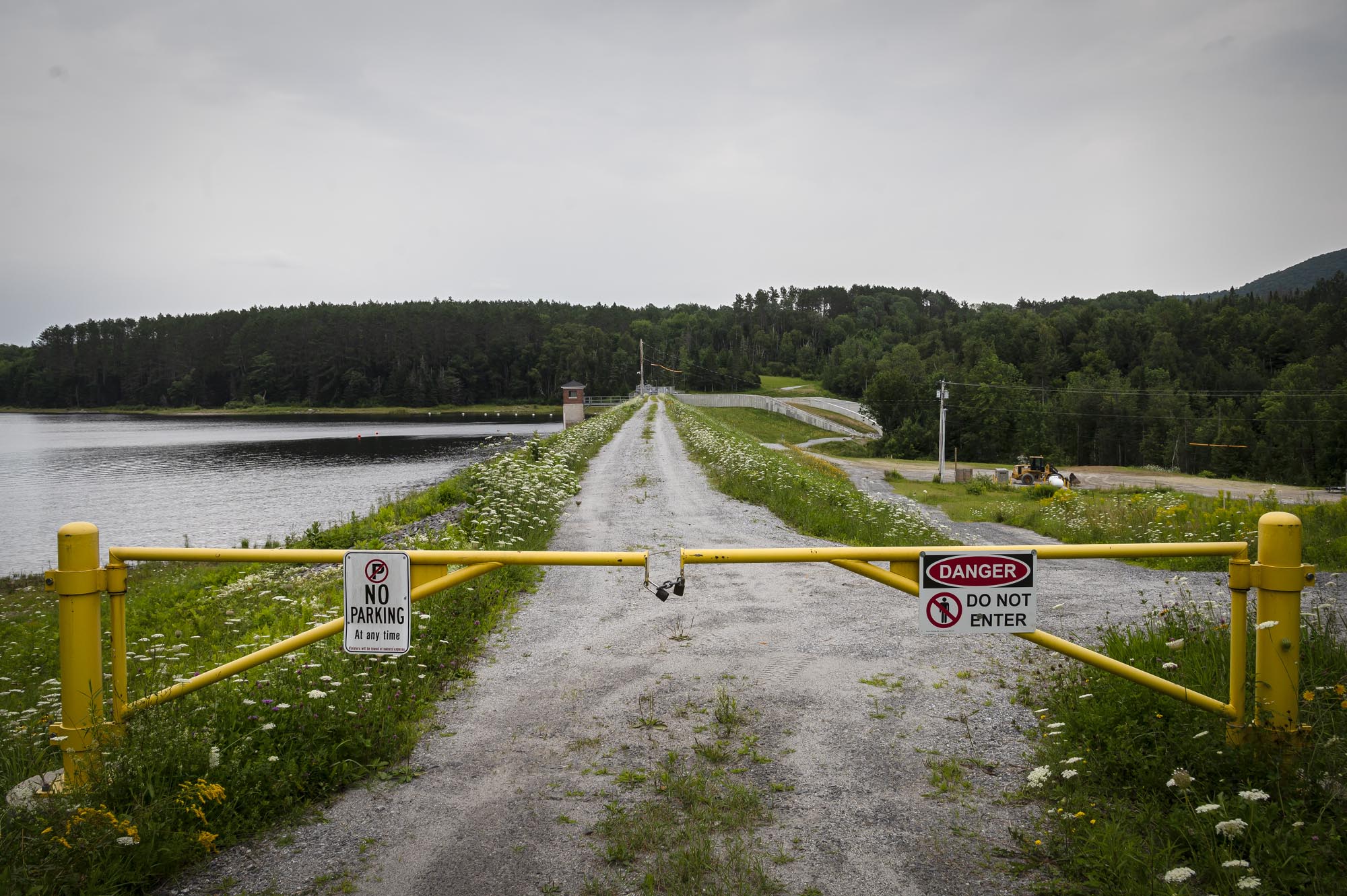
The Marshfield Dam, technically located in Cabot, holds back the roughly 400-acre Marshfield Reservoir, also known as Molly’s Falls Pond, a state park.
Water from the reservoir flows through the dam into Molly’s Brook, which joins the Winooski River in Marshfield, roughly 2.5 miles downstream, before continuing on to Plainfield. The hydroelectric facility generates roughly 6,000 megawatt hours of electricity annually — enough to power about 1,000 homes, according to Carlson.

In February 2018, Michael Billingsley, Plainfield’s emergency management director, petitioned the Vermont Public Utility Commission to investigate concerns with the nearly century-old dam.
“This 1927-built dam is showing serious signs of age,” Billingsley wrote. “I have openly questioned (Green Mountain Power’s) rather glib assurances that everything is o.k. and no problems need to be immediately addressed.”
An inspection report completed later that year found that the dam was experiencing a slate of problems: Water was seeping out at the base of the dam, an underground conduit was leaking and the main spillway gate wanted upgrading.
Craig Findlay, a certified engineer who conducted that inspection of the Marshfield Dam for the utility, set forth a series of recommendations for improving the dam’s condition — all of which Green Mountain Power completed over the next few years, he said.
“There were a lot of things that needed to be addressed,” Findlay said. “And you know, Green Mountain Power was really good about it.”
Green Mountain Power administrators said that the construction had been planned for years and had nothing to do with Plainfield’s requests.
“There's been work happening at Marshfield for decades, as with all of our dams and facilities,” Josh Castonguay, who leads Green Mountain Power’s engineering and generation teams, said in an interview.
‘They’re right to be concerned’
But in Plainfield, Billingsley believes that one piece of the dam still needs work: the emergency spillway, a chute used to release water during an emergency. That spillway has a type of gate that, when opened, cannot be closed again until water recedes.
In an extreme rain event, he fears that the gate — a “terrible, frightening design” — could cause catastrophic flooding downstream.
“I come from a family of engineers, and although I'm not an engineer, I have studied engineering informally and I'm self-taught in a lot of areas,” Billingsley said in an interview. “I've interfaced with professionals and basically became knowledgeable enough to discuss matters with professionals.”
Findlay, the engineer, said such systems are in fact a common feature in dams. After multiple visits to the Marshfield Dam during the renovation process, he said, the structure is “well up to snuff now.” But he said he understands the concern of Plainfield residents.
“Anytime somebody in a town lives downstream of a dam, I mean, they’re right to be concerned,” he said. “And they ought to be aware of what's going on. So I've got no arguments with them.”
Plainfield officials also believe that Green Mountain Power’s plans in case of an emergency are inadequate. Dam owners are required to draw up such plans, which should include flood maps and procedures for alerting residents in the case of different scenarios.
But Billingsley believes the utility’s plans for the Marshfield Dam are insufficient. The flood maps are “blurry” and “lacking in resolution,” he said. And Plainfield officials believe that the utility should play a greater role in helping devise evacuation procedures in case of disastrous flooding.
Currently, that responsibility falls on emergency management agencies, according to the Emergency Action Plan.

Carlson, the Green Mountain Power spokesperson, meanwhile, says that the utility followed federal guidelines in drafting the Marshfield Dam’s “robust” emergency plan. Administrators there contend that they have a long-standing offer to all towns to discuss concerns with those emergency plans.
“We tell anybody, at any time — whether it's during an event like this or not — (we’re) happy to come in, sit down and talk through and look at the plan, talk through any questions,” said Castonguay, the Green Mountain Power administrator, referring to last month’s flooding.
Green Mountain Power also noted that not all downstream towns are worried about the dam. In Marshfield, which sits even closer to the Marshfield Dam — that is, upriver from Plainfield — officials said they had no concerns about Green Mountain Power’s management.
“I have not felt anxiety myself in regards to the dam,” said Justin Campbell, Marshfield’s emergency management director and a selectboard member. “I actually feel very confident in the management of the dam.”
‘Not an ideal situation’
Still, some downstream residents want greater changes to Vermont’s dam oversight.
The state’s dams are owned, operated and inspected by a patchwork of different entities. Many fall under the jurisdiction of the Vermont Agency of Natural Resources’ Dam Safety Program, which conducts inspections at most every other year.
The Marshfield Dam — along with other dams owned by Green Mountain Power — is under the purview of the Public Utilities Commission. Under the commission’s rules, dams need only be inspected at most every five years, and dam owners are responsible for hiring outside inspectors.
“I think most engineers who do this work perform it to their level of adequacy, regardless of who their client is,” said Rep. Marc Mihaly, D-East Calais. “But it's not ideal. I mean, you're essentially asking everybody to self-regulate, and that's not an ideal situation.”

Mihaly, who represents Marshfield and Plainfield, said he is considering whether to propose legislation to consolidate dam safety oversight into the Agency of Natural Resources in an attempt to standardize and tighten dam safety regulations.
Green Mountain Power said it uses federally certified inspectors, who must follow certain rules to avoid conflicts of interest. The utility also monitors and inspects the dam more frequently than every five years, administrators said.
Concerns about the Marshfield Dam’s safety now are “really flummoxing to me,” Carlson said. During last month’s flooding, she said, “the dam just did what it was supposed to do.”
But Green Mountain Power is not necessarily opposed to changes to the inspection regimen, the utility’s representatives said.
“We meet really strict guidelines, or exceed them, for our inspections,” said Castonguay, of Green Mountain Power. “So that's going to be what's important to us. I mean, obviously, we would want to see whatever was being proposed.”
Towbin, the Plainfield selectboard member, said he did not want to imply that anyone was engaged in wrongdoing. He just wants Green Mountain Power to be more beholden to those who could be impacted by the failure of their infrastructure, he said.
“Look, here's what I'm for, and I really want to stress this,” Towbin said. “I want a process whereby the people most affected by the problem have a say in what the regulation is.”
