


Montpelier business owners are asking the state to provide funding, guidance and planning to respond to the city’s devastating floods.
At a press conference Friday, Shannon Bates, owner of Enna, a deli on State Street, said that capital city business owners are facing roughly $20 million in losses, based on an initial survey from the Central Vermont Development Corporation.
“The financial impact of this disaster has been profound,” Bates said. She said the development corporation estimated an average of $186,000 in losses for each of the more than 100 businesses that have been affected by flooding in Montpelier.
At a separate press conference one hour later, the Agency of Commerce and Community Development announced a “Business Restart Gap Assistance Program,” which would provide $20 million in grants to businesses across the state.
The details of the program will be announced next week, said Commerce Secretary Lindsay Kurrle. It is expected to cover losses to businesses’ physical space and the replacement of inventory and equipment.
Kurrle acknowledged to reporters that the money will only go so far. “We know that this will not make our business owners whole,” she said.
“This is absolutely intended to be an emergency bridge funding that will hopefully enable business owners to begin the process,” the secretary continued.
The Federal Emergency Management Agency provides grants to homeowners and renters for certain losses experienced in the eight counties in Vermont under a major disaster declaration. But for businesses, the only federal aid available is a loan from the Small Business Association.
Bates said that would not be enough.
“Although the 30-year loans are interest-free for the first year, the rates can be as high as 8% for the remaining 29 years,” she said. “Taking on loans is not an option for many businesses, some of whom are still paying off loans from Covid.”
Only a small percentage of Montpelier businesses had flood insurance, due to the “high cost” of that coverage, Bates said.
Most businesses affected by the flooding have been stripped to their subfloor and studs, meaning that they will need to be completely rebuilt, a process that could take months, Bates continued. The loss of income could have a “major impact.”
The North Branch Cafe has reopened for online orders, but even it is losing income, said owner Lauren Parker. She said the restaurant can’t cover payroll with its current daily earnings.
“I don’t want to lose the staff because we are going to be open and we do need staff,” she said. “So we’re continuing to work our schedule, but it’s a complete loss financially from that standpoint.”
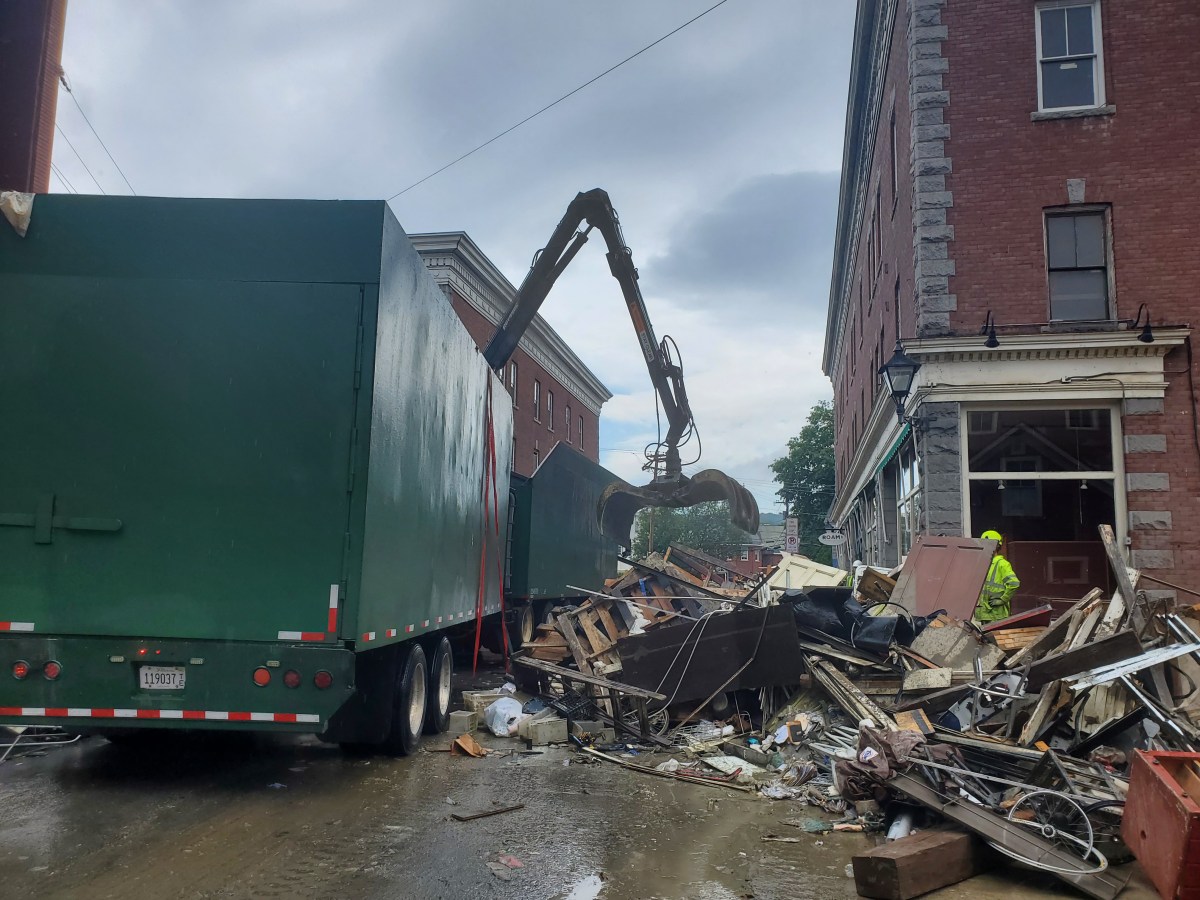
Cleanup efforts are ongoing in Montpelier, with city employees and state-provided contractors helping to remove debris piled up on sidewalks. At one point, the business owners’ press conference came to a halt to allow a debris removal truck, called a knuckleboom, to pass by. The sounds of drills and trucks backing up rang through the city streets, which remain closed to everyday traffic.
Kurrle’s announcement was met with optimism — and some skepticism — in Montpelier. State Rep. Conor Casey, D-Montpelier, said it was welcome news, but he wasn’t sure if it would be adequate when all the costs to businesses statewide were tallied up.
Beyond funding, business owners also said they were struggling to make sense of public health and regulatory guidance on remediation for damaged properties and merchandise.
“The rumor mill has been our primary resource for how to clean and rebuild our shops,” said Jen Roberts, owner of Onion River Outdoors on Langdon Street. “We have heard varied advice, but what we do not have from our state government (is) what specific protocols and best practices we should follow to clean out and decontaminate our shops.”
She said building owners needed guidance on how to handle flood-damaged and flood-contaminated structures to prevent mold and rot, and how to do it right “the first time.”
“We cannot afford to go back in later to replace floors,” Roberts said.
She asked that the state do outreach to business owners on remediation guidance, including for those whose first language is not English.
Parker said she’d heard varied information about whether the Department of Health needs to do an inspection before she can fully reopen. She added that many businesses initially thought they could still use their refrigerators after sanitizing them, only to hear from another source that they had to be tossed because the lining inside the fridge could not be disinfected.
In an email, health department spokesperson Ben Truman said that businesses should reach out to their local health inspector or contact the department’s Food and Lodging Program to find out if they need an inspection.
Casey added that he would like to see a “state presence” on the ground in Montpelier in the next few weeks. “A natural disaster is a regional issue, right? If it’s regional, the state does have a role to step in,” he said.
Business owners have another concern: “that this is gonna happen again,” Roberts said.
Climate change has made flooding more likely, turning 100-year floods into regular events, Parker said. “It is scary to hear that many businesses in town cannot commit to reopening because they fear the next flood could be imminent and potentially worse,” she said.
She said business owners needed to know that state and federal agencies and the Legislature are working on a plan to reduce the likelihood of severe flooding in the future.
A large portion of Montpelier is located in the FEMA Special Flood Hazard Area. The city has experienced previous floods, the largest of which occurred in 1927, while floods in 1992 and 2011 caused lesser but still significant damage downtown.
“We need the state to commit to finding modern ways to manage water flow to keep our towns and cities safe from this devastation,” Parker said.
