


BARRE — The cities of Montpelier, Vermont’s capital, and Barre, just to its south, will always be linked.
Barre City Manager Nicolas Storellicasto called his city the “scrappy younger brother,” despite the fact that Barre is larger in population.
“We’re a couple miles away, but worlds apart,” Storellicastro said in an interview in Barre on Wednesday.
Barre’s self-proclaimed “scrappy” reputation has added to the sense that disaster response in the capital has overshadowed the devastation experienced in the Granite City.
One of the first noticeable differences, some say, is the volunteer response.
In Montpelier on Wednesday, volunteers cleaning out businesses in the downtown area often worked in teams, many with matching T-shirts. Some came from companies that paid their employees to be there.
Organizers coordinated and assigned people who showed up to help from a cluster of about a dozen tents on Main Street. There were portable toilets, personal protective equipment, hand-washing stations, cleaning supplies, a “tool library,” food trucks and printed guides to help inform people of the work required. Helpers piled debris from downtown stores into the streets and sidewalks.

A volunteer coordinator from the city, Leila Faulstich-Hon, said between 200 and 300 volunteers arrived in Montpelier each day this week. Over last weekend, that number was closer to 500 per day, she said. By Wednesday, most businesses had finished cleaning out debris and some had even asked for help to start rebuilding.
Those scenes stood in contrast to Barre, where volunteers said the number of people helping was nowhere near as high. After a few hundred people turned up in Barre to help last weekend, the numbers have dropped off to a few dozen, according to one volunteer coordinator, Amanda Gustin.
The differences in the response, though, run deeper than hand-washing stations and are tied to where the flood landed its hardest punch on each town.
Much of the most concentrated damage was centered in North Barre, largely residential and relatively low-income. While both cities experienced widespread damage to homes and businesses, in Barre the early damage assessments indicate that residences, particularly the old-stock housing of North Barre, bore the brunt of the water and mud.
“It’s just a different nature of problem,” said Gustin, a Barre resident who has worked to coordinate volunteers in the city. She described how volunteers need to go house-to-house in neighborhoods still reeling and dealing with mud.
“It’s different from saying, ‘Go downtown, you’ll find someone clearing out their store, have at it,’ and saying, ‘This homeowner needs help doing this specific thing that we have to task out.’ And that’s just a lot,” Gustin said.
First Street
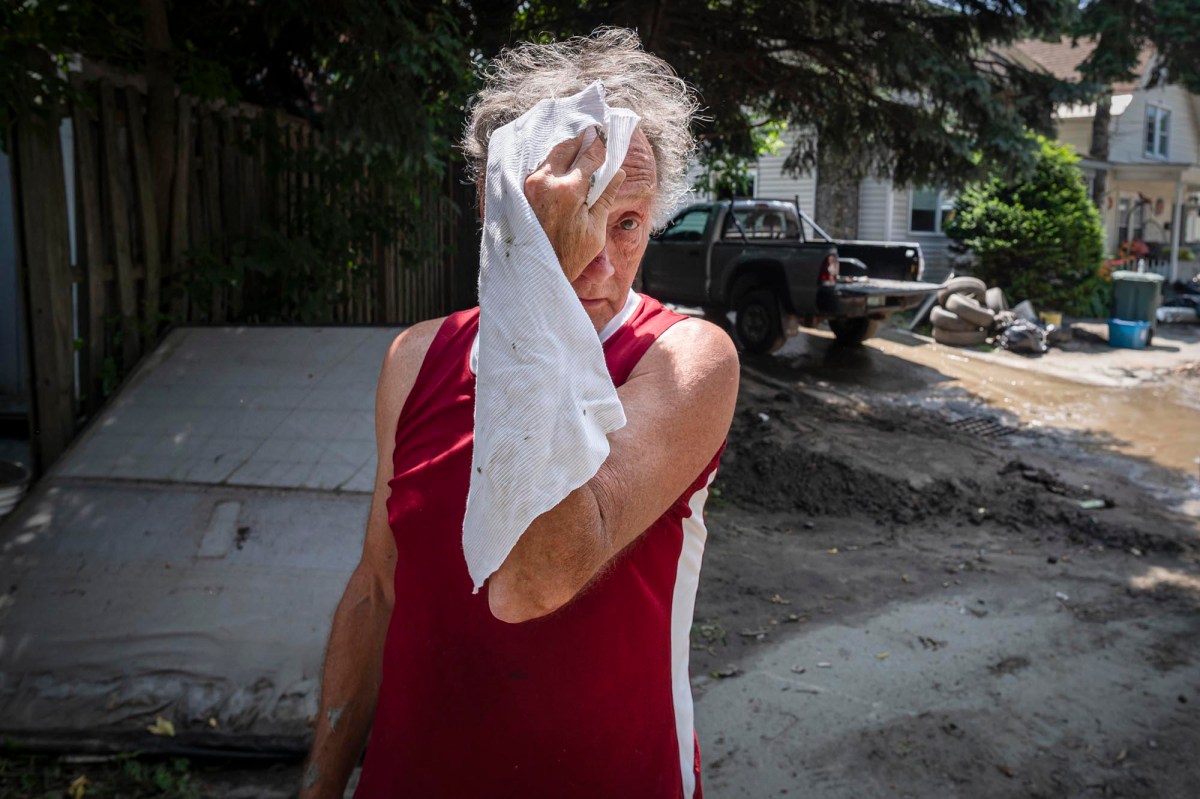
First Street is a short dead-end residential neighborhood in Barre’s north end. On Wednesday afternoon, dust hung in the air while homeowners hosed off belongings, emptied basements and carried buckets of mud to the curb.
The housing in this area of the city is mostly older buildings and a mix of apartments and single-family homes. Every building on First Street was hit by floodwaters on July 10, the Monday that the state was struck.
Piles of debris collected in front of each building along with mud and ruined cars. Water was still being pumped out. The Red Cross pulled into the street, offering free lunches over a loudspeaker.
Jacki McCarty purchased her home on First Street last year, her first time owning a home. Wearing mud boots and looking tired, she and a friend took a break from carrying buckets of mud out of her garage to speak with VTDigger on her porch.
On the first day of flooding, McCarty watched the water rise, first on North Main Street, which eventually turned into rapids. But she was surprised when the water ended up arriving on First Street flowing from the opposite direction, from Beckley Street.
Like all the houses on the street, the water filled McCarty’s basement. It rose until she could see it just at the level of her first floor. Outside, electric meters were popping like gunshots. Propane tanks floated by, leaking gas. Car horns beeped and the train crossing bells rang after being triggered by debris on the tracks.
“It was very warlike,” McCarty said.
McCarty’s basement and garage were ruined and packed with mud. She and her son spent days digging out. Some volunteers have stopped by, but the work has largely been done by the two of them and one friend, Lynda Cummings, who works as a teacher with McCarty at Harwood Union High School in Duxbury.
Early this week, Cummings drove McCarty up the hill to Berlin to go to the grocery store and pharmacy. It was McCarty’s first time leaving her street since the floods.
“I started clutching my seatbelt and I got this really weird feeling,” she said. She noted how normal life seemed at the Shaw’s in Berlin, full of grocery shoppers. But it was only a short distance from her devastated street. During the interview on her porch, she admitted feeling something like post-traumatic stress.
The concentrated devastation on First Street was repeated all over North Barre. “It tends to be one of the areas of higher need in the city,” said Storellicastro, the city manager.
“A lot of families who are going to be scrambling for housing, which, you know, I can’t even get my mind around,” he said. “We were already in a housing crunch right before this happened.”
Mobilization
Gustin, the volunteer coordinator, lives in Barre and works at the Vermont Historical Society in Montpelier.
Last Tuesday, after “the whole world had been turned inside out,” according to Gustin, she helped to clean out a restaurant in Barre. The next day she helped someone whose home had flooded.
Then on Thursday, Gustin returned to Montpelier to check on the historical society’s building. “But I drove through Montpelier and the numbers of people I saw at the volunteer check-in tent and pulling things out of everything downtown was incredible,” she said. The scene made her realize that all of the individual chipping-in that she had been doing in Barre City “was not going to be enough.”
Gustin and others helped organize a volunteer organization day last Saturday, after pitching the idea to the Barre City Council. They set up in front of the library, were able to send hundreds of people out and cleaned up around 75 homes and businesses.
But on-the-ground volunteers reported right away that the damage in Barre was very labor-intensive. The flooding there left more mud — a heavy, silt-laden blend from the Stevens Branch that is still a hindrance to cleanup efforts.
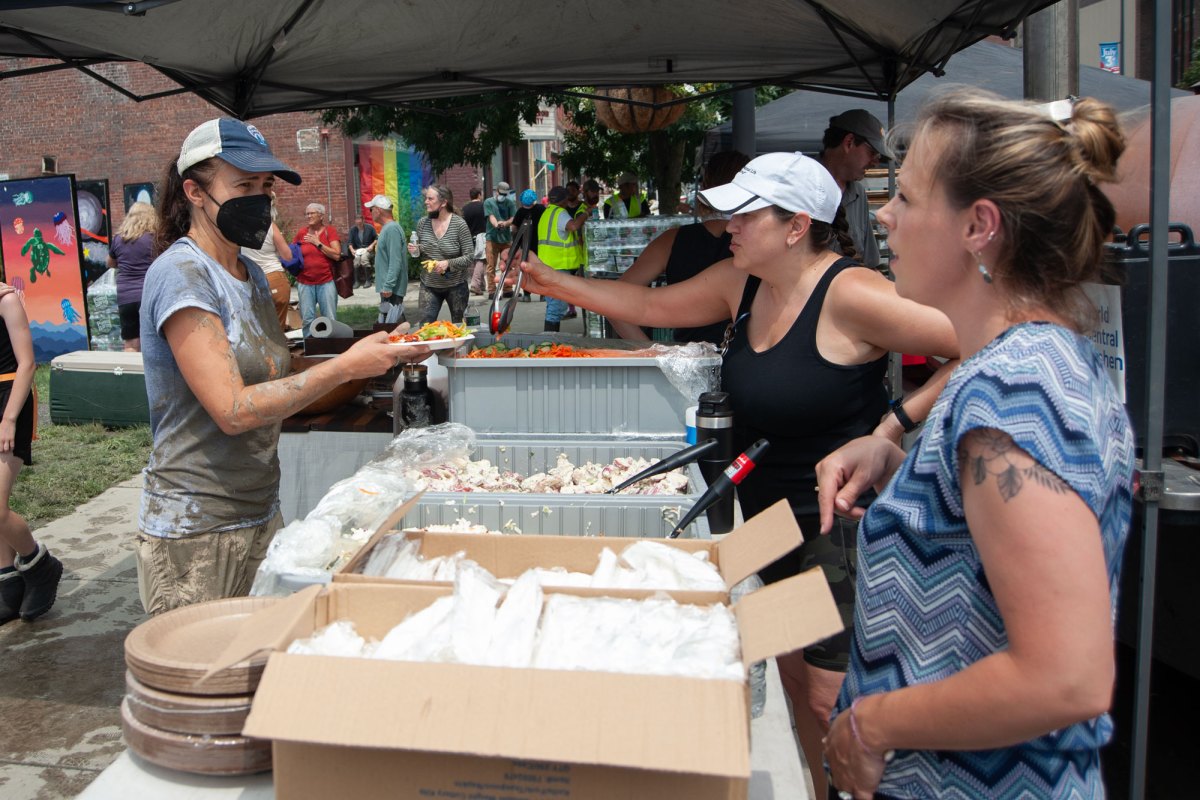
Gustin’s group always intended to complement a more formalized recovery effort that been slower to develop in Barre. Another group that jumped in last week was Rainbow Bridge Community Center, a nonprofit organization based in downtown Barre. The LGBTQ+ community space has been devoting itself to recovery since last week, giving out food, water, clothing and other essential needs. The group also said it has tried to be more mobile to deliver items to people who may not be able to get to the Barre Civic Center, where agencies like the Red Cross are based.
On Wednesday, Rainbow Bridge volunteers said they mobilized out of necessity.
“It’s just local people in the community who are coming together,” said volunteer Stevie De, who lives in Barre. “Because we weren’t really seeing the aid from outside people in the beginning.”

‘We’re very different’
Storellicastro, the city manager, said Barre works very well with Montpelier and called the two cities “great partners.” He’s been in his position for just over one year, but in that time he’s picked up on the dynamic between the two cities.
“We’re very different even though we’re so close,” he said.
The center of Barre, with a large portion of businesses and more dense housing, is Barre City. Separately, there is also Barre Town, an independent municipality that nearly surrounds the city.
According to the latest data from the U.S. Census Bureau, Barre City has a 24% poverty rate, compared to about 10% statewide — and only 5% in Montpelier.
The median household income in Barre City is $44,298. Montpelier’s is $71,163.
Storellicastro and others used the term “blue collar” when describing the Granite City.
Barre store owner Rick Dente, who spoke to VTDigger in the mud-caked ruins of his store on North Main Street, said the extra attention on the capital was “a natural thing.”
“Montpelier’s the seat of the government,” he said. “So when you’ve got two close areas that have similar disasters — or whatever it could be — similar situations, I just think that they’re going to look at their home door first before they get to the next door.”
Dente said that still shouldn’t mean the next door gets ignored, although he said he does not believe the differences are “politically motivated.” He was happy to see representatives of Secretary of State Sarah Copeland Hanzas’ office at Dente’s Market this week to help clean out the muck.
Rep. Conor Casey, D-Montpelier, was among those who acknowledged the differences.
“Generally, lower-income people suffer in a disaster like this,” Casey said.
Casey noted that there are plenty of impacted residents in Montpelier in places such as Lower State Street, St. Paul Street and apartment buildings around the city. But in viral moments or national news, Vermont’s capital surrounded by floodwaters was often the lasting image.
Casey said one advantage that Montpelier had was the work of the organization Montpelier Alive, which transitioned from an economic development nonprofit to disaster response in a very short timeframe.
To be sure, Barre has seen an influx of volunteers, out-of-state recovery groups, nonprofits and state agencies to build up its recovery efforts. The point argued by some volunteers like Gustin is that, with a higher concentration of damaged homes, Barre finds itself in a “very different situation.”
If a business can’t rebuild, it means it closes. But if a house is gone, it means someone lost their home.
“So I think that’s going to be our rebuilding challenge,” Gustin said. “And that’s going to be the next and that’s going to come soon.”
McCarty said she gets judged for living at her address. One volunteer who approached her last week greeted her with “baby talk,” she said, “like I don’t understand things because I’m dumb, because I’m from this place.”
“This is my home and I love it,” McCarty said. “And this is my neighborhood and I love it and these are people I really like.”
