


BARRE — Floods, fire, closure: The building that houses Rise Up Bakery on Granite Street has seen it all.
Now the shop’s owners are attempting to recover from the overwhelming mud and mess after last week’s massive flooding. Jim and Larissa Haas, who relocated from Ukraine to Vermont just before the Covid-19 pandemic to bring baking back to the historic building, have been cleaning nearly non-stop.
On Tuesday afternoon, a tired Larissa Haas, 55, swept up caked dust in the bakery building, which has seen several closures and renovations across more than a century.
She pointed to the waterline on the thick brick walls — about two feet high — and said all the equipment and raw ingredients at the Rise Up Bakery were destroyed or damaged.
“It was a disaster zone here,” she said, pointing out bags of melted chocolate chips and ruined sacks of flour.
She estimated the bakery lost $2,000 worth of raw materials, but what’s really hurting them is the stoppage of work. “It’s a lot of expenses and no revenues and that’s hard for a small business,” Larissa said.

Jim, 61, drove up in a black pickup truck and started unloading blue pallets he scored at the Hunger Mountain Co-op and stacking them in the wooden barn next door that fared much worse. It will probably need rebuilding, he said, like many other parts of Barre that were severely damaged in last week’s statewide flooding.
On Wednesday, the giant 70-quart industrial dough mixer that was sent out for cleaning and repairs came back. “It’s running but it’s noisy and won’t reverse,” said Larissa.
But it would have to do for now as Jim readies dough for sours and fires up the kiln which will need to run for a while before it’s ready. They hope to start baking soon, and if all goes well, they could start taking wholesale orders for next week.
This is not the building’s first brush with disaster — nor the couple’s.
The bakery rises
Built as a co-op bake shop and store at the end of 1913, the historic Union Cooperative Store — as the building was named — has flooded multiple times and was closed for decades, according to Carolyn Shapiro, a board member of the Barre Historical Society.


The building, which includes a room-sized, wood-fired kiln made of brick, sits behind the adjacent block-long brick building that was once the Socialist Labor Party Hall in Barre, a union town at the beginning of the 20th century. It was created when the labor party needed a place to make bread and was a hit from the start. The first bakers were Batista Fumagalli and Joseph Piccolini, according to research by the historical society.
Initially based in the basement of the main hall, the bakery was destroyed in a fire in 1904, according to the society. Then in 1912, the building flooded. With help from the city, a new building was built in 1913, set back from the street, behind the labor hall. But it was devastated again by floods in 1925 and 1927 and “sustained the greatest losses of any business in Barre,” according to the society.
It changed hands several times, ceased as a working bakery in the 1940s, and was used for storage by granite companies. In 2004, the bakery building was bought by the historical society. It lay unused during a multi-year fundraising effort and reopened as the Rise Up Bakery at the end of 2018, Shapiro said.
To maintain its original purpose, board members searched for an artisan baker who would also agree to host teaching workshops in the space. Jim Haas applied and was a clear winner, Shapiro said.
Both the bakery and labor hall buildings are owned by the historical society, both are on the National Register of Historic Places — and both suffered flood damage last week. The society has flood insurance which Shapiro hopes will cover most of the damage to the buildings, while Jim Haas is managing the impact to his business, she said.
Recovery efforts continue, with the help of neighbors and volunteers.
Trey Cook stopped by Tuesday to see what the Haases needed and to give Jim a hand.
A field organizer with the Vermont State Labor Council AFL-CIO, Cook said he had been busy visiting union members in Barre all day to see what they needed as they began to clear out the debris.
“It’s spooky seeing all the climate change stuff all at once,” Cook said, referring to the floods and wildfires across the continent. “You can’t help thinking if all this was avoidable at some point. All we can do now is help each other out.”

Meanwhile, pumps were giving out as they tried to suck the mud out of the cavernous basement of the Old Labor Hall after volunteers carted out water in buckets, Shapiro said. Then they had a tough time finding a company available for cleanup.
The labor hall building was built by Italian immigrants years before the bake shop, in 1900, as a major meeting, shopping and cultural hub for the community that had emigrated to work in the famous granite sheds of Barre, according to the historical society. Many of them joined the Granite Cutters Union, one of the first of the American Federation of Labor.
On Tuesday, dark gray, still-damp mud was piled up in the lot between the Labor Hall and the Rise Up Bakery. An open back door led to submerged steps and stagnant water in the basement of the hall, where many of its exhibits have been ruined, Shapiro said.
Both buildings were rebuilt to better withstand floods after previous flooding, according to historical society research. The bakery luckily did not have a basement, as it was erected on a 6-foot high cement foundation. But when the Haases stopped by on July 9, the Sunday on which the rains began, fast-flowing water had already covered the second of four steps.
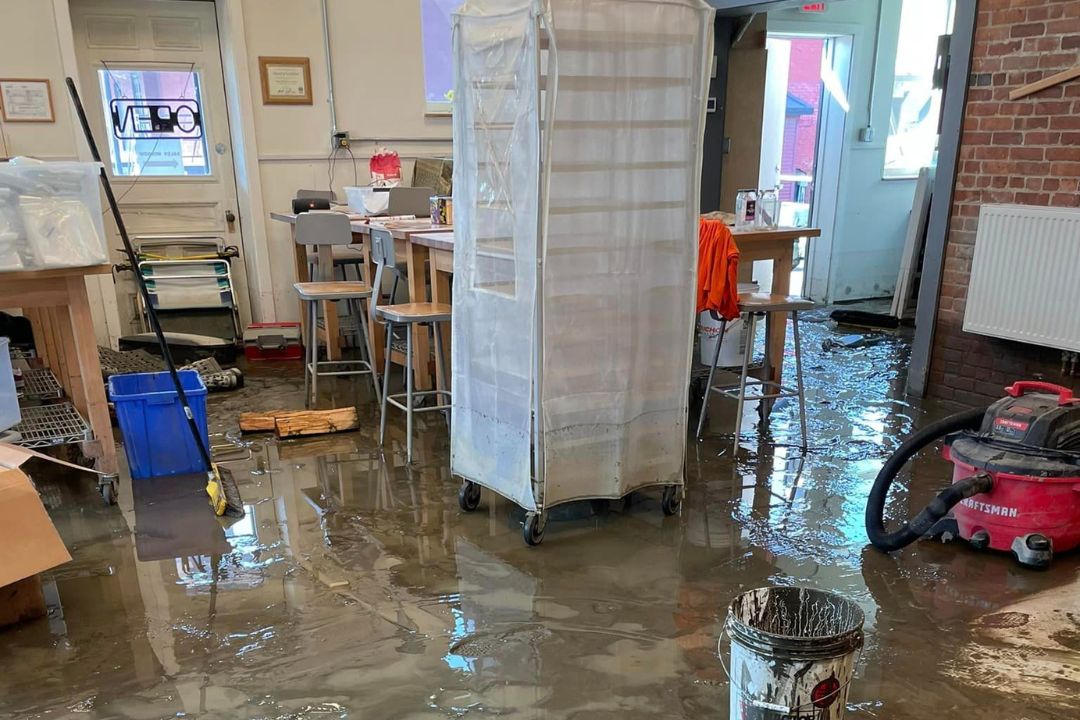
Inside the bakery this past Tuesday, the walls and floor were almost dry and it was boiling hot, even with the doors and windows open. The industrial fans had jacked the temperature inside to 102 degrees this week, Larissa noted.
From Ukraine to Barre
Jim was raised in Derby and moved in 1991 to work in Ukraine, where he met Larissa, who grew up there. In 2006, he founded the country’s first commercial wood-fired bakery, AgroEast Baking & Milling Co., near Kyiv, which specialized in artisan hand-crafted breads. Together the couple raised three sons; two are in the U.S. and one is in Canada.
The couple relocated to central Vermont from Ukraine in 2019 after they spotted an ad in the Bakers’ Guild newsletter for a wood-fired baker in Vermont. And the old bakery was once again filled with the old smell of rising loaves, missing since Piccolini closed the bakery in the early 1940s, according to the historic society website.

The Haases, who each speak multiple languages, have friends and family they have worried about since the Russian invasion of Ukraine last year. Last May, the couple organized a fundraiser to buy supplies for Ukrainian soldiers and collected more than $20,000.
Larissa’s 84-year-old mother is still in Ukraine and the family has strong feelings about the war. Putin will not recognize the independence of any country that was a part of the former USSR, said a grim Jim.
“The war is beyond tragic; it’s genocide,” he said.
The couple has seen more than its fair share of historic upheavals, from the dismantling of communism to the Gorbachev-era policies of glasnost and perestroika.
The Covid-19 pandemic hit just months after they started baking in Barre.
“They opened in Covid, didn’t have the funding and it was tough finding business, but they persevered,” said Shapiro, who stopped by Tuesday to see if they needed any help. “People really enjoy their baking, particularly the rye that you can’t get in other places.”
Soon they were selling wholesale, dishing out a bevy of bakes: organic whole-grain rye, flavored focaccia, French baguettes, Italian Fumagalli rolls, poppy rolls, sourdough and more. Then they expanded to opening a small window and participating in co-ops.

Shapiro’s favorite? Depends on the day, but she always enjoys the popular round loaves of pain au levain, especially for making French toast, she said.
Jim’s philosophy is simple: tried and true bakes using natural, local and organic ingredients as often as possible.
Leaning on a broom inside the hot and dusty space Tuesday, he and Larissa smiled at each other and remained upbeat.
“We roll up our sleeves and get back to work pretty much like everyone else,” Jim said.
He picked up a broom and began to sweep a corner.
“We are hoping to be open by the end of the week,” said Larissa, pausing in a blue apron to clear items strewn on the floor.
