


After historic floods swept through Vermont last week — eviscerating roads, drowning crops, and pushing chronic social, environmental and economic crises to new heights — thousands of Vermonters have been left standing knee-deep in pools of unmet need.
While government crews are providing vital support to residents in the form of emergency shelter, boat rescues, clean-up and more, activists are attempting to address a gap — often experienced during disasters — between the immediacy of peoples’ needs and the state’s ability or willingness to respond to them.
Wendy Rice formerly worked for the Federal Emergency Management Agency coordinating disaster relief for Tropical Storm Irene, which similarly decimated the state in 2011. Last week, she launched a statewide Facebook page called the VT Flooding 2023 Response and Recovery Mutual Aid.
“Individuals, municipalities, the states and the federal government all have a specific role,” Rice said. “But FEMA is a juggernaut. … It takes a really long time. Those processes will never make you whole after an event like this.”
Rice is among dozens of grassroots organizers who have turned toward a framework known as “mutual aid,” a once-fringe practice that gained mainstream attention across the U.S. toward the beginning of the Covid-19 pandemic as people began looking for new ways to support each other during lockdowns.
Grassroots mutual aid — distinct from the mutual aid system utilized by fire departments — typically takes the form of informal networks through which people source food, money, supplies, skills and other resources on a community level, according to Linus Owens, a scholar and professor of sociology at Middlebury College.
“The systems are always failing most of us all the time. And it only takes these large-scale disasters, or disasters in our personal lives, to recognize just how fragile the support system is,” Owens said. “Mutual aid (can be) embedded within everyday practices of taking care of each other (and) making decisions about what care looks like in a collective and non-hierarchical way.”
Through online mutual aid platforms such as the Facebook page and spreadsheet, Rice said, connections are formed and then translated into in-person interaction. Needs are attended to organically, emergently and imperfectly, but at a pace that bureaucratic processes could never meet.
“I think the real value of mutual aid is that it’s hyperlocal. It’s based on relationships,” Rice said.

Updated July 27 at 11:11 a.m.
Organizers around Vermont were mobilizing mutual aid responses as early as the first night of the storm, anticipating the crises that would follow the water.
Members of an existing mutual aid group in the Northeast Kingdom called Hardwick Area Neighbor to Neighbor began coordinating their volunteer base to respond to specific requests for help.
Neighbors in Ludlow and Montpelier began distributing free meals, and in Burlington, volunteers responded to calls to help harvest produce on the Intervale. Organizers at 350Vermont mobilized to create a mutual aid spreadsheet where people could offer and request resources such as food, shelter, clothing or transportation.
Front Porch Forums, the listserve-like online platforms across Vermont, have facilitated similar exchanges.
The mutual aid Facebook group coordinated by Rice and others has already gained more than 7,500 members who have turned toward each other to try to address a slew of immediate needs in the storm’s aftermath.
On the page, one woman posted a photo of her family’s home, almost fully submerged, alongside a request for immediate long-term housing, which received dozens of comments from Vermonters offering support.
Hundreds of others continue to post similar requests or offers, prompting a flurry of communication in each comment section.
Radical roots bloom in 2020
In the U.S., mutual aid has most often developed in communities historically neglected or criminalized by the state. First used as a term by the Russian anarchist and philosopher Peter Kropotkin, it was popularized perhaps most famously in the 1960s and ’70s by the Black Panther Party.
Not everyone identifies with the movement’s radical origins. But for those who do, the practice is intentionally aimed at distorting the social power dynamics that other forms of volunteering can easily reify, relying on non-hierarchical and reciprocal forms of organizing that are distinct from traditional charity, according to Connor Wertz, a community organizer at 350Vermont who helped initiate the flood mutual aid spreadsheet.
“Charity is essentially a pressure vent release for people who are on top of our society to feel good about the fact that they are there,” Wertz said, “That’s not everybody who actively contributes to charity or works in charity, but (in terms of) the historical system of charity and philanthropy, that’s the difference, I think. Mutual aid is a community creating resilience for itself.”
In 2020, statewide and national mutual aid responses to the pandemic set a precedent for the proliferation of mutual aid that ignited last week, Rice said.
“During Covid-19, we developed really, really good systems,” she said. “Those people and those systems are being called upon again and we can deploy them quickly.”
In Vermont alone, at least 52 distinct mutual aid networks existed across all 14 counties by the middle of 2020, most of which had emerged that year, according to research conducted by VTDigger. Today, at least 24 mutual aid groups have continued on or sprung up since 2020, responding to the persistent crises — like food insecurity, economic strain, lack of housing and lack of connection — that the pandemic elucidated.

Nour El-Naboulsi, an organizer with the People’s Farmstand, a mutual aid group that has distributed free produce since 2020, said that the flood is both mobilizing and challenging existing mutual aid networks in Burlington.
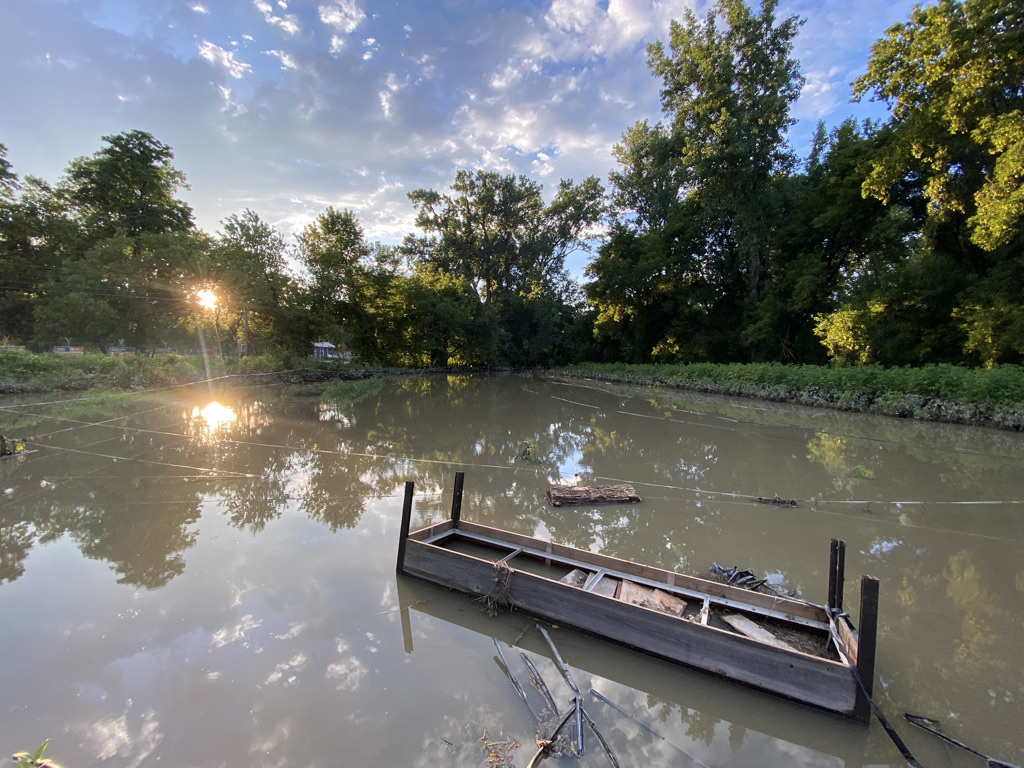
While one of the locations that the farmstand sources produce from — Hyacinthe Mahoro’s farm in Williston — was untouched by the flood, El-Naboulsi said the farmstand also sources produce from the Intervale, where floods decimated fields and brought an early end to the growing season.
“It was very scary in terms of (not knowing) what the People’s Farmstand and greater Burlington produce access groups (were) going to look like in the near future,” El-Naboulsi said. “At first, we were worrying about whether we’d be able to continue at all and what that would look like for the families we work with.”
Evie Wolfe, a University of Vermont graduate who used to work at New Farms for New Americans, one of the Intervale farms, said farmers there are facing similar problems.
“One of the more devastating parts of what happened at NFNA is that it’s one of the only places where people can grow culturally significant crops from their country of origin,” Wolfe said.
Wolfe said she has begun coordinating mutual-aid style efforts to acquire seeds and starts for the farm. “Right now what can be (restored) are plants already grown in Vermont, but what’s lost are the more niche crops that people brought as seeds from the countries they moved from.”
Wolfe first got involved in mutual aid organizing in D.C. in 2020, when Black Lives Matter protests in response to the police killing of George Floyd converged with the pandemic. That cultivated an “intense collective experience where we were being failed by the presidential administration (and) by the police,” Wolfe said, “and it became clear that we had to trust each other.”
For individuals and networks alike, that moment seemed to galvanize new energy behind a kind of organizing that already existed, El-Naboulsi added.
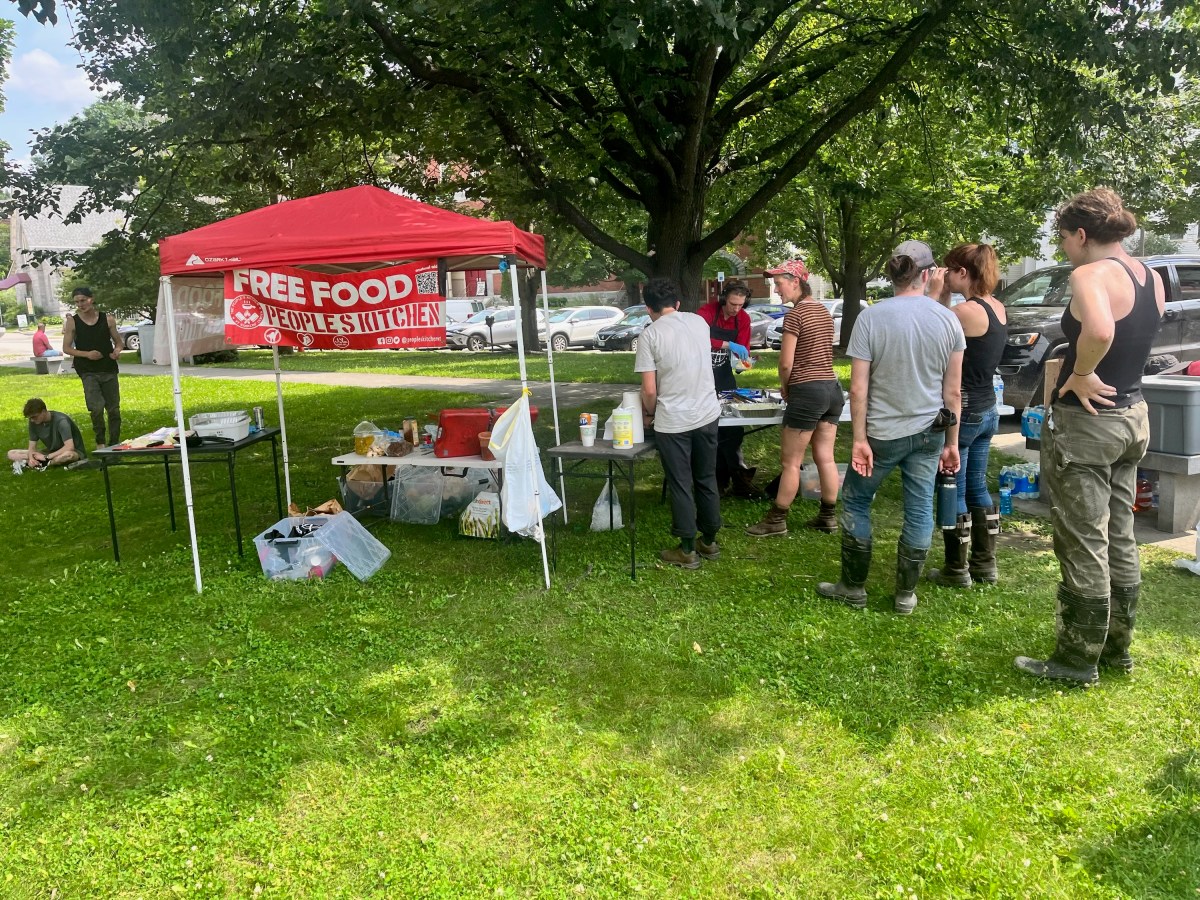
“The People’s Farmstand, and even the People’s Kitchen’s weekly distributions, were born from the pandemic, so I do think that was this kind of spark of social awareness,” El-Naboulsi said. “(But) it’s largely the underserved members of the community — communities of color, low-income folks, unhoused folks — who were already engaging in these kinds of things out of necessity, who really laid the foundation for a lot of these kind of upstart projects since the pandemic.”
While charity often upholds the hierarchy between those who give and those who receive, said El-Naboulsi, mutual aid seeks to uproot those hierarchies, prefiguring a world where the people meet each others’ needs without replicating what caused them.
“We’re all in need in some portions of our life and we all are able to show up for those in need at other times in life,” said El-Naboulsi. “Mutual aid takes away power structures. … It’s the idea that you can show up for your community where you can and in the ways you can knowing that will be reciprocated in the future.”
Tough to measure
Like any grassroots work that lacks institutional presence by design, mutual aid can be hard to quantify and difficult to distinguish from other kinds of volunteer efforts, even among organizers themselves.
For some Vermonters who coordinate mutual aid, the effort is apolitical and not at all dissimilar from many of the ways that Vermonters have supported their neighbors organically for generations.
But even for organizers who don’t see their work as political, using the term ‘mutual aid’ is intentional.
“There are emergencies and people need food and you have to show for each other, but I do like the notion of mutual aid as a way to do it,” said Bethany Dunbar, an organizer with Hardwick area Neighbor to Neighbor. “It does seem more egalitarian.”
Through its emphasis on reciprocity and asking people what they need rather than making assumptions, mutual aid can avoid many of the pitfalls that other efforts to help sometimes succumb to, according to Rep. Mari Cordes, D-Lincoln, who is helping coordinate the flood mutual aid Facebook page.
In Vermont, the inequities that can surface during disasters when such listening is less present were evident in 2011 when Tropical Storm Irene flooded entire Vermont towns and killed seven people.
Rob Koier, the director of “Strength of the Storm,” contends that low-income neighborhoods were left behind by state-run relief efforts. Even during volunteer-coordinated clean-ups, Koier said, people avoided low-income neighborhoods in favor of wealthier ones.
The film, sponsored in part by the Vermont Workers’ Center, documented grassroots efforts that residents of a manufactured home park took to push the state to cover the cost of removing the destroyed homes.
For organizers at 350Vermont, the flooding that occurred this week is not a new or singular crisis, but part of a larger pattern of climate and capitalist-fueled disaster that became suddenly acute.
“What we’re witnessing is what happens when corporations have a lot more power than the people that they purport to serve,” said Wertz, “I think that mutual aid can be the beginning of forming community and flexing those muscles of forming power together.”
Correction: A photo caption misstated the name of an Intervale garden that flooded.
