


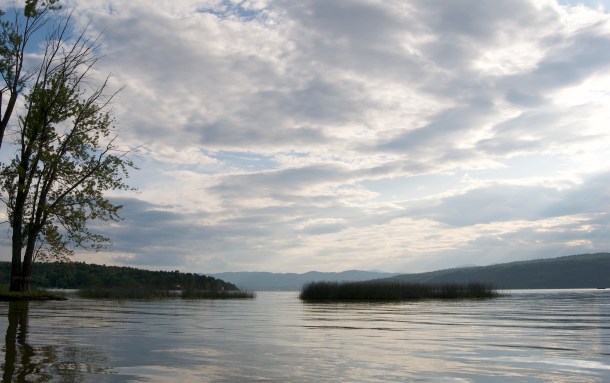
As rivers carry floodwaters downstream in western Vermont, many of the pollutants they sweep up — livestock waste, human sewage, chemicals, oil and gas — will likely end up in Lake Champlain.
Tires, debris and entire propane tanks have been sighted barreling down the Winooski River, according to members of the Lake Champlain Basin Program. Across the state, cars have also been submerged and swept downstream.
Oliver Pierson, lakes and ponds program manager for the Vermont Department of Environmental Conservation, said large debris cannot be safely intercepted in fast-moving water and will need to reach the lake before it can be removed.
“If there is large debris that gets into the lake — be it an automobile, construction debris or debris from a house that has unfortunately washed into the river — there is a process to remove it,” Pierson said.
Once stormwater has run into the lake and the pace of the water flow has calmed down, Pierson said his department conducts assessments to find debris — or “encroachments” — and sometimes receives reports of items from locals.
“We then work with salvage companies to get (debris) removed,” Pierson said. “If we can, we figure out who the original owners (of vehicles) were and reach out to those people to let them know the fate of their vehicle.”
According to Pierson, recovery efforts can begin once water levels recede enough for boats to travel safely. He said that will likely happen this weekend.
Petty Officer Jacob Range of the U.S. Coast Guard station in Burlington said there are no current advisories warning boats against going out on Lake Champlain, but said boaters should stay away from river mouths to avoid logs and other debris, especially while rivers are still flowing quickly.
“I think we’ll probably be out over the weekend inspecting some of these river deltas and river mouths to see if there’s anything that really shouldn’t be there,” Pierson said. “We’ll make a plan to remove that in a safe and deliberate way.”
The quick removal of debris that severely pollutes lake water, Pierson added, is especially pressing.
“If a fuel storage tank got washed into the lake and was leaking oil or fuel, that’s the kind of thing we would move very quickly to remove,” Pierson said.
Yet, according to Pierson, the most severe threat to lake water quality and safety lies in pollutants that are too small to see.
“Our biggest concern is pathogens from combined sewer overflows, or from wastewater treatment facilities that lost electricity and released untreated effluent into the lakes,” Pierson said. “There are both viruses and bacteria that can get into rivers and lakes that way.”
On Wednesday morning, a sewer pipe underneath the Winooski River broke. Since then, it has been spewing an estimated 350,000 gallons of wastewater —or 10% of Burlington’s total ongoing sewage flows— per day into the Winooski River, which feeds into Lake Champlain.
Eric Howe, program director at the Lake Champlain Basin Program, offered a similar assessment.
Sewage and other pollutants can add excess nutrients — including phosphorus, a key contributor to toxic cyanobacteria blooms — to the lake, Howe said.
Along the lakeshore in the Champlain Valley, where dangerous cyanobacteria blooms have periodically closed beaches, the flood might momentarily reduce cyanobacteria, Howe said, as sediment increases the turbidity of lake water and cuts off light to the algae.
“Sediment plumes coming into the lake from the Winooski (River) could help knock down the cyanobacteria blooms,” Howe said. “Usually when we have a large storm event, regardless of the sediment, the winds and the wave action will help to break up and knock down those cyanobacteria blooms.”
But any momentary reduction of cyanobacteria won’t last, Howe said, and won’t mean swimmers in the Champlain Valley can return to the water, either.
“We are definitely at risk of increased blooms for the next several weeks, if not the rest of the summer,” Howe said. He expects the impact of floodwaters to be geographically specific, with increased risks of pollution where large rivers feed into the lake.
While Lake Champlain Basin Program officials have yet to complete their yearly assessment of lake water quality — an analysis that will evaluate more precise levels of bacteria in the lake — Howe said officials are predicting that the flood will raise bacteria levels.
Tom DeBell, an environmental health engineer at the Vermont Department of Health, said those predictions are reason enough to stay out of the water.
“Really exercising caution and giving these water bodies some time to clear out those contaminants is going to be the best thing to do before swimming,” DeBell said. Swimming in contaminated water can cause health issues, including skin rashes, sore throats, diarrhea, and other more serious problems, he said.
“The lake, as well as rivers, ponds and streams, are always susceptible to disease-causing microorganisms,” DeBell said, “Especially with the stormwater runoff that we’re seeing, chemicals and fuel are also a possibility.”
DeBell said it is difficult to gauge the long-term effects that flood-related pollution will have on the lake’s water quality and ecosystem, or how long it will take for that pollution to clear up.
“Floodwaters are being compared to (Tropical Storm) Irene and in some places we’re seeing even more runoff,” DeBell said, “so it’s hard to really predict, ecosystem-wide, what that’s going to look like.”
Burlington Parks, Recreation & Waterfront tests Burlington beaches for bacteria throughout the summer. Regularly updated information on the status of local beaches can be found on its website.
The Vermont Department of Environmental Conservation advises Vermonters to avoid the water until flows return to normal, regardless of posted warnings.
More information on flood recovery resources can be found on the state Agency of Natural Resource’s website.
