


BURLINGTON — On the heels of the three hottest days in Earth’s modern history, U.S. Secretary of the Interior Deb Haaland took her first visit to Vermont on Friday as part of the Biden administration’s Invest in America tour.
Halaand, the first Native American to serve as a cabinet secretary, spoke alongside U.S. Rep. Becca Balint, D-Vt., and U.S. Sen. Peter Welch, D-Vt., to tout a $25 million investment in the Northern Forest region funded by the Inflation Reduction Act, the federal law enacted last summer that marked the biggest climate investment in U.S. history.
“This investment will provide for the development and implementation of a collaborative cross-jurisdictional conservation plan across northern-tier forests in 10 states, including right here in Vermont, and it will improve infrastructure and habitat to be more climate resilient in the Midwest and Northeast regions,” Haaland said at a press conference Friday morning at Burlington’s Union Station.

The funding, which lasts through 2026, will primarily be used “to develop a landscape conservation plan to look at the entire Northern Forest,” said Kyla Hastie, acting regional director in the northeast region for the U.S. Fish and Wildlife Service. The forest covers 26 million acres from Maine to New York, making it the largest continuous forest east of the Mississippi River.
As part of the plan, the agency expects to work with community partners across the 10 states on projects such as forest inventory and river stream restoration to better understand how the forest system is dealing with the effects of climate change.
“It is so important to talk about conservation, but also how to preserve the natural environment so that we can continue to enjoy it as Vermonters,” Balint said at the press conference. “It is one of the things that we enjoy most about living here in this most beautiful state … and we want to make sure that we can do everything that we can to make sure that it is a safe, vibrant place for all of us to be in.”
Haaland got the full Vermont experience, eating a creemee Thursday night (“The thing to do when you’re in Burlington,” she said) and soaking up the views of Lake Champlain, which backdropped the patio at Union Station.
The country’s 13th largest lake was top of mind Friday, as Haaland, Welch and Balint hosted a roundtable earlier in the morning with leaders of Vermont’s outdoor recreation industry, which brought in $1.5 billion for the state in 2021, 4.1% of the state’s GDP, and provided more than 14,500 jobs, 4.7% of the state’s employment, according to Haaland.
Hastie said the Fish and Wildlife Service is actively working to identify the most important places where stream restoration work would improve flow into Lake Champlain and the Great Lakes. Some streams and rivers are currently degraded by roads or stream crossings that don’t allow for proper run of water, she said.
She also said that her office would work to improve fish passages to improve water quality in the lakes, something critical for carbon sequestration, the process by which carbon dioxide is removed from the atmosphere.
“We’re still working collaboratively with our partners and local communities to try to iron out all the details of how long it will take,” Hastie said.
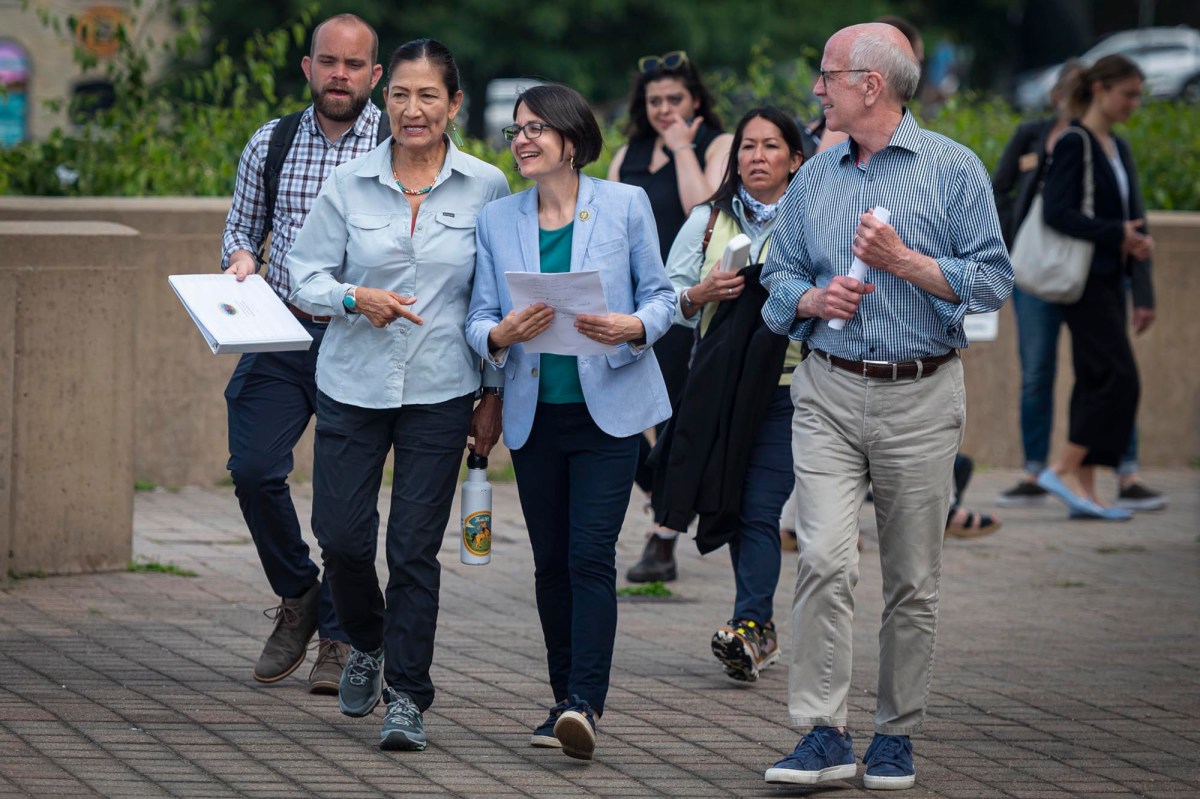
Haaland, Balint and Welch also underscored the weight of the climate crisis during the 20-minute press conference.
“This argument about whether climate change is real or not is long gone,” Welch said. “What we now face is the practical steps that we can take as quickly as possible that are going to help us address the absolute urgent challenge of climate change.”
On a divided Capitol Hill, the prospect of passing legislation to combat climate change can seem increasingly difficult, Welch said, but the trio noted that extreme weather doesn’t discriminate along partisan lines.
“You know what? The heat and the effects of climate change know no political boundaries,” Welch said. “(Whether) you’re in a red state or you’re in a blue state, you care about your kids and their future.”
Balint said she’s heard from constituents across Vermont and the political spectrum who have “really been bearing the brunt” of climate change. The work ahead of her, she said, is to bridge the gap between national Republicans and Democrats to help combat worsening effects of the crisis.
“We cannot allow a small group of extremists to make it impossible for us to do what’s right for the American people, which is to continue to invest in all of America, including rural America,” she said.
