

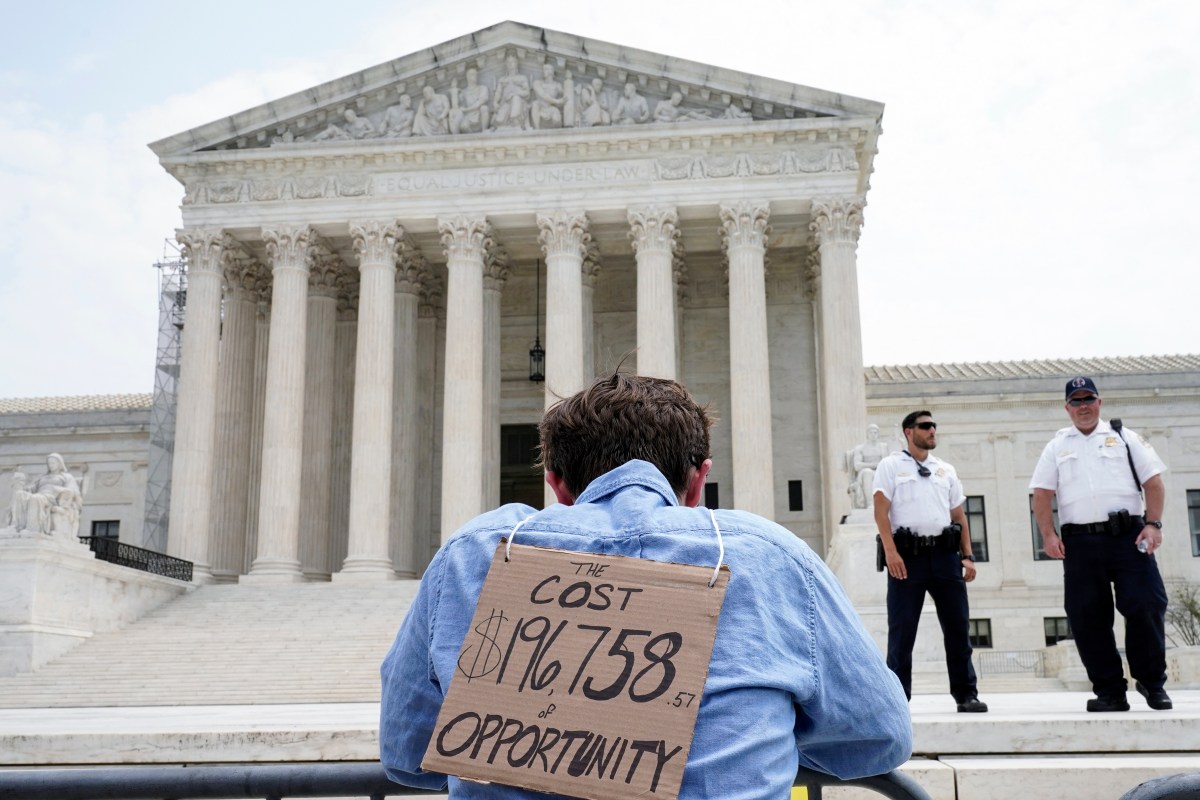
Leaders of several Vermont colleges joined a chorus of dismay after two historic rulings this week by the Supreme Court, which on Thursday banned the use of race-based affirmative action in college admissions and on Friday struck down President Biden’s student loan forgiveness plan.
Middlebury and Dartmouth colleges, the latter located in New Hampshire on the Vermont line, were among the schools that signed amici curiae briefs in support of Harvard University and the University of North Carolina, the defendants in two affirmative action cases the court ruled on together.
The two cases were brought by Students for Fair Admissions, a group of white and Asian American students, spearheaded by conservative legal strategist and outspoken affirmative action opponent Edward Blum.
The court’s 6-3 ruling on Thursday, divided along conservative and liberal justices, overturned five decades of precedent, finding that affirmative action admissions practices like those of Harvard University and the University of North Carolina violated the equal-protection clause of the Fourteenth Amendment and Title VI of the Civil Rights Act.
In a ruling Friday morning, the Supreme Court struck down President Joe Biden’s student loan forgiveness plan, which would have canceled $400 billion in student debt and brought some financial relief to millions. The court was again sharply divided, voting 6-3.
‘Diversity will decline’
Leaders of several Vermont colleges said they were reviewing the affirmative action decision to see how it might affect their processes.
But according to Vermont Law and Graduate School President Rod Smolla, a constitutional law scholar who has studied the issue, people can reasonably expect to see fewer students of color accepted. Especially at schools that put an overwhelming focus on test scores and GPAs in admissions, or those who might fear litigation, the implication is clear, he said.
“It is the case that the diversity of the student bodies in those schools will decline,” he said.
Smolla said he was “disappointed” by the court’s decision, but remained hopeful that schools with holistic admissions processes would be able to adapt to the law, maintaining its goal of attaining a diverse student body.
“We need to pay more attention to things like essays and interviews, other ways to understand and get to know students,” he told VTDigger. “There are some tools in the toolkit that still allow us to try to build a student body that reflects the character and the accomplishments of students.”
In a statement, University of Vermont President Suresh Garimella said the affirmative action decision “must be carefully absorbed,” but meanwhile “our commitment to inclusive excellence will not change” and “our university is better because of the diversity of backgrounds, perspectives, and ideas our community comprises.”
Middlebury President Laurie Patton similarly told students and employees in an email on Thursday that the school was reviewing the decision to determine next steps.
Dartmouth College’s new president, Sian Leah Beilock acknowledged “the strong emotional response the Court’s decision is already provoking, across the nation and among our community.”

In Vermont, one of the 41 states that has not banned affirmative action through state laws, diversity efforts at the state’s most selective schools have yielded mixed results.
In 2021, the University of Vermont had the highest percentage of white students at 83%, compared to 59% at Middlebury College and 50% at Dartmouth College, just across the state line. Over the past decade, many selective schools have seen an upward trend in enrollment of Hispanic and multiracial students. In Vermont, enrollment of Black students has remained low.

Though admissions committees across the country are already reviewing and restructuring their processes to be “race-neutral,” the consequences of this ruling will not be immediately clear to the public eye until the next college admissions cycle.
Blum, the affirmative action opponent, celebrated the ruling on Thursday, calling it “the beginning of the restoration of the colorblind legal covenant that binds together our multi-racial, multi-ethnic nation.”
Others see the decision as a perilous leap backward. Vermont Racial Justice Alliance said in a press release that the decision “not only disregards the persistent racial disparities in education but also threatens the progress made in achieving racial justice and equity.”
The University of Michigan, which ended its affirmative action policies in 2006, offers a preview of what may be to come. In an amicus brief supporting the two universities, the University of Michigan noted that its efforts to recreate the diversity of its student body prior to 2006 has taken “not only time — over 15 years and counting — but vast resources.”
Despite those strenuous efforts, the school adds in the brief, the Black student population has since dropped by 44% and the Native American student population by 90%.
‘A mountain of debt’
Scott Giles, president of the Vermont Student Assistance Corp., said in an interview that his organization was “very disappointed by the decision” related to student loan forgiveness.
Giles estimated that a third of Vermont’s borrowers, who have smaller loan balances, would have become completely free of debt if Biden’s program had stood.
Federal loan payments were placed on hold for three years because of the Covid-19 pandemic, and are slated to resume in October.
“We are hearing from borrowers who are somewhat anxious about what the resumption of payment will mean,” Giles said. “And we were hoping that loan cancellation would reduce the amount that they had to pay.”
Vermont has 77,000 federal loan borrowers with an average student loan balance of $37,000, according to the U.S. Department of Education. Their collective debt totals roughly $2.9 billion.
The Biden program — which would have canceled $10,000 in federal student loans for individuals with an annual income under $125,000 — “would have provided a real material benefit” to those borrowers had it been able to proceed.
While Friday was a disappointment for Giles, he noted that alternative programs remain options for borrowers to find relief, with details available on the organization’s website.
In a statement, U.S. Senator Bernie Sanders, I-Vt., who heads the Senate Committee on Health, Education Labor and Pensions and has long advocated for student debt cancellation, lambasted the court’s “extremist views,” urging the president to move forward in canceling student debt.
Sanders said, “The American people understand that we cannot continue to crush our young generation with a mountain of debt for doing the right thing — getting a college education.”
Correction: An earlier version of this article misspelled the name of University of Vermont president Suresh Garimella.
