


Lives are being transformed in the building trades space at Northwest Career & Technical Center in St. Albans where Ross Lavoie and Steve Allard spend two hours every day teaching carpentry and more to 90 students.
“These students are learning with their hands and with their brains,” Lavoie said.
“The more ways you learn something by touching it, doing it, seeing it, feeling it, that’s how you’re really going to drive those points home, as opposed to sitting in a traditional classroom,” he said.
The students mainly come from three high schools: St. Albans’ own public high school, Bellows Free Academy; Missisquoi Valley Union Middle/High School in Swanton; and Bellows Free Academy Fairfax. Students also come from Project Soar Elementary/High School, an alternative school in St. Albans Bay.
Lavoie and Allard both graduated from the program where they now teach. But Lavoie said today’s students face social and economic challenges he did not have to face in high school, such as substance abuse and poverty.
Lavoie said he teaches accountability to students who have never been asked to be accountable. “They have to tell us where they are, dress appropriate,” he said. He talks with them about the importance of driving sober.
Lavoie also tried to teach his students to become better citizens by getting involved in their communities, and he takes his students into the community to do work for nonprofit organizations.
“Our goal is to work for people that can use our help and our free labor the most, and make their money go further,” he said.
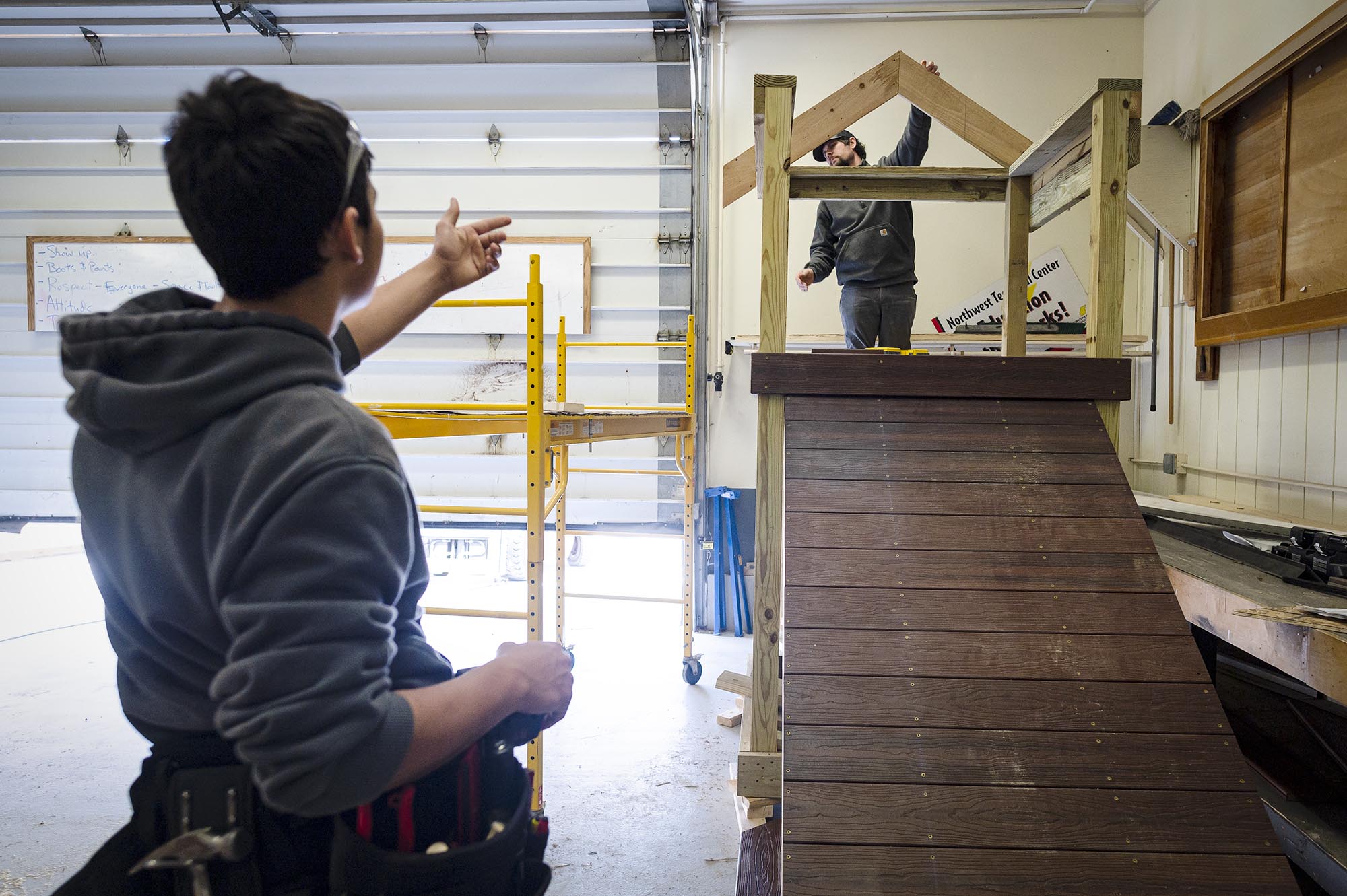
So, his students have built housing, remodeled the local soup kitchen, worked on projects at Hard’ack, the local nonprofit ski hill, and worked on blighted homes in the city of St. Albans, he said.
Steve Wunsch, who taught both Lavoie and Allard when they were in high school, has come out of retirement to help them teach today’s future carpenters. The Covid-19 pandemic made a lot of parents and students reevaluate college educations, he said.
Lavoie said his graduates are in great demand.
Juniors and seniors can sign up for a co-op work-based learning program that lets them work on job sites part time, or even nearly full time, during the school day, provided they have met their academic requirements.
“They already have a career before they graduate, and they’ve been getting paid to do that,” Lavoie said.

Vermont’s most promising jobs
Students are drawn to the carpentry program because they realize there is good money to be made in the building trades, Lavoie said.
Carpentry is one of Vermont’s most promising jobs, according to the McClure Foundation and the Vermont Department of Labor — defined by them as jobs that pay more than the median Vermont wage of $22.50 an hour and have the greatest number of openings.
To draw attention to the opportunities, the organizations are spotlighting the four occupations with the greatest number of projected openings through 2030: bookkeepers, carpenters, nurses and teachers.
VTDigger’s Promising Jobs series is taking up the torch to look more closely at how people are getting into those four careers. Today, we look at carpentry. Yesterday, we covered teaching. And coming up, we’ll dive into bookkeeping and nursing.
“In Vermont, there is a career and education pathway for you,” said Tom Cheney, executive director of Advance Vermont, a nonprofit that aims to connect Vermonters with careers in the state. There are promising jobs that are trained for through apprenticeship. “It doesn’t just require college,” he said.
Advance Vermont posts Vermont’s most promising jobs on its website, where people can find out about 500 careers in Vermont and can see what training they need to land a job in one of those careers.
Through 2030, Vermont can expect 4,460 openings for carpenters, the report estimates. Over the course of their careers, carpenters can expect to make a median wage of $23 an hour, more than $47,000 a year.
The carpentry profession is a good fit for people who like to work with “your hands or with machines to make, fix or build things,” according to a brochure from the McClure Foundation.
A limited supply of carpenters
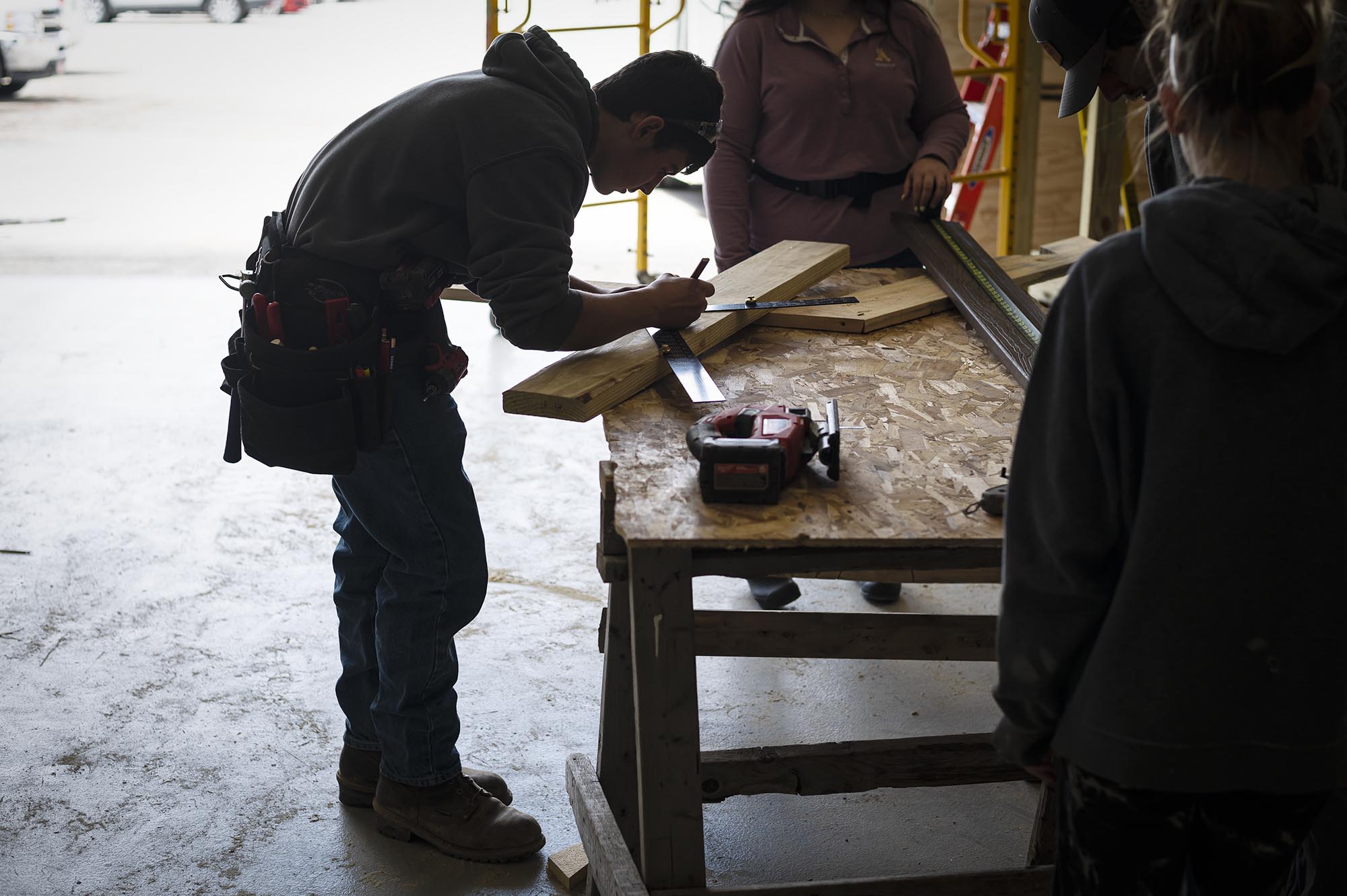
High school career centers are one avenue for learning carpentry.
Mary Ann Sheahan, who runs the Vermont Talent Pipeline for the Vermont Business Roundtable, worked with general contractors to identify a credential of value in the trades that is now being taught at every career technical education center in Vermont. It is called the National Center for Construction Education and Research core credential.
“It’s the first skill set for anybody who works in construction,” Sheahan said. “It includes things like basic safety, construction math, hand tools, power tools, blueprint reading.”
At some career centers, even though the programs are much smaller than the one in St. Albans, there is still plenty of room for interested students. In Rutland and Springfield, for instance, there are still a few openings for next fall’s classes.
But other programs, such as those at the Center for Technology in Essex, are oversubscribed. At the Cold Hollow Career Center in Enosburg Falls, there’s plenty of student interest in carpentry classes, but for several weeks, Nate Demar, director of the center, struggled to find someone to teach them next fall.
“We lost our amazing Construction Teacher because he can make a lot more money in the private sector,” Demar wrote in an email. By last week, Demar reported that he had finally found someone to teach the six students who have applied to enroll next fall.

If a candidate has a bachelor’s degree or the equivalent and no teaching experience, the starting salary for a carpentry teacher at Cold Hollow is $45,000 a year, and if a candidate is certified to teach the national curriculum and has 20 years in the field, it is $64,000, Demar said.
Lavoie said it is hard to draw carpenters to teaching because they make so much more
working in construction. “We have some students, even some students almost right out of this program, making what we make in a year,” he said.
But money is not everything, said Lavoie, who appreciates the school hours and summer vacation, which allows him to be home with his young children.
The shortage of carpentry teachers restricts the supply of carpenters in Vermont, to the point where Ryan Ahern has to bring them in from out of state.
“We can’t find commercial framers to build large projects,” said Ahern, director of field operations at ReArch Company, a contractor in South Burlington. “We’re bringing people up from Boston to do this work.”

Other paths to carpentry
Someone who graduates from a career technical education center with a core construction credential could get hired by a contractor, but would not have all the skills to work as a carpenter, Sheahan said.
So Vermont Talent Pipeline approached contractors to ask how people coming into the field with this credential could get more skills so they could become independent carpenters.
Together, they put together an 18-month apprenticeship program; Sheahan said that experience boosts the average wage by about 50%.
And, apprenticeships are one way that employers can attract employees.
Ahern hosts apprentices at his business through a program that recruits and trains carpenters over 18 months. The program teams up incoming apprentices with foremen and skilled carpenters in the field with pay starting at $19 an hour.
“They start with basic tool skills, like keeping all the fingers on their hands,” Ahern joked. “They’re learning plan-reading. They’re learning framing. They’re learning some finish carpentry.”
Associated Builders and Contractors sponsors the apprenticeship program, which is taught by ReSOURCE Vermont. Young people starting out in the trades get Wednesday afternoons off to go to class at ReSOURCE Vermont, and a mentor on the job checks that they can actually do what they are supposed to be learning. Over 18 months, the apprentice graduates from laborer to carpenter’s helper to carpenter.
Here’s the pitch, Sheahan said: “We’re going to hire you even if you have just basic skills and we’re going to teach you how to become a carpenter over the course of 18 months. It could be that you’re starting at $20 an hour and when you’re finished, you’re going to be $30 an hour.”
A quicker route is the Construction 101 class at ReSOURCE. The six-week construction program is designed to get students jobs when they finish.
Students spend four weeks in the woodshop, gaining credentials for working with power and hand tools. Then there’s a job fair, and the last two weeks are spent working with employers who came to the job fair.
“At the end of the sixth week, ideally, you’re talking contracts,” said Maggie Robinson, program coordinator at the ReSOURCE Burlington site, running construction and weatherization programs.
Ry-An White, who lives in Shelburne, took the class. He is now building basement doors and hatches, putting up drywall and reframing damaged sections of homes for the Champlain Valley Office of Economic Opportunity weatherization program.
He started at $18 an hour. Now, after less than a year on the job, he makes $21.75 an hour.
Someday, he hopes to be able to build his own home.

Advice to young people
Ahern, at ReArch, said demand is high for people who are interested in getting into carpentry. “If you’re ambitious and you’re looking to get into this business, it’s an awesome time,” he said.
He offers some advice for high school students considering carpentry.
“You gotta like the physical aspect of it,” Ahern said. “There’s a certain hardship (to) this business, especially in Vermont, with the cold, and you have to actually like physical work.”
Ahern advises students interested to start out with internships while they are still in high school.
“I’d advise against going to work with the uncle down the street,” he said. “If I was 18 years old, I would spend six months with two or three of the best (employers) around, and then take a pick.”
