


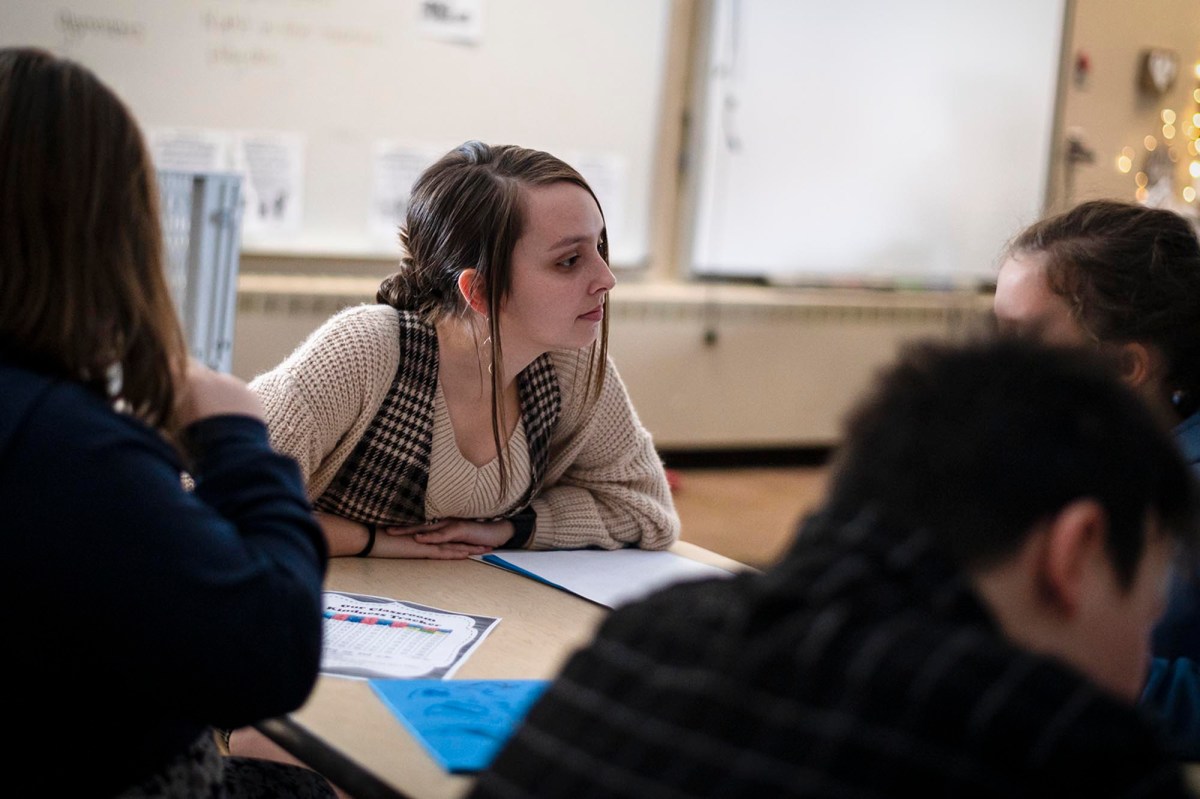
Kristin Baker’s route to the front of her middle school math classroom at Richford Junior Senior High School started when she found herself unhappy in her first job out of college doing marketing.
Despite her business administration degree, she decided to go work as a paraeducator, also known as a teaching assistant, at Montgomery Elementary School. There, she met principal Beth O’Brien, who saw how well she fit in.
“And she was wonderful and I said to her: ‘You should go into middle-school math,’” said O’Brien, knowing that specialty would be in particularly high demand.
Baker entered the 10-month Teacher Apprenticeship Program at Champlain College, which is one of several programs that provide teacher training for people who already have a bachelor’s degree. Meanwhile, O’Brien had moved to the Richford school, and hired her before she had even fully completed the credential.
Apprenticeship programs, which Baker said mostly involve working in the classroom with a mentor teacher, are popular because a circuitous route into teaching is common.
“Most everybody in our teaching faculty has an interesting story,” said Jenny Rainville, a Richford upper school colleague.
Rainville studied animal science at the University of Vermont. She, too, didn’t like her first post-college position, breeding cows, and started working as a paraeducator.
Also encouraged by O’Brien, she attended a one-year master of arts in teaching course at St. Michael’s College for her initial licensure. She went on to earn a credential to teach special education and is now head of special education at the school.
“We — most of us — took a roundabout way,” she said.
Vermont’s most promising jobs
Teaching is one of Vermont’s most promising jobs, according to the McClure Foundation and the Vermont Department of Labor — defined by them as jobs that pay more than the median Vermont wage of $22.50 an hour and are expected to have at least 500 openings or more over the next decade.
To draw attention to the opportunities, the organizations are spotlighting the four occupations with the greatest number of projected openings through 2030: bookkeepers, carpenters, nurses and teachers.
VTDigger’s Promising Jobs series is taking up the torch to look more closely at how people are getting into those four careers. Today, we look at teaching. Tomorrow, carpentry. And later this week, we’ll dive into nursing and bookkeeping.
Employer demand for people to fill those “most promising jobs” has never been higher.
“There’s sometimes this narrative in our state that there are no good jobs for Vermonters,” said Tom Cheney, executive director of Advance Vermont, a nonprofit that aims to connect Vermonters with careers in the state.
“The truth of the matter is that we have many good jobs right here in the state that are going unfilled,” Cheney said.
Advance Vermont posts about Vermont’s most promising jobs on its website, where people can find out about 500 careers and can see what training they need to land a job in one of them.
Vermont is expected to have 7,850 job openings for teachers between 2020 and 2030, paying a median salary of $60,986.
The teaching profession is a good fit for people who like to work with people and to “use your creativity to guide or persuade,” according to a brochure from the McClure Foundation. In that category, the foundation includes K-12 education, along with special education and continuing technical education.
The teacher shortage
Erica McLaughlin, who was principal at Randolph Elementary School for 17 years, said that, years ago, she would receive 90 to 100 applications a year for teaching jobs. But in recent years, the pool of applicants has been much smaller, according to McLaughlin, who now is assistant executive director at the Vermont Principals’ Association.
The shortage of teachers is being acutely felt in Richford, at both the elementary and middle-high school.
“We went into the school year with teacher positions unfilled,” said Kelli Dean, principal of Richford Elementary. She said she had to combine classes to make up for it. Instead of two first grade classrooms, this year the school has one. Instead of two fourth grade classes and two fifth grade classrooms, the school has two classrooms for fourth and fifth graders combined.
Both schools compete for experienced teachers with nearby Chittenden County, where the pay is the highest in the state.
In Burlington, starting pay for a teacher with a bachelor’s degree is $49,129, according to the teacher contract, and Vermont ranks 19th in the nation for average teacher pay, at $62,866.
O’Brien, Richford Junior Senior High principal, estimates that in Richford, on the other hand, the starting salary is around $45,000.
The lack of housing increases the challenge, in Richford and across the state.
O’Brien said two teachers recently were hired to work in Richford, “and when they were looking for a place to live, we couldn’t find anything,” she said.
She and her husband were about to sell a house, “and I went home and I told my husband: ‘We can’t sell that house right now because I’ve got a teacher coming from Texas and I’m not losing that teacher.’”
Training as a teacher
For school leaders, particularly in more rural areas, filling positions often requires creativity, outreach and spotting talent that can be further developed.
“So I have had to grow my own program,” O’Brien said, and she has often turned to former students who had gone into other careers.
O’Brien prides herself on being able to see characteristics in people that help her know that person would be a good teacher, pointing to Baker and Rainville.
“I saw something in them and I counseled them into teaching,” she said.
Like other school administrators, O’Brien is also working with career technical education centers to encourage high school students to consider teaching. For Richford, that’s the Cold Hollow Career Center in Enosburg Falls.
That street runs both ways: One of her best teachers, she said, left to teach at Cold Hollow. “I hated to lose her, but I understand she’s trying to develop future teachers for our area,” O’Brien said.
Students at Cold Hollow work at local schools through internships to get an understanding of what it takes to be a good teacher.
“It gives them experience and confidence going into the field,” O’Brien said.
O’Brien said some students know intrinsically that teaching is what they want to do, but other students don’t.
Melody Tracy, a senior at Richford Junior Senior High, said even when she was younger, she knew she wanted to help people.
Volunteering for the Special Olympics made her realize she wanted to become a special educator, and so this year, Tracy joined the Cold Hollow Teacher and Human Services Prep Program. At Richford Elementary, she works with students with disabilities three afternoons a week and all day Friday.
“I love working with kids and I like that I’m having a role (in) how they grow up,” Tracy said. “I love watching them grow. If one week, they can’t do something and the next they can, that’s so great to see, and that makes me feel very happy.”
Even with that knowledge, she is not planning to get a teaching degree right away. First, she plans to go to college to major in psychology.
Advice to young people
Above all, anyone going into the field must have a passion for the work, O’Brien said. It also helps to be empathetic. “You’ve got to have the ability to relate to other people and see their perspective,” she said.
Baker, the math teacher, tells high school students thinking about a teaching career that they will need a sense of humor.
“They need to have a little bit of a personality, because you’re going to see things every day that you’re not exactly expecting, and you’re going to have to roll with that and be flexible,” she said.
The job is challenging, teachers say.
“You never know if (your students have) had a bad night the night before and so you’re just trying to meet them where they are at,” Baker said. “They learn differently, and so you have to think about many different ways that they can access the material. It’s a lot of planning and preparation. The school day doesn’t end when the school day ends.”
“We’re short-staffed,” said Rainville, the special education teacher. “You can only do so much. There’s only so many hours in the day. It just seems like our plates are always really full.”
And yet the rewards are endless, said Baker.
“Seeing them be successful in something that they tried is very rewarding,” Baker said. “The day is never boring. If you want to make a difference, this is the place to do it.”
Clarification: This story was edited following publication to clarify the full scope of the mission of the nonprofit Advance Vermont.
