

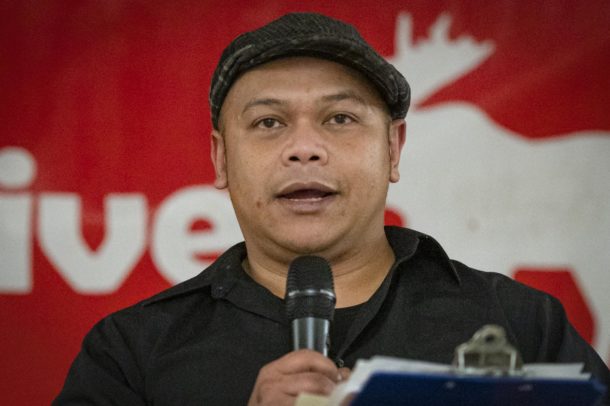
FaRied Munarsyah compares the Burlington city charter to an operating system. He and other advocates for Proposition Zero, a proposed charter change, think they’ve found a bug that they hope to patch.
The independent candidate for the South District city council seat has a background in information technology, which could explain why he is prone to using computer analogies while describing a ballot question that will go before Burlington voters on Town Meeting Day in March. Munarsyah and other activists contend the proposed change is a necessary expansion of “direct democracy.”
“But seeing the reaction, I’m convinced now that these people think it’s a feature” — in other words, viewed positively — “that we don’t have direct democracy,” Munarsyah said.
The charter change, if passed by voters and approved by the Legislature, would allow Burlington voters to petition binding changes to city ordinances onto the ballot, allowing them to circumvent City Council approval.
Ordinances are rules passed by a municipality, ranging in Burlington from restrictions on nuisance animals to licensing taxis.
Mayor Miro Weinberger opposes Proposition Zero on the grounds that it would reduce the council’s authority.
Weinberger cited an example from 2019 when the City Council declined to put a question related to the planned City Hall Park renovation before voters despite a petition campaign. The petition asked that voters be able to weigh in on the park’s future. Weinberger argued that the request would have interrupted months of work by the city.
The mayor was asked about the proposal at a Feb. 2 press conference during which he decried a separate ballot measure that would establish a community control board to oversee police. Weinberger said he didn’t consider the stakes with Proposition Zero to be “quite as high as they are with the control board charter change.”
The control board ballot question, like Proposition Zero, arrived on ballots by way of a petition campaign, which requires signatures from 5% of registered voters. The two petition campaigns had some overlap in terms of gathering signatures, organizers said, but arose independently of each other. So far, the community control board proposal has elicited much more public debate.
The Proposition Zero ballot question aims to “grant voters the powers to initiate ballot questions, propose enactment and repeal ordinances by majority vote,” according to the proposed charter change language. Ballot questions could be nonbinding advisories or mandatory changes to the city’s code of ordinances.
Another section of the proposal details a referendum process whereby voters could petition the City Council to reconsider an ordinance. If the council decided not to repeal it, the issue could be placed on citywide ballots. While state law already grants voters the power to call a referendum, Proposition Zero organizers said they were “just surfacing it so that people know we have it,” according to Amy Malinowski.
Complete language of the proposed charter change can be found on the city’s website along with all other ballot questions.
If passed by voters in March, the proposal would still require legislative approval in Montpelier.
Munarsyah said he sees Proposition Zero as a means of “decentralizing some decision making and having a more grassroots approach to policy development.”
The idea originated in the aftermath of Infinite Culcleasure’s unsuccessful bid for mayor in 2018, according to Munarsyah, who was involved with Culcleasure’s campaign. Campaign workers kept running into voters who argued that too many city decisions were being made without enough public engagement, he said.
The effort to gather signatures for the petition was done by a loose affiliation of “activists and concerned voters,” according to Munarsyah, but included some members of the Burlington Tenants Union and the progressive Coalition for a Livable City.
During a Jan. 25 neighborhood planning assembly meeting for Wards 4 and 7, Munarsyah and Malinowski participated in a panel discussion about the issue. The two supporters noted during the panel that several other cities in the state have similar language to allow direct ballot questions, including South Burlington, Winooski, St. Albans, Montpelier and others.
“We’re just bringing Burlington’s city charter up into alignment with the charters of other municipalities,” Malinowski said during the panel. “So really, in essence, I think it’s about continuing a long-standing Vermont tradition.”
At the same meeting, Chip Mason, a former Democratic city councilor, criticized Proposition Zero, arguing that Burlington’s governance “is a little bit different” from the other municipalities with direct ballot questions. He said Burlington has a “strong mayor system” in addition to the City Council, and that the two serve as checks and balances against each other.
Rep. Carol Ode, D-Burlington, said during the panel discussion that she worries about the potential for the proposal to introduce more “money in politics.” She characterized the current system as a “deliberative process” of testimonies, public hearings and votes by the City Council before the public weighs in. Under the proposed system, “whoever’s got the money to push an initiative might win,” Ode suggested.
The direct ballot initiative proposal has brought comparisons to ballot initiatives in California, where, critics argue, special interest groups dominate the process.
“I don’t see that as being a real and present threat,” said City Councilor Gene Bergman, P-Ward 2, who supports the measure. Bergman said in an interview that one major difference between California and Vermont is that “we only have the power to do what the Legislature gives us the power to do anyway,” referring to the charter change process.
Councilor Ben Traverse, D-Ward 5, said in an interview that while he supports some expansion of “direct democracy,” he thought the wording of this proposal could end up “forcing questions on the ballot, and not allowing for any debate or amendment or tweaks to it through the normal legislative process.”
Traverse also said he had unanswered questions about how this proposal would fit with the city’s existing charter. He pointed out one section which says that residents would be able to force an item to the ballot if the City Council fails to take action.
“Well, what if the City Council does vote in favor of language, but then the mayor vetoes it? We still have a mayor, remember, who has veto authority,” Traverse said. “Does that mean under the language that they’ve put forward that the City Council has failed to take action?”
City Councilor Joan Shannon, D-South District, who is running in the same district race as Munarsyah, also expressed concerns about the proposal, saying she worries about issues making it to ballots even if voters know very little about them.
“This is why we have representative democracy,” Shannon said in an interview on Friday. “So that we rely on a few people to really dig into the details of this and make rational decisions based on a lot of information, not just the words that you will see on a ballot.”
Munarsyah is unconvinced by the arguments against Proposition Zero.
“It still doesn’t address the concern that power has been consolidated into fewer and fewer hands,” he said.
Correction: An earlier version of this story misspelled Amy Malinowski’s last name.


