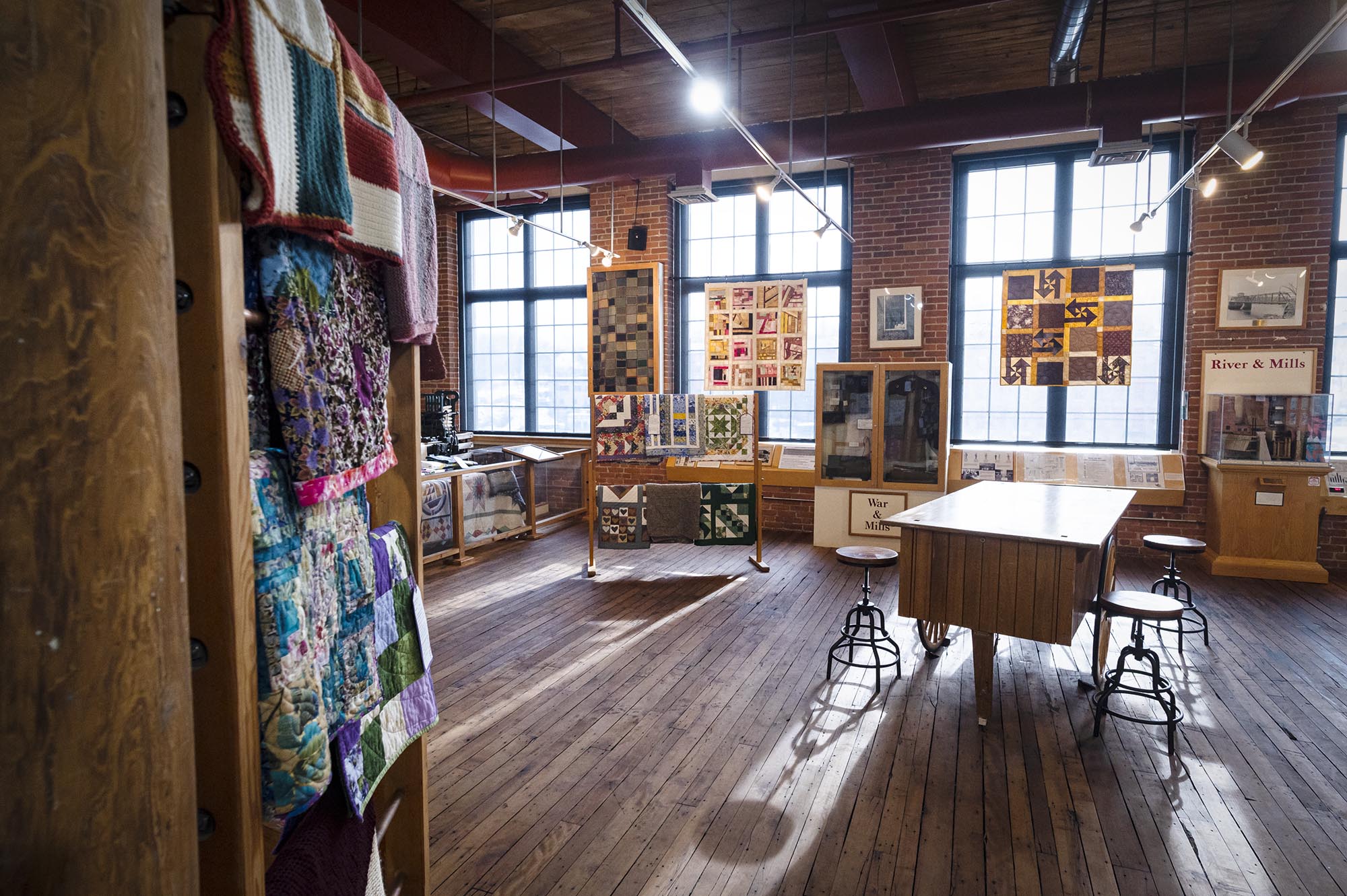
WINOOSKI — Woven fibers and written stories tie past immigrants to recent refugees in a unique crowd-sourced art project that’s now in Vermont.
Sixty quilts pinned with welcome notes are on display at the Heritage Winooski Mill Museum through February. But unlike a typical exhibit, the works of art will be given away at the end of the show.
The quilts and stories are part of a national art project called Welcome Blanket. It involves local residents stitching, knitting, crocheting quilts – an American tradition – to welcome new immigrants. The idea to bring it to Winooski came from historian and artist Erica Donnis in Burlington.
Local participants who have contributed the quilts include descendants of mill workers in Winooski, whose ancestors arrived from France in 1610; an Irish family who came in the late 1800s to work in the logging industry; and refugee women who recently relocated from the Congo.
“Winooski has always been a city with a large immigrant population. This project for us was really meaningful because we’re kind of connecting our textile history of the past with the people who live in our community today,” said Miriam Block, director of the mill museum. The museum is accepting submissions to the exhibit through February, after which immigrants from Winooski will be invited to pick a blanket to take home.
“The conversation and the ramifications about who makes up our community I think are very relevant,” Donnis said. “And it’s a wonderful way for us to express support for folks who are newly arriving and are great additions to our community.”
It took Donnis about six weeks to knit a blanket that’s a part of the exhibit. The note she submitted with it explains how one side of her family came to America after World War I from what is now Poland.
“They were experiencing the economic hardships and deprivations of war, and the United States offered a new opportunity for them,” she said. “I have a lot of empathy for folks who are arriving in the United States and in Vermont locally, who have had similar experiences.”
Community and comfort
It is a “wonderful, wonderful, collaborative project,” said Irene KeruBo Webster (who prefers to be called KeruBo), case manager with the Association of Africans Living in Vermont, a refugee resettlement organization in Burlington. She said the project was a great source of comfort and helped foster a sense of community for a group of recently resettled women from the Congo who submitted two blankets to the exhibit — one knitted and one crocheted.

Twenty women, all war survivors, worked on the blankets for weeks at the Women’s Cafe organized by the Association of Africans Living in Vermont, sharing stories and finding comfort in the community of knitters who joined to work and heal together.
“They were excited because they will be gifting these blankets to other newcomers. And they wrote down personal messages for them,” KeruBo said.
One of the blankets is made up of 16 knitted squares and embroidered with a flower, a hand, a star and messages like “Karibu (welcome in Swahili) to USA.”
The handwritten tag for the recipient reads: “May this blanket give you warmth during this cold season. It was knitted in love in order to welcome you to America. We are here together with you.”
A bright yellow and red wool blanket, knit by Gizela Neumann from Starksboro — a Holocaust survivor — was submitted to the exhibit by her daughter. “She faced many of the same issues you are facing, having to make a fresh start of a life which was interrupted by circumstances beyond her control,” the accompanying note reads.
The blankets help museum visitors “see that these are actual human beings, human beings who came with skills from back home, human beings who need connection with America, real human beings who are trying to integrate into a community that is new to them,” KeruBo said.
“When you weave a blanket, there are so many pieces that you bring together and it’s not a whole blanket until all those pieces are weaved together,” she added, likening the making of a quilt to how immigrants make up America.
Los Angeles-based artist Jayna Zweiman created the Welcome Blanket project in 2017 to protest then-President Donald Trump’s call for a border wall with Mexico. It began as a project to weave 2,000 miles of yarn — the length of the proposed border wall — to make blankets for refugees, but the crowd-sourced collective has long superseded that goal with international contributions and exhibits around the country. It now aims to create 36,521 quilts and notes to cover 24,901 miles, or the equivalent of earth’s circumference.
“Welcome Blanket is an opportunity to craft the country we wish to see,” said Zweiman, whose grandparents came to America as refugees or immigrants.
It is fitting that Vermont’s most diverse city is hosting this project “to celebrate and honor the importance immigration has on the city, and Vermont as a whole,” she said.
Zweiman is expected to visit the museum on Feb. 2 with the help of a grant from Vermont Humanities Council, Block said. She will talk about the Welcome Blanket project, craftism and the Pussyhat Project she previously spearheaded, which created a sea of pink at women’s marches around the world.
Sharing stories of immigration, migration and relocation with words of welcome helps connect people to newcomers today, Zweiman said. “We may disagree about specific policies, but we should never lose sight of the fact that immigration is about people starting a new chapter in a new place.”

Diverse contributors
From students and newcomers to longtime residents and artists, the local contributors are as diverse as the colors and designs of the quilts on display in the mill building museum.
Alexandra Turner, a teacher and artist at the nonprofit Inclusive Arts Vermont, said she decided to participate because one of the classes she teaches was learning about citizenship and the project seemed “an ideal fit.”
She has been working with two groups of students with autism, aged 8-16, enrolled at the Mosaic Learning Centers in Morrisville and Colchester. They have been painting cloth, cutting pieces and crafting a blanket for the project since September.
“I’m always looking for projects that will give the students I work with an opportunity to collaborate with each other, and to connect to the community,” Turner said. “I thought this would be a great fit with learning about how our rights come with responsibilities to everyone in our community.”
Williston artist Carmella Cyr made two blankets with recycled fabrics — a yo-yo quilt using round pieces of cloth stitched like flowers, and the other using Japanese methods of stitching called boro shashiko.


Cyr, a third-generation immigrant, said her mother’s parents came off the boat from Sicily and opened a grocery store in Connecticut. Her father was a Native American from the Winnipesaukee tribe and it was hard for him to assimilate in a new society, she said.
She would like to see the project stay in Vermont to bring awareness to the struggles people face coming to live in a new country. “It’s very stressful. It’s very scary. And it takes a lot of work to get established,” she said.
Many participants in the project mentioned the importance of the diversity that immigrants bring to America — a diversity that’s reflected in the exhibit on display at the Winooski museum.
Zweiman took that thought further.
“I want a child crafting a welcome blanket today to remember this experience when the next wave of xenophobia hits,” she said. ”I want him as an adult to remember his family’s story, the process of making and gifting, his connection to new neighbors, and call out xenophobia.”