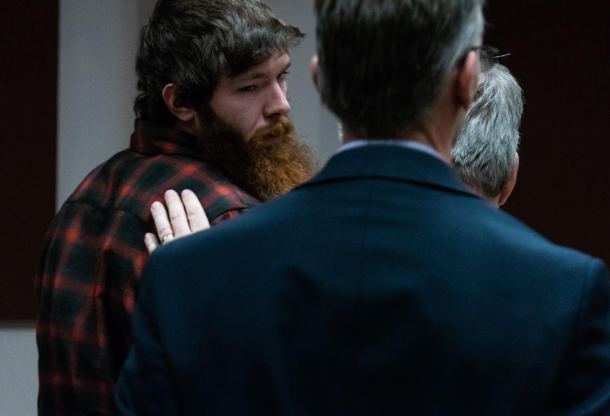
WHITE RIVER JUNCTION — A prosecutor told jurors that Tyler Pollender-Savery acted out of a jealous rage and killed an infant who he believed was the link bringing his girlfriend and the child’s father back together.
The defense attorney said the prosecution has “scant and speculative” evidence for that theory and can’t prove his client was the killer.
Pollender-Savery’s trial began Monday in Windsor County Superior criminal court in White River Junction. He is charged with second-degree murder in the 2018 death of 11-month-old Karsen Rickert in Ludlow. If convicted of second-degree murder, Pollender-Savery faces 20 years to life in prison.
“The case is about the defendant and his jealousy and control of his relationship that led him to kill an 11-month-old child on January 11, 2018, as that child lay asleep on his bed,” Assistant Attorney General Robert Lees, the prosecutor, told jurors in his opening statement.
Abigail Wood, Karsen’s mother, was in a relationship and living with Pollender-Savery in the Ludlow home with her child, Lees said. Wood and Pollender-Savery were the only other people in the Route 100 home on the morning when Karsen was found unresponsive. Both denied harming the child, according to court filings.
The baby was declared dead at Dartmouth Hitchcock Medical Center in Lebanon, New Hampshire. After a nearly yearlong police probe, the murder charge was filed against Pollender-Savery, 26, in December 2018.
The infant’s death was ruled a homicide, according to charging documents, with New Hampshire’s chief medical examiner finding the cause of death to be asphyxiation from strangulation or smothering.
In the weeks leading up to Karsen’s death, Lees told the jurors, Wood was preparing to end her relationship with Pollender-Savery and move in with the child’s father, Nicholas Rickert.
Pollender-Savery was aware of that, the prosecutor said, and saw Karsen as the connection that had brought Wood and Nicholas Rickert back together.
According to court records, on Jan. 11, 2018, Wood woke up around 4:30 a.m., “as she routinely did,” to feed Karsen and she returned to bed. “Karsen was absolutely fine when she left him,” the prosecutor said.
Later, Lees said, Wood noticed that Pollender-Savery was no longer in bed with her and then saw that Pollender-Savery had gone to Karsen’s room down the hall.
“Defendant told her he had checked on Karsen and he was sound asleep,” Lees said, adding that Pollender-Savery was the last person to see Karsen uninjured.
Moments later, Wood got up and checked on Karsen, found him unresponsive, saw “significant” redness on his neck and yelled for Pollender-Savery to call 911.
According to an affidavit filed by a Vermont State Police detective, Sgt. Michael Dion, a 911 call came from the home at around 7:30 that morning.
“My baby’s not breathing,” the man told the dispatcher during the call, adding, “Please hurry,” before hanging up, the affidavit stated.
Karsen was taken to Springfield Hospital, then flown by helicopter to Dartmouth Hitchcock, where he was later pronounced dead.
“You’ll learn the medical evidence established that Karsen was murdered,” Lees told jurors. “The defendant was the only person who had the opportunity and the motive to do this.”
David Sleigh, Pollender-Savery’s defense attorney, countered that the prosecution’s case is built on “the worst kind of conjecture” and “uncertainty” in seeking to convict an innocent person.
“Suspicion is not proof. Proximity is not guilt,” Sleigh told the jurors in his opening statement. “They will not and cannot prove Tyler murdered Karsen.”
Sleigh said evidence will be presented at trial about what Wood told medical personnel as they tried to save Karsen.
“In the moment, without a chance to reflect or worry about how people might regard her, she said, ‘I found the boy with a blanket wrapped around his neck,’” Sleigh told the jurors. “This is a description of events that Abby gave spontaneously.”
The findings from Dr. Jennie Duval, New Hampshire’s chief medical examiner, also “embrace uncertainty,” Sleigh said.
“She says that the death was either strangulation or smothering,” the defense attorney said. “She won’t be able to describe how this death actually happened.”
The trial is expected to run through the remainder of the week.