This story by Frances Mize first appeared in the Valley News on Oct. 8.
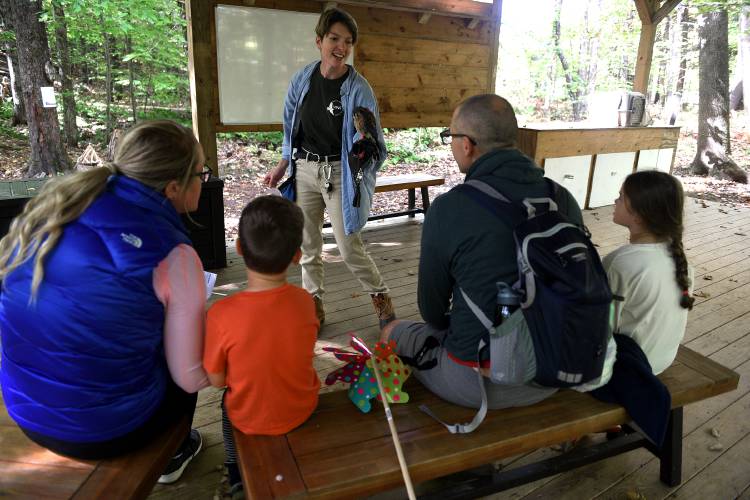
QUECHEE — A raven sings on a perch above a half-eaten corn cob, close enough that you can hear the clapping sound of the bird’s beak when it snaps shut.
It might as well be singing happy birthday: An Upper Valley mainstay for tourists and residents alike, the nonprofit Vermont Institute of Natural Science, the raven’s home, turned 50 this year.

During the “on” season at the VINS Nature Center, which begins in the summer and runs through October, visitors can see a live bird show three times a day, or embark on a sprawling “canopy tour” — up in the trees on a 50-foot tall sidewalk — which looks out on the river that birthed VINS half a century ago.
In 1970, David Laughlin, a Woodstock dentist, agreed to support an environmental study proposed by one of his patients of the Ottauquechee River, which was badly polluted by mills and factories on its banks. Laughlin was joined in these early efforts by his wife, Sally, as well as fellow Woodstock residents Rick Farrar and June McKnight. The study that they pioneered led to the first water quality litigation in the state, resulting in massive cleanup. To further protect the river through educational outreach aimed at kids, the group founded the Vermont Institute of Natural Science in 1972.

Farrar served as executive director for two years, after which Sally Laughlin took over. Over the next two decades, VINS grew to more than 5,000 members with her at the helm, while also moving to expand the institute’s focus toward animal rehabilitation.
The Raptor Center in Woodstock opened to the public in 1987, complete with an exhibit area and a behind-the-scenes infirmary.
“People were bringing us injured birds all of the time,” David Laughlin said back then.
Community-based rescue efforts happen in even greater numbers today. The institute typically accepts around 400 to 600 birds annually in its rehabilitation program. But two years ago, at the height of Covid-19, VINS took in 1,000 birds.
“We couldn’t believe that people were bringing so many animals into our care,” Assistant Executive Director Mary Graham said. “When people were at home during the pandemic, all the time they spent outside meant that they were finding more orphan nests and injured birds.”
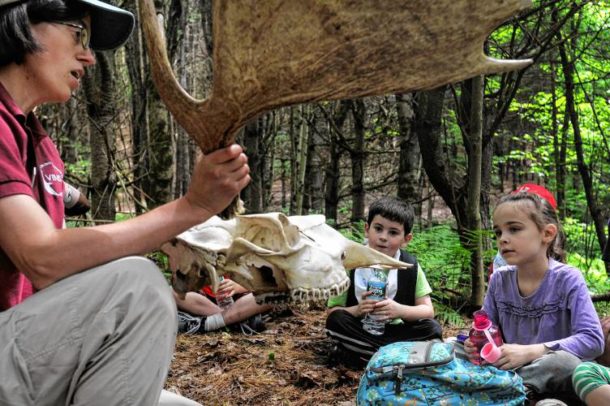
Anna Morris, 30, serves as the institute’s lead environmental educator and is in charge of the birds’ training and care. Since joining VINS in 2016, Morris said, other trainers and rehabilitators across the country are increasingly viewing the organization as a source of expertise.
“I find more and more people coming to us to learn,” Morris said.
Malerie Muratori, an environmental educator who has been working with raptors since she was 14, said that this respect comes from the level of care that the birds at VINS get every day as they’re rehabilitated. Inside their enclosures, the birds are often given something to shred or hunt.
“These are efforts to engage them with their natural behaviors,” Muratori said. “The other day I watched one of our broad-winged hawks kicking golf balls.”
The initial interest in the Raptor Center helped draw roughly 25,000 annual visitors by the mid-1990s, and the board of directors began searching for a site in the Upper Valley that could accommodate their growing fan base.
The VINS Nature Center, an expansion of the work being done in the Raptor Center, moved in 2004. The campus is off Route 4 in Quechee, on just under 50 acres of woodland adjacent to the Ottauquechee River.
“Today, VINS is very much a part of the fabric of the Upper Valley, and it’s also a significant economic engine, if you will,” Executive Director Charles Rattigan said.
VINS has 28 full-time employees, and when it hosts a nature camp in the summer, the staff increases closer to 40.
The Quechee site became a refuge for many during the pandemic, when families, especially with young children, were looking for an outdoor destination. Last year, around 70,000 people made the trip to VINS.
Rebecca Kern visited the Upper Valley on Wednesday from Easthampton, Massachusetts, with her 3-year-old daughter Violet, who had the day off from school.
“We have two friends who recently came and were saying how incredible this place is,” Kern said. “It’s so immersive.”
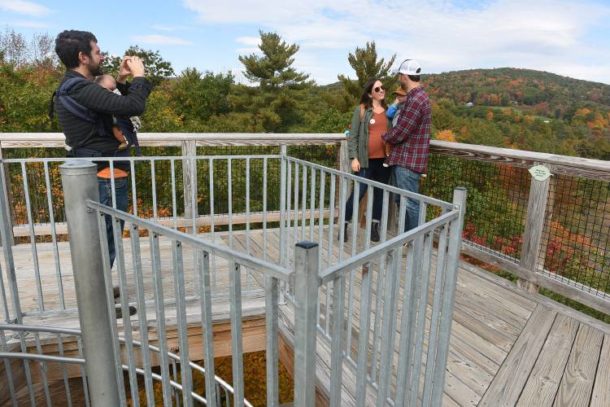
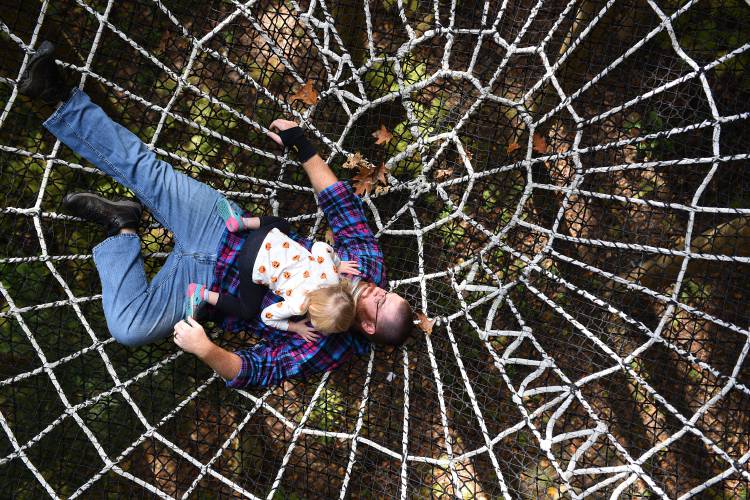
Violet had recently emerged from “the spider web,” a giant net at the top of the canopy walk that lets visitors see down to the forest floor far below and maybe catch a glimpse of a robin or a woodpecker.
“Visitors that are dropping by for one time only sometimes look at us like a museum or a zoo, but we try to emphasize that we’re leaders in outreach and research,” Graham said.
The institute tags monarch butterflies, pulls invasive species and tracks red-tailed hawks. VINS School Programs, which focuses on environmental education, operates in 25 schools throughout Vermont and New Hampshire.
But a crucial part of their advocacy work continues to center on building human connection to nature through animals.
Last week, in one of 17 raptor enclosures that the public can walk alongside at the Nature Center, a snowy owl perched over a breakfast of white mice and a Cooper’s hawk looked out through the net roofing at the sky.
“It’s migration season,” Graham said. “The birds can feel it. They get angsty this time of year.”

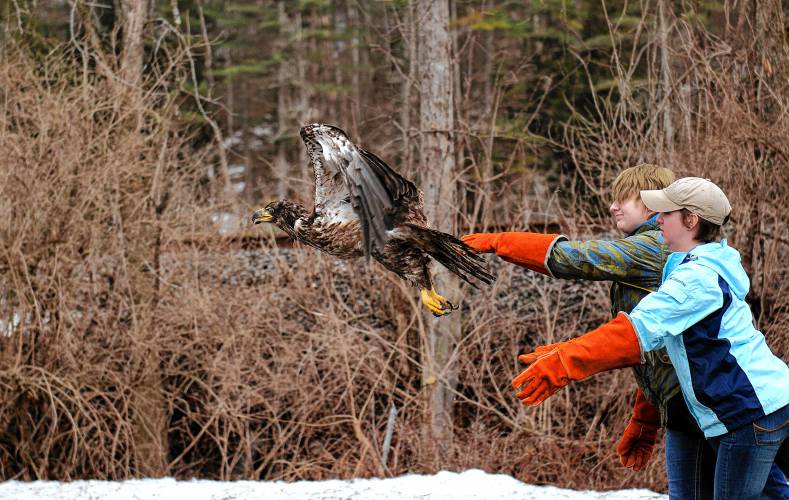
Most of the birds that reside in VINS’ care have been rehabilitated, or are rehabilitating, and wouldn’t be able to survive if returned to the wild. But some recuperate to the point that they can be released.
“That’s a celebration of an animal that gets a second chance in nature,” said Morris, the lead environmental educator.
In the songbird aviary, which opened for the first time this summer, mourning doves, American robins and cedar and Bohemian waxwings tweet and dart over visitors. A heat lamp sits above the feed pedestal in the aviary and turns on when temperatures dip below 40 degrees. It’s around that time that VINS, which stays open to the public year-round, starts offering snowshoes to visitors.
Warmer, shorter winters stress raptors’ hunting season, and birds like barred owls are brought into VINS emaciated and starving.
“We’ve talked about climate change a lot in the past 10 years,” Graham said.
This summer, VINS hosted climate activist Bill McKibben for a panel discussion alongside Vermont congressional candidates Peter Welch and Becca Balint.
The event shocked some community members, especially business owners, Graham said: “When VINS started in 1972, we weren’t advocates for climate change, but we were advocates for the water and the air.”
With the institute turning 50, climate change is a “perfectly appropriate” discussion for VINS to participate in, as Rattigan sees it.
“We should also encourage others to participate in it, especially I think given our efforts to educate people about the natural world, to encourage concern, involvement and stewardship,” he said.