



ST. ALBANS — The only homeless shelter in Franklin and Grand Isle counties, now under new management, is slated for major renovations this fall. The shelter operators also plan to lower the barriers to staying there, amid a statewide housing crisis.
For years, the organization Samaritan House has managed a shelter in St. Albans — called Tim’s House — and provided services to people in the area who are experiencing homelessness. On July 1, Samaritan House merged with the Champlain Valley Office of Economic Opportunity, a Burlington nonprofit that will now operate the facility.
Local advocates and officials announced the changes Wednesday outside the shelter.
About 20 people currently live at Tim’s House, which is set up for congregate living with shared bedrooms and bathrooms. The $750,000 renovation, slated to take place from September to January, will create new, single-occupancy bedrooms for 16 people.
The project is funded by a grant from the Vermont Housing and Conservation Board.
Ben Kaufmann, the program director at Samaritan House, said while the renovations will reduce the shelter’s capacity he is confident that newer, more private rooms will help people stabilize and move more quickly into transitional and permanent housing.
It’s not uncommon for people to stay at Tim’s House for six months or more, Kaufmann said, noting that Samaritan House currently has no limit on how long people can remain there because they know how hard it is to find affordable housing in the region.
“Right now we work off a waiting list that will only grow as our capacity goes down,” he said. “And our length of stay has gone up in recent years.”
Advocates said the merger also will give Samaritan House’s existing staff more time to work with guests directly, since the administrative side of the operation will be handled through the existing infrastructure of a larger organization.
Samaritan House also provides outreach services to people living in motels, and allows anyone to use services at the shelter including laundry, showers and air conditioning.
“It’ll be a place for people to be with dignity and respect,” Champlain Valley Office of Economic Opportunity Executive Director Paul Dragon said of the shelter. “And we think in the end, this really does help move people out of homelessness.”
The Champlain Valley Office of Economic Opportunity also plans to start operating Tim’s House as a low-barrier shelter — meaning that guests will be able to stay there on a first-come, first-served basis regardless of drug or alcohol use.
“This is a place for the most chronically homeless individuals — people who’ve been on the street who can’t make it at the hotel or make it anywhere else,” Dragon said.
Kaufmann said that Samaritan House temporarily closed Tim’s House at the outset of the pandemic and instead began offering more outreach services to people at local motels.
They continued those additional services even after reopening the shelter, he said, and it was becoming a strain on the organization’s seven-member staff.
The Champlain Valley Office of Economic Opportunity, which addresses economic, environmental, social and racial justice issues, saw that Tim’s House was struggling, Dragon said. The organization does not typically operate shelters, but felt Tim’s House had an important role in the region and wanted to ensure that it stayed open, he said.
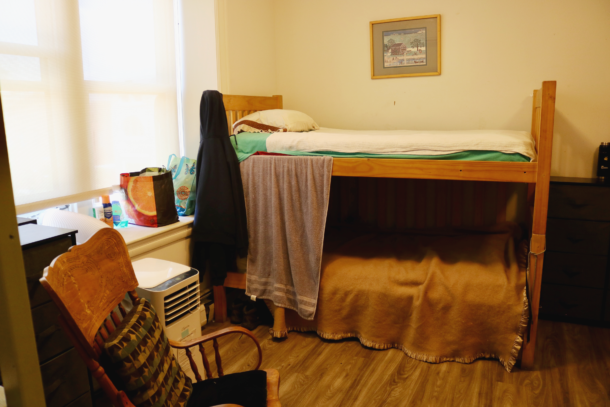
Kaufmann said that plans are for no one to be displaced from the shelter as a result of construction. Crews will renovate the building one section at a time, allowing guests to move out of older sections and into newer sections as work progresses.
At a given point in time, there are about 200 people — in some 130 households — who are experiencing homelessness in Franklin and Grand Isle counties, according to Jess Graff, director of the organization Franklin-Grand Isle Community Action.
Those figures include people living in motels through the state’s general assistance housing program, she said, and are very likely an undercount.
Graff said there are services and funding available in Vermont to rehouse people, but there aren’t enough affordable units.
At Tim’s House, Kaufmann said he’s seen this firsthand.
“We have people staying with us doing everything that’s asked of them,” he said. “And they’re still with us longer than six months because there’s just nowhere to go.”
