



Some South Burlington residents are opposing a housing development that’s been decades in the planning and is currently going through the Act 250 permitting process.
The proposal is to construct 32 residential units with roadway and utility access on an undeveloped 6.9-acre parcel in the Wheeler Nature Park at the north corner of Dorset Street and Park Road.
“It is a mixture of duplexes, single-story carriage homes and two-story single-family homes,” said Benjamin Avery, president of construction and development at BlackRock Construction LLC. “If the project is approved this summer and is not appealed to the Environmental Court, we would start the project before the end of the year.”
It includes 1,020 feet of new roadway off Park Road, sidewalks, landscaping and utility lines.
The city’s Development Review Board approved the project last July, and the developers applied for an Act 250 permit last September, as required by the state’s land use and development law. They are awaiting an answer from the Act 250 district commission.
The District 4 Environmental Commission held a hearing on April 11 and has begun its deliberations. Officials usually issue a decision about three weeks after deliberations are complete, a coordinator from the district said in an email.
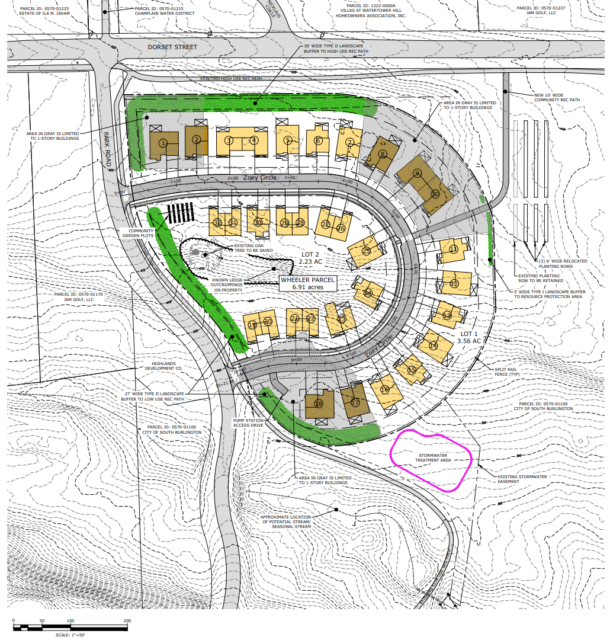
Residents are concerned that the project would fragment the 110-acre Wheeler Nature Park, violate city and regional comprehensive plans, disturb wildland habitat in a pristine setting with scenic views, and defy Act 250 criteria regarding noise, traffic and emissions.
“The maps show that this area is supposed to be conserved,” said John Bossange, a nearby resident who said he is one of more than 125 neighbors opposed to the project. “So this has become an issue of trust and an issue that sort of permeates the whole decision-making process.”
The project includes blasting rock ledges on that parcel, which Bossange said would affect the quality of life of area residents and disturb, or possibly displace, wildlife from the park.
More concerning, he said, neighbors contend that the developer submitted false information pertaining to the nature of the land, clearly identified as “open land” and “rural” in regional documents, in the Act 250 application.
“One of the overriding issues and concerns is the intended purpose of the entire Act 250 process, beginning with the ability of citizens to present their case, without legal counsel, and to advocate for the protection of natural settings and the environment,” Bossange said.
Bossange teamed up with James Marc Leas, a neighbor and patent lawyer, to submit claims “regarding materially false or misleading statements” with supporting documents on June 1 and June 16 to the District 4 Environmental Commission, along with a request for a hearing on the Act 250 permit. They even filed a report to South Burlington police June 29 outlining the alleged violations that they characterize as “criminal.”
A subsequent police report notes that an officer called the developer and a member of the Act 250 board, determined there had been no criminal activity and closed the investigation.
“We’re waiting for a decision from the district commission on our motion for reconsideration on all these flaws that we identified,” Bossange said.
Avery declined to answer specifics about the ledge, the blasting process or alleged false statements, and referred to the materials filed in the permitting process.
The city has adopted plans and regulations that are consistently reviewed and updated that aim to balance the goals of natural resource protection and thoughtful community development, said Paul Conner, the city’s director of planning and zoning.
The city “trusts the state Act 250 process to address matters under their jurisdiction,” he wrote in an email.
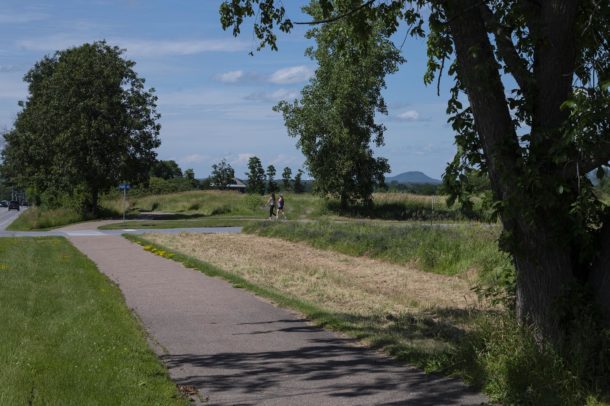
The city acquired the 110-acre nature park in 1992. It consists of mixed forest, grasslands, shrublands, wetlands, about 2 miles of walking trails, a tree nursery and a 14-acre Wheeler Homestead area that includes community garden plots for rent. City planning documents have referred to it as “the green lungs of the City Center.”
Most of the park is already protected and home to a rich tapestry of wildlife, including warblers, thrashers, woodcocks, deer, foxes and voles. A conservation easement process is also underway to preserve the park in perpetuity.
The Wheeler parcel at 550 Park Road was created in 2017 as part of a settlement agreement between the city and James McDonald (also known as JAM Golf), who still owns the property through a limited liability corporation, according to documents filed with the city.
It is one of several developments approved in the original master plan for the Vermont National Country Club and golf course over 434 acres of land.
The issue of the Wheeler parcel dates back to 2003, when the city’s Development Review Board denied portions of an amended master plan submitted by the golf course for further development. The denial centered on retaining a wildlife habitat corridor along the eastern boundary of the adjoining golf course, which was built in the 1990s, and raised concerns about the fate of the nature park.
After litigation, a settlement proposal was endorsed by voters in 2011 and approved by the City Council in 2015, according to Conner. That agreement included a land swap — 22 acres around the wildlife corridor was given to the city by the golf course in exchange for almost 7 acres of land on the Wheeler park property.
That Wheeler parcel was subsequently approved in the applicant’s master plan for planned unit development. The city, as part of the agreement, modified the zoning there to allow up to 32 homes, Conner said.
But that’s not good practice and is not a good precedent, the opposing residents have contended.
The issue is not whether to build housing but where to build it, Leas said, suggesting that South Burlington has plenty of open land in the city center, which is most conducive to smart growth.
It is “not a place for drilling rock and dynamite-blasting 12,000 cubic yards of ledge, not a place for bulldozers, not a place to demolish grassland and shrubland the size of seven football fields for 32 houses, along with their lights, lawnmowers, snowblowers and leaf blowers,” Leas said.
“The whole point of Act 250 50 years ago was because towns were making deals with developers that were going to make Vermont into New Jersey, just wild development,” Leas said. “If Act 250 does not prevent development in such a gem of a nature park, no open land anywhere in Vermont is safe.”
Corrections: A previous version of this story incorrectly published the wrong map and mischaracterized the authorization process for the development.
