



Editor’s Note: Student journalists from more than a dozen schools across Vermont contributed to the Climate Report Card series, reporting on their schools’ systems for heat, electricity, transportation, food, and climate education. Each article in the series collects a handful of accounts from participating schools; together these stories show that our school communities are working hard to be more energy efficient, and that we face complex trade-offs in seeking to reduce our carbon footprint. The project does not claim to be a complete or authoritative evaluation: its core purpose is the students’ civic engagement. Special thanks to Mariah Keagy her colleagues at VEEP for their generous collaboration.
The Underground Workshop’s Climate Report Card series was compiled, organized and edited by a team of student editors: Anika Turcotte, Montpelier High School; Adelle Macdowell, Lamoille High School; Anna Hoppe, Essex High School; Mei Elander, Enosburg Falls High School; and Cecilia Luce, Thetford Academy

Contents:
One community in focus: Essex High School
Snapshots:
Champlain Valley Union High School, Hinesburg
Lake Region High School, Barton
Burr and Burton Academy, Manchester
Introduction
by Anna Hoppe, Essex High School
Vermont is known as a “green” state, but some of the statistics about our electricity production and usage require a deeper look.
According to the U.S. Energy Information Administration, “In 2020, Vermont generated about 100% of its electricity from renewable resources, a larger share than in any other state. About 58% of Vermont’s utility-scale in-state generation came from conventional hydroelectric power.”
However, Vermont currently consumes over three times as much energy as it produces. Because of this, only about 32% of the state’s energy consumption comes from renewable sources.
Schools around Vermont are looking to increase that number by using renewable energy such as solar and hydro to help power their buildings.
These investments can be expensive, so schools often enter into arrangements called net metering agreements, or power purchasing agreements, with private companies. This allows the school to avoid a high upfront cost, but it means that schools will not always get all of the benefits from the project.
In addition to bringing schools into the future with renewable energy, many schools have to work to bring their buildings to the present. Older buildings are not built with the energy efficiency strategies that are relatively standard today, such as LED bulbs and timers and daylight sensors for lights.

One Community in Focus: Essex Westford School District
by Anna Hoppe, Essex High School
On February 1, 2022, the Essex High School Environmental Club gathered in a science classroom before school to talk about solar panels. The club and the Essex Rotary Club’s environmental committee had both independently decided to focus on new municipal solar installations, so they decided to meet through Zoom to discuss collaborating. The goal was for the Rotary Club to support the students’ work of getting more solar panels for Essex High School. This meeting was the culmination of student advocacy, and the project would build upon work already being undertaken by the school district.
The Essex Westford School District administration itself has also been working to reduce electricity consumption and offset usage. In the 2021 fiscal year, Essex High School consumed 1,974,338 kilowatt hours at the cost of $314,255. That’s about 5.6 KWh per square foot. According to the Energy Information Administration, the average for US schools, as of 2012, was 10.3 KWh per square foot.
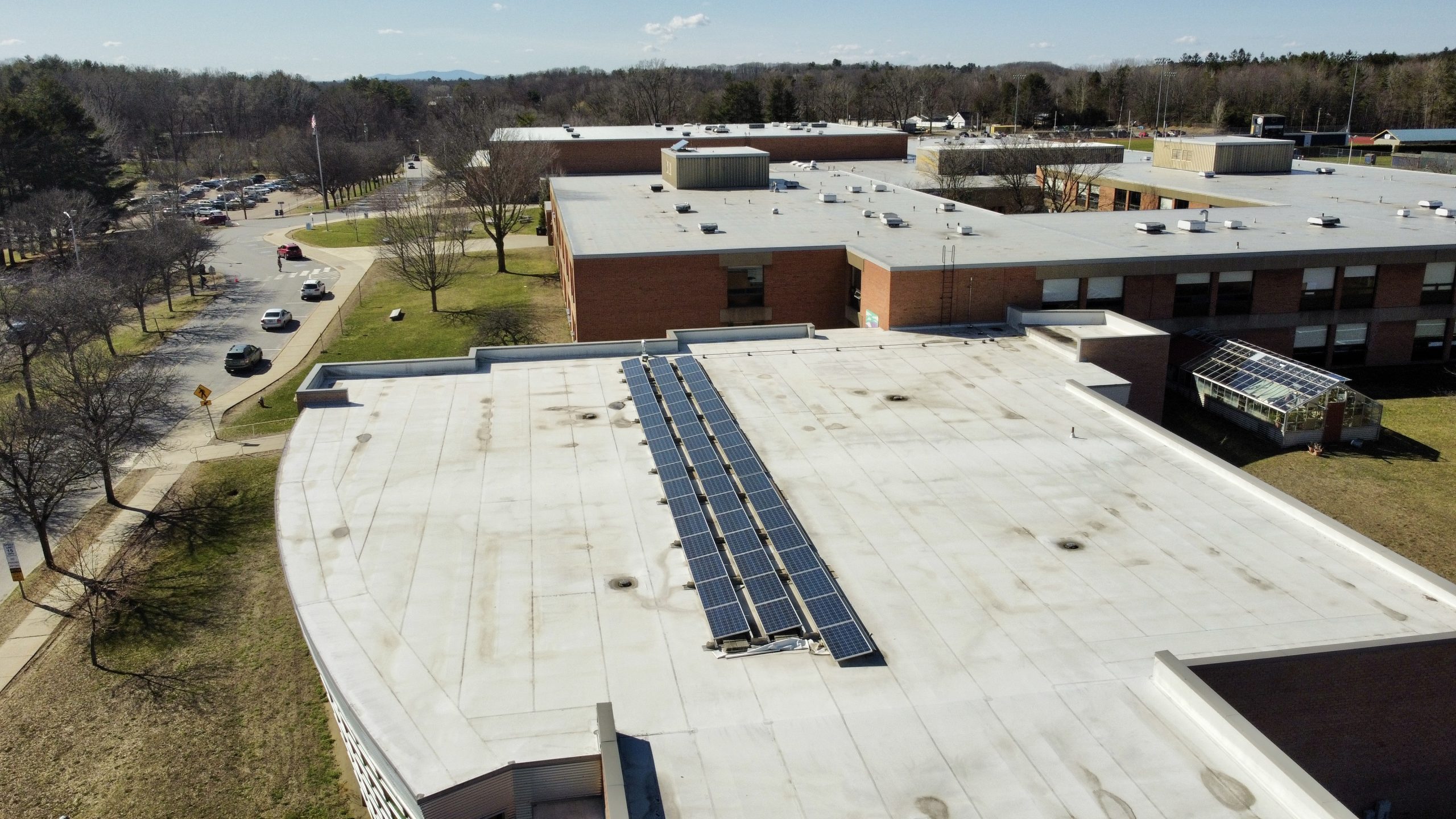
The Essex Westford School District partnered with Green Lantern Solar in 2019 to offset its electricity consumption with five solar arrays that cover around 20 acres of land. Three of the arrays are on old landfills, which are often a popular choice for solar arrays because they are not taking up arable land.
Brian Donahue is chief operating officer for the school district. He said these panels are offsetting almost all of the district’s energy consumption through a credit system with Green Mountain Power, “so when we’re in the middle of summer, our Green Mountain Power bill might be minus $20,000 because it’s producing a lot of credits that are going on to our bill.”
“It’s a win-win situation for everybody,” Donahue said.

The Essex High School building was constructed in 1969, so its electrical systems were not built with today’s education or standards for energy efficiency in mind. Donahue said that the cost to renovate the buildings to bring them to current standards would be “tremendous” – around $180 million over 20 years– and that investment would just replace old infrastructure with similar versions. The facility assessment conducted by the district in the summer of 2021 found that many of the schools are reaching the end of their life cycle, so the community will need to decide whether to replace or improve the current building in the next few years.
To reduce electricity consumption, the district is replacing older, less efficient light bulbs with LED light bulbs, using a grant from Efficiency Vermont for 3,000 bulbs. Donahue said the maintenance team will continue to add LED lights and motion sensors for lights as they need to be replaced in order to have “cost effective best practices.” These energy efficiency techniques are standard now, so the focus is more on bringing the building up to the present day than pushing it into the future.
These changes have been occurring across the district. Building staff move from replacing the lights in larger rooms, such as the gymnasiums and learning centers, to smaller ones.
Donahue said students “have to push this agenda.”
The students of Essex High School are doing just that. Essex High School’s environmental club is working on securing additional solar panels for the district that will, ideally, funnel electricity directly to Essex High School, instead of towards energy credits. This initiative has been led by Iris Hsiang, a 12th grader, school board representative, and a member of both Youth Lobby, a youth advocacy organization that focuses on climate justice, and the Vermont Climate Council. Since Hsiang will be graduating this June, Essex High School is currently looking for another student to lead the initiative. The club has teamed up with the Essex Rotary Club, which also includes Underhill, Jericho, and Westford.
Hsiang has been involved with the club since her sophomore year, but increased her participation last year. In the past, the environmental club focused more on changing students’ habits, especially their recycling practices.
“We have been trying to create this broader shift to make it from a recycling club to environmental club,” Hsiang said. “I’m personally really excited about the solar panel project because I feel like it’s a really real concrete action that we can take…I think that the best way we can do things is through big aggregate changes.”
As a student representative to the school board, Hsiang has pushed for electrification efforts, but she said that the school board has “been adamant that [any electrification project] depends on grants.”
The school often relies on grants for big projects. Since it is a public institution, it can’t directly take advantage of incentives designed for taxable entities like the federal solar incentive tax credit. Hsiang thinks that climate change-related investments will likely save the district money in the end, but she added that too much of a focus on economics might not be the best way to approach climate change solutions.
On April 13th, the Essex Rotary Club met to discuss the Essex High School project, as well as other potential municipal projects, and decided to move forward. Their goal is to facilitate the installation of solar panels on public land in Essex Town and Essex Junction, including school-owned land.
“We think it’ll help Essex and the state reach aggressive climate change goals,” said Greg Morgan, a member of the environmental committee at the Essex Rotary Club. “I think it will save the town money, and save taxpayers money, if it’s done right.”
Typically, projects like these are started with grant money, but there is another option that does not require a full up-front investment. Ben Gordesky, a solar project manager, explained that private investors can buy the system, receive the tax benefits, and give the town or school partial benefits before eventually transferring ownership to the municipality.
For example, a town could pay for 85% of the system over time, as lease payments to the investors, who own the system. After six years, the investors will have fully secured the tax benefits and will transfer the ownership of the system to the town or school for a small sum. During the first six years, the school or town typically only gets about 10% of the net metering benefits, but after that they receive all benefits except the tax benefits, as they are public entities. These agreements are called power purchasing agreements or net metering agreements.
Net metering is “one of the main economic drivers of solar in Vermont,” Gordesky said. “The way net metering works is that if in the summer you generate extra credits, like… if your meter starts at 5000 [in] the beginning of June and at the end of June, it’s 4000 and went backwards, net… those extra 1000 kilowatt hours of credit would be saved for 12 months.”
Once construction has started on the projects, which can be as simple as having the initial 5% investment and a contractor, the contractor and private investors for the projects will be able to benefit from higher tax credits. The tax credit for solar installations is currently at 26%, but it will drop to 22% after December 31st, 2022.
Both students and staff, including Brian Donahue, will keep working for a greener future.
“I’d like to think of myself as an advocate,” Donahue said, “[but] we’re more used to what we’ve been doing for the last 50 years than what we need to be doing for the next 50 years. And so we really need the voice of the younger generation reminding us that it’s time to change, and change fast.”

Snapshot: Enosburg Falls High School
by Mei Elander, Enosburg Falls High School
Enosburg has a Power Purchasing Agreement (PPA) with Green Lantern Solar. Schools can form an PPA with a solar contractor or business which allows them to purchase excess energy from owners of solar panels at a lower rate than their regular electricity cost. In exchange, the contractor or business receives tax breaks from the solar panels. This type of agreement is one of the easiest as schools gain some benefits of the solar panels without having to maintain them.
Morgan Daybell, the business manager for Franklin Northeast Supervisory Union (FNESU), explained that the alternative would be for Enosburg to own and set up their own array. This would mean that Enosburg would receive one hundred percent of the solar energy.
However, they would also have to pay the upfront costs which could be a couple hundred thousand dollars plus maintenance, Mr. Daybell said. While a PPA agreement is less expensive for the school there are also downsides to the PPA; the community and students are not as involved and are likely not aware of the agreement or know who the owners of the panels are.
The solar panels Enosburg are using are on the gravel pit owned by the Leach family, and the energy produced puts credit toward the cost of Enosburg Schools’ power. Enosburg Leach Estate Solar LLC and NST Solar LLC, the owners of the solar panels, have named six to twelve other places who utilize this solar energy, like Enosburg. As a result, these places do not pay as much for electricity. In return, Enosburg and the other companies pay back a percentage of the credits to Enosburg Leach Estate Solar LLC and NST Solar LLC for the initial installation and upkeep.
Snapshot: Champlain Valley Union High School, Hinesburg
by Emma Crum
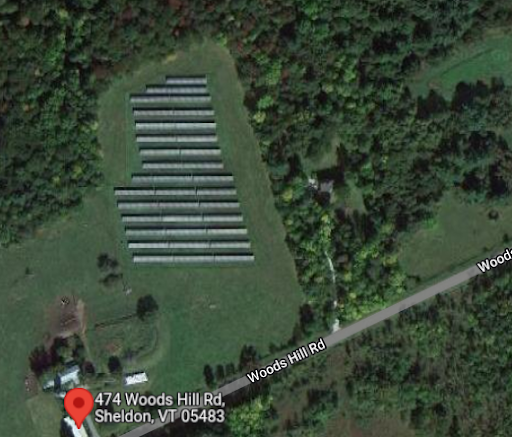
“Since the fall of 2017, CVU entered a group net metering agreement with BDE Sheldon Lazar Solar, LLC to purchase solar credits. CVU’s allocation of the energy generated is estimated to purchase approximately 820,000 kWh annually,” said Katie Antos-Ketcham, CVU’s Environmental Action Club adviser.
Snapshot: Lake Region High School, Barton
by Tressa Urie

In the basement of Lake Region one classroom is run by solar power from solar panels on the maintenance shed roof. This classroom is used for woodshop, welding, horticulture and alternative energy classes, and a space for hydroponics and tilapia fish.
The solar panels were installed by Lake Region in 2020 with the idea to use the data from the panels as a learning opportunity for the alternative energy class, to look at solar power. The system was gained through federal money and it was about $30,000 according to Principal Andre Messier.
The solar setup is from Green Mountain Solar. There is little information on the exact usage and specific amount of electricity that the solar panels are generating. For the year until the end of February 2022 the solar panels had created 268 kWh of electricity compared to the school overall using 20,860 kWh in February of 2021.
Tim Gustafson-Byrne is the horticulture, woodshop, and the alternative energy teacher. He said that there is little information about the electricity the solar panels are creating, and is frustrated with this because it makes it more difficult to have the solar panels be used in the classroom for learning material. Expanding the amount of solar panels the school that the school board has discussed and barriers include cost and space.
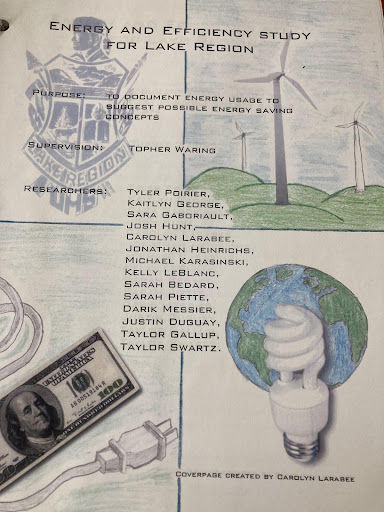
Mr. Topher Waring is a former science teacher at Lake Region High School who worked with an Honors Physics class in 2011 to delve into the school’s energy consumption. The class conducted a study evaluating all of the aspects of the school’s energy usage and possible pathways to be more efficient. The purpose of the project was to “assist the School Board in being able to create a more energy efficient school.”
The school administration looked at their energy usage when it started to increase rapidly. The class was divided into groups and each group focused on different aspects of the school. The school replaced the light bulbs twice to be more energy efficient. Lights on timers, based on natural light levels, replaced the windows. The visibility of the efficiency effort has declined over time but has continued to positively impact the school. Mr. Waring thinks that there is still work to be done at Lake Region.
Snapshot: Burr and Burton Academy, Manchester
by the Burr & Burton Academy Environmental Club
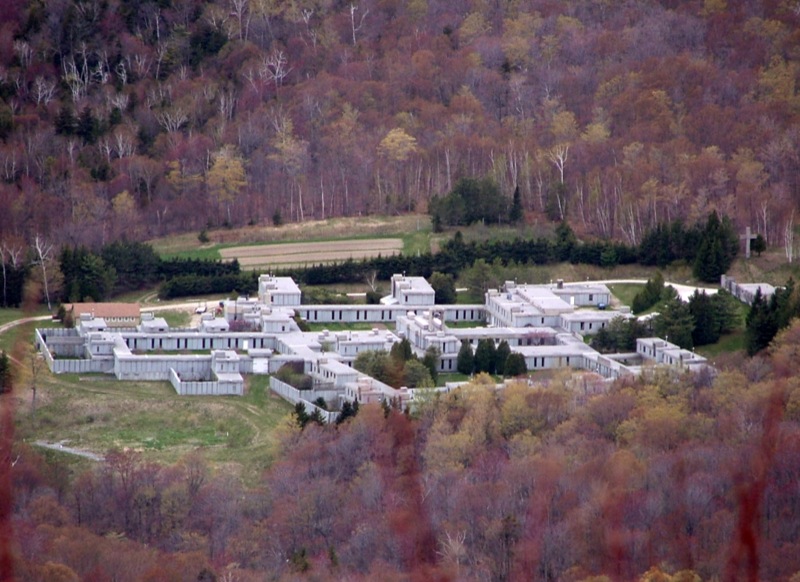
Burr and Burton Academy (BBA) has a unique arrangement with the Carthusian Monks, who have lived on Mount Equinox since 1950. The monk’s electric energy is sourced solely from the hydroelectric facility built by Dr. Joseph Davidson in 1959 which rests at the base of the mountain.
The monks, who only need to power a few buildings, were looking for someone with whom to share their extra energy. On Monday April 22, 2013 Headmaster Mark Tashjian declared that BBA would be buying the Carthusian Monks’ excess hydroelectric energy.
This agreement is more than just a transfer of energy. Monsignor Stephen Rossetti, Director and Chairman of the Equinox Foundation and business liaison to the Carthusian Monks, said in an interview with Manchester Journal that “[i]t’s not just about selling excess power. It is an educational opportunity for the kids to come up and look at it and share our resources.”
“[The Prior] had told me that it was a God-given resource and that it was to be used wisely,” Rossetti said. Today, half of BBAs electricity comes from the hydro project, 25 percent from solar, and the rest from standard electricity supply.
Lingering Questions
by Anika Turcotte, Montpelier High School
Are schools using electricity as effectively as possible? How could consumption be reduced in addition to sustainable sourcing?
How can state government support sustainable power within our schools?
How will school districts find the funding for facility upgrades?
Is the renewable energy sector robust enough to support all Vermont schools? Is this a realistic expectation?
Schools acknowledged that space is a limiting factor of solar energy. How can this be overcome in urban settings?
