



This commentary is by Robby Porter of East Montpelier, a self-employed woodworker and owner of small hydroelectric projects.
Robby Porter’s father, Bill Porter, was a remarkable character, a former editor of the Barre-Montpelier Times Argus who lived on a hillside farmstead in the village of Adamant in Calais. He died April 8.
In 1998, as part of a corporate downsizing, my father chose early retirement. He took his money in a lump sum and invested it in the stock market himself.
His next risky choice was to take flying lessons. A grizzled old Vietnam vet named Wayne gave him flight instruction. I was working in front of my house one summer day when I heard the drone of a single-engine plane. Looking up, I could see the silhouette approaching from the northwest. I watched for a minute and, as they got closer, waved both of my arms over my head. The wings dipped, a little harder on one side than the other, and I assumed it was my dad at the controls.
After watching them for a minute, I turned away — and as I did, I heard the unmistakable sound of a plane engine getting louder and more high-pitched as it divebombs.
At first I thought I wouldn’t give them the satisfaction of turning back around. But the plane had seemed pretty close when I looked away and after a few seconds, with the engine starting to sound more like a scream than a whine, I couldn’t stand the suspense anymore. I turned and peered at the approaching windshield, trying to make eye contact through the propeller blur and waving to show that I got the joke.
The engine sounded truly desperate by this point. I was beginning to see details on the landing gear and I realized several things simultaneously. First, if Wayne wasn’t piloting the plane, then they were going to die in a fiery crash. Second, the joke wasn’t to imitate a dive bomb but to see if they could actually make me run. Third, I wasn’t sure anymore that it was a joke.
I ran in place for a second while the same instinctive math that tells you how to catch a baseball was trying to figure out whether they would hit in front of me or behind me, then I ran forward. Wayne was at the controls (as I learned later) and pulled the plane out of its dive. He and my father thought it was funny as hell and, for weeks afterward, reminded me every time I saw either of them.
The FAA never said decisively no to my father’s pilot’s license, but his application stalled, a victim of the FAA bureaucracy, concerns over bypass surgery he had had years before, and his choice to have a physical by his own doctor instead of the one recommended by Wayne.
I breathed a sigh of relief. By this point, my father and I had worked together, cutting firewood in the fall and hay in the summer, for a quarter of a century. I’d come to realize that he was not a natural with machinery.
When I was 10 years old, my parents and a friend of theirs bought two tractors and a collection of worn-out haying equipment. The tractors were small, but my father and his friend hooked everything together behind the tractors and drove it home from a neighboring town.
They arrived in the summer dark quite a while after we expected them. One tractor had headlights, one of which worked. We could see and hear the procession when it came through the village a mile from our house, a single, steady light followed by an irregular symphony of scratching and clanking as the various machine, tethered together in an unnatural fashion, bounced over potholes and dragged their tines on the gravel road.
Relief filled me — my dad was alive. I had gathered enough from the adult conversation leading up to this event to learn not only that they were unsure how well the tractor-train idea would work, especially on the downhill sections, but also that neither tractor had good brakes.
The three hills
I learned to drive on one of those tractors starting with simple tasks like tedding hay or pulling the hay wagon slowly around the field so people, usually my father’s friends from work, could load it with hay bales. When the wagon was loaded, my father would drive the tractor to the barn. Our house and barn sat at the top of a steep driveway composed of three hills. The first was steep, the second steeper and shorter, and the third more gradual and longer.
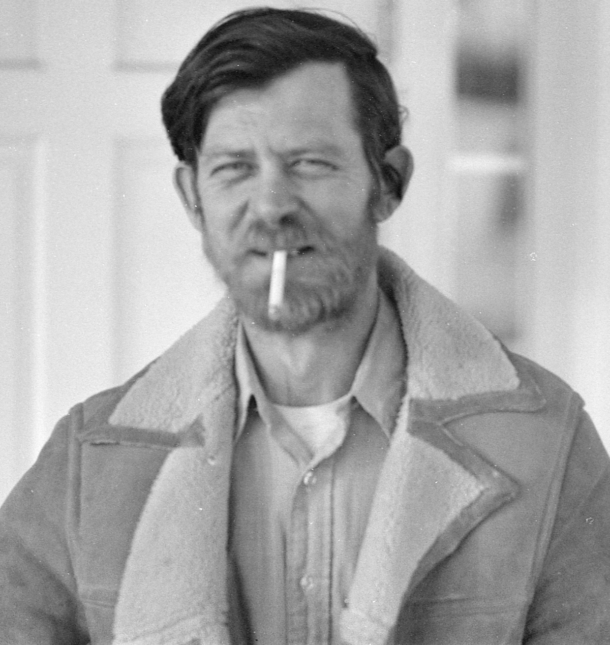
My father’s technique was to hit the first hill in third gear with the throttle wide open. Midway up this hill, the tractor would start bogging down and he would shift to second. This involved putting in the clutch, pulling the gearshift out of third and timing the shift into second just as the tractor stopped forward motion, since you had to be stopped to shift into gear on these old tractors. The trick was to get the clutch out before the tractor and hay wagon started to roll backward.
The brakes helped a bit by slowing backward motion, although they were ultimately no match for gravity and the pull of the tractor and loaded wagon, so you had to hit the shift and clutch release just right on the first try.
If the load was particularly big, then the whole process would be repeated on the next and steeper hil,l where he would need first gear instead of second. It was an aggressive, dramatic and entirely unnecessary way to manage the hill.
When I got old enough to drive the loaded wagon and tractor, I followed the procedure demonstrated by my father, but I was unable to get any useful stopping power from the brakes without pressing down with more than my body weight, a necessity I accomplished by bracing one hand under the steering wheel for more down pressure. This left the other hand free for the shift. It was a complicated choreography and it gave me a knot in my stomach every time I approached the hill.
It took years before I realized the obvious: Stopping at the bottom and shifting into first gear was a much safer and more predictable method for getting up the hill. I undertook this change in procedure with the same reluctance any child feels when they deviate from the behavior modeled by their parents — I was unsure, perplexed at how my father had missed this solution and afraid that it was me who was missing something important.
Force of will leading the charge
It has taken me several more decades to conclude that I was in fact missing something important.
The nature of unspoken lessons, especially those received when you are young, is sufficiently subtle and instinctive that it never occurred to me to ask my father how to tackle the hill with our small tractor. If I had asked him, he probably would have told me that I should approach the hill in whatever way I felt safe and comfortable, and that attitude is probably why I eventually tried doing it my own way. But, if he had told me why he did it the way he did it, I suspect his answer would have been something like, “It’s a big hill so I want to hit it hard at the bottom.”
There is a certain logic to this answer, although it applies more to riding a bicycle than operating a tractor. It is the same logic my father used for most challenges. His approach to mechanical problems — and there were many throughout the years because his collection of equipment was all purchased used and mostly worn out — followed more or less the same thinking. He came at problems with force of will leading the charge and supported by whatever foot soldiers of understanding he happened to have at his disposal at the time.
I follow a different strategy, not just for gaining a hill with an undersized tractor, but as a general approach to life — you need to understand how things work first and proceed on that basis. I figured out pretty early on that I was a better mechanic than my father, but, because I admired him, I assumed that in most other ways I was like him. Recognition of our differences came slowly and then with a flash of clarity.
There are few experiences more humiliating, as a middleaged man, than waking up in the morning and realizing that all night your mind has been endlessly looping a Taylor Swift lyric — “oh, oh, oh,…a careless man’s careful daughter.” But one morning there it was, the succinct summation of parent and child, action and reaction, packaged by a lyrical genius into a bubblegum song. While my father attacked mechanical problems with conviction, often based on a misunderstanding and emphasized by hammers, I try to unravel the mysteries of cause and effect, prudently aware of my ignorance and cautiously advancing only to the edge of what I understand. I would call it will vs. understanding but careless vs. careful is much more poetic.
So, when he took his retirement money and began investing it in the stock market in 1999, it occurred to me that he might not know what he was doing.
If he hit it hard and paid attention …
When my mother and father decided to get married, he was a college dropout working as a tour bus driver on Nantucket. He had a strong Alabama accent and a penchant for drinking, gambling and fighting.
When my mother’s father, an Ohio doctor, heard about the impending marriage, he dispatched my grandmother to put a stop to it. My mother and grandmother spent the visit picking out wedding dresses and the patriarchy grumblingly acquiesced, but never relinquished a slight suspicion about my father, especially with respect to money.
In 1964 my father found work on the Rutland Herald. It was the beginning of a 20-year career he would say was so fun he would have done it even if they hadn’t paid him, which was a good thing because the pay was pretty low.
The year I started college, 1985, my father quit his newspaper job and started freelancing. Before long he had a gig writing the annual report for a utility. He’d hardly ever read an annual report but he approached the challenge of writing one the same way he repaired a machine he didn’t understand — with a conviction that if he hit it hard and paid attention, he could get it done. It turned into a recurring gig and a few years later the utility started winning prizes for the clarity of its annual report, a quality prized by investment analysts as they tried to make sense of the utility’s confusing and highly regulated business prospects.
Eventually my dad succumbed to the utility’s offer of full-time employment and then, when the company fell on hard times and offered early retirement, he took his retirement money and started paying attention to the stock market.
I’d been building and selling furniture for a few years by this time and my little furniture business provided my wife and me with an income — very modest, a lot of creative satisfaction, and a growing need to challenge my mind. When my dad handed me a Fortune article written by Warren Buffett and Carol Loomis that assessed, from a long-range perspective, the state of the stock market in 1999, I took to it with great interest.
I followed this reading with a lot more reading, and a lot of conversations with my father. Not surprisingly, the simple logic advanced by Buffett — you can’t know what the stock market will do tomorrow or the next day, but you can know the approximate value of an individual company — was compelling for both of us in our own way.
To me it meant trying to learn the basics of valuation and analysis. To him it meant reading about companies, getting a sense for them. Pretty much the same difference between our approach to fixing a broken machine, where I tried to advance from understanding and he approached the problem with intuition based on an often faulty analysis. Gradually he started investing his retirement money
My dad had a few months of heady gains before the stock market collapsed in March 2000. The 2000 crash confirmed for me that I didn’t understand why stock prices went up or down. My father’s investments didn’t go down quite as far as the rest of the market, and he hadn’t been fully invested, so when things started to turn around he was able to invest more money and his earlier investments started to creep back toward break-even.
My father and I were cutting firewood at a spot in the woods we called Gert’s Landing when the market hit a peak in early October 2007. Then the market started to slide and went down all winter. The market rallied in the spring before continuing to decline over the next summer. We were back on Gert’s Landing exactly a year later, cutting wood and listening to the radio through our headphones, while the stock market, already down more than 20% from its peak, lost close to another 20% in the first 10 days of the month.
Occasionally, isolated inside the headphones from the noise of the chainsaws and tractor, one of us would catch a pause and point to our ear, a silent, “You hear that?” and the other would nod, he too had heard the headline, “Market down 500 points” (which was a lot in those days).
With my father’s encouragement I had been dabbling in the stock market myself, but I was mostly out of it by this point. That was luck more than foresight. My father had lightened up a bit, but he got hammered along with everyone else. I forced myself to buy in November but I didn’t trust the rally and got out after the market got back up around 13,000. My father stayed in. A corollary feature to his “hit it hard with all your conviction” approach was, “never, ever back down.”
The hydroelectric project
Now I need to flash back and bring in another business story that involves my father and me and, in an indirect way, my grandfather.
In the early 1980s, before my dad quit his newspaper job, he and a friend invested in a small hydroelectric facility. It was an abandoned woolen mill that they hoped to revive for the purpose of generating renewable electricity, a prospect made possible by new legislation.
My mother’s father took a dim view of this endeavor. “That’s the kind of project where the first guys put in all the work and then some other guy comes along and buys it from them and makes all the money,” he said.
A year after they got the project up and running, a flood washed out part of the dam. The additional debt required to repair the dam and other damaged equipment was a heavy financial burden on the project, but the turbines spun and over the years chipped away at the debt, although there wasn’t a lot of money left over as profit. My father’s friend, much the better mechanic of the two, took on the heavy responsibility of running the plant and my father became, in effect, a silent partner.
Toward the end of 2010, my father’s partner wanted to sell his half of the hydroelectric plant. By this point the plant was selling its electricity into the spot market, where the prices were variable but trending lower.
I told my father that he should buy out his partner because I thought the hydro plant was the best investment he’d ever made. A permanent, renewable energy resource, how could you get a better investment than that? Unlike the caprice of the stock market, the physics of this was clear to me. The sun would evaporate water and make rain, the rain would raise the river and you could make energy and money, forever.
My father replied that he’d taken on a huge amount of risk and never made much money, but I was welcome to buy out his partner if I wanted to.
I’d read about peak oil and the days of $4-a-gallon gas were a not-too-distant memory. I thought I understood how this system worked. Energy prices would go back up eventually; they had to. I used our home equity line of credit to write a big check.
So now my father and I were partners in a hydroelectric plant with a bunch of deferred maintenance. We convinced VEDA to loan us money to do the necessary repair work. The loan officer seemed somewhat bemused by our prospects which, at the rate we were getting for our power, would allow us to cover operating costs and repay our loan, but not much more.
Then, a little more than a year after I bought half of the plant, the Vermont Legislature passed net-metering legislation, which allowed us to get a much better rate. And this is where the story gets more personal. It was during this time that my father started to show the first symptoms, unrecognizable at the time, of what would later become Alzeheimer’s disease.
I was absorbing the minutiae of the net-metering laws as enthusiastically as I had read investing articles 10 years earlier. Day by day, I would share with my father my evolving understanding of how this new legislation would apply to our hydroelectric business. It was complicated stuff, abstract and boring, and the next day I would often have to reexplain points I thought he understood the day before.
At the time, I thought he was simply not paying close enough attention and I took his vagueness as a sign of his confidence in my analysis. In retrospect, I think it was the start of his memory issues, which would not be fully apparent for another four or five years.
The thing is, what made the hydroelectric plant work financially had nothing to do with what I thought I knew about physics or peak oil; all of that was beside the point. What made it work was luck. We got lucky when a change in legislation got us a better rate for our renewable generation. It took a few years for this cold reality to settle over me.
A matter of conviction
Frankly, I’m still trying to understand how it works, the yin and yang of parent and child expressed so succinctly in Taylor Swift’s catchy line. Are they equal parts, the willingness to plunge forward undeterred and the cautious analysis securing the rear flank? I don’t know.
I’m pretty sure the tip of the spear of all human advancement from fire to democracy to semiconductors has started with someone’s conviction, unrealistic at the time, that they were going to do something and the hell with the analysis and consequences. And if there ever was a guy who moved forward based on his own conviction about what should happen and without regard to the odds or analysis or other people’s opinion, it was my father.
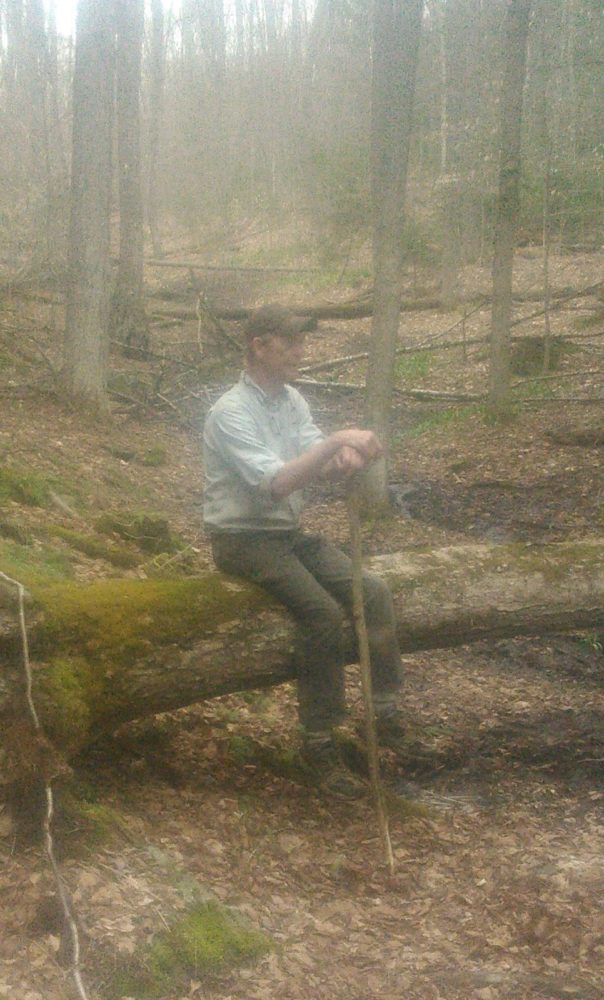
In the spring of 2018, he and I scouted for firewood again on the steep ridges above Gert’s Landing. His Alzheimer’s had advanced and then plateaued and he seemed part of this world but also a little faded. I took a picture of him sitting on a blown-over tree trunk in his woods where he’d always loved to be. The camera lens on my cheap phone had a thousand tiny scratches from riding in my pocket and it made the image seem gauzy and blurred, perfect in a way for the condition he was in.
We cut 20 cords of firewood at Gert’s landing that year, enough for both of our houses. We had the winch on a tractor with no brakes, a different, better, bigger tractor than that old one I learned to drive on, but still no brakes. He’d taught me years ago to use the gearing and not rely on a tractor’s brakes, but now he’d forgotten this knowledge and as he positioned the tractor so I could rig the hitch, he kept trying to ease it into place with the brakes instead of low gear.
He was all right skidding because the load acted as a brake and when he got down to the landing it was flat and he didn’t need brakes, but setting the hitch on the hillside was dangerous and dicey. I tried to explain to him to keep it in gear and keep the clutch out as he backed into a hitch, but he couldn’t understand my explanation — hell, maybe he never could understand my explanations. That wasn’t the way his mind worked.
He just kept bearing down on what was left of the brakes with the muscles left in his 78-year-old leg, convinced he could stop the tractor if he just bore down hard enough.

