

This commentary is by John Freitag, the historian for the Strafford Historical Society and a past moderator of the Universalist Society of Strafford.
These days, when political divisions often seem so intense, it is good to look back at a time when things in Vermont were far worse and take a lesson on how once the most bitter enemies were able to come together and create a structure of lasting beauty and a religious institution based on inclusion.
While it is generally overlooked, the American Revolution was in many ways a civil war. This certainly was the case in Strafford, Vermont, where neighbor turned against neighbor, and the brutality and injustice, a hallmark of all civil wars, was present.
In 1777, Strafford was at the edge of the frontier. Chartered in 1761, it had grown quickly and had dozens of families who had built their homes and cleared land.
At a time when neighbor often depended on neighbor, the hostility between the Colonies and Great Britain deeply divided the community. The invasion of Gen. Burgoyne’s army down the Champlain Valley that year raised the tensions to a boil.
The small Strafford militia, part of every colonial town, split with Capt. James Pennock, Lt.Samuel Pennock and Sgts. Jesse and Arron Pennock, joining their four other brothers, James’s teenage son Alexander Pennock, and a handful of other Strafford men to fight in the Queen’s Loyal Rangers, a Colonial Tory unit attached to the British army.
The Patriot side in Strafford was headed by Fredrick Smith. Smith’s leadership made him a target for “the wrath of Tories.” As Justin Morrill, in his history of Strafford for the Vermont Gazetteer, wrote, “One day a Tory saw Smith alone in his barn and thereupon went in and seized him and attempted to drag him out. He was a larger and stronger man than Smith, but not more nimble or plucky.
“Smith caught at once the center post of the barn, and the Tory could not pull him away, though he got the forefinger of one hand of Smith between his teeth and held it with the grip of a savage. Smith, seeing a new iron-toothed currycomb within reach of his other hand, seized it and brought it to bear with a merciless sweep down the face of his antagonist. The blood spurted, the Tory roared, and of course opened his mouth, when Smith got away losing a finger, but with no scratches on his face.”
Another time, “Smith had a narrow escape when one of the Tories in town, regarding him as a public enemy, lay in ambush for him. As Smith passed by, he cocked his gun and aimed it at him; but, as he afterwards confessed when ‘reconstructed’ his heart failed him, and he did not fire.”
The Pennocks, meanwhile, had an even worse time. At the Battle of Saratoga, three of the brothers — James, William and Jesse — were killed and teenage Alexander was wounded fighting for the British. After the battle, two brothers went to Canada and two, Peter and Oliver, as well as Alexander, returned home.
There, they found much of their land had been confiscated to help pay for the Revolution, as had happened to other loyalists and those suspected of being loyalists,
While some Strafford loyalists like Ezekiel Parish, Daniel West, and Peter and Freelove Thomas, Strafford’s first Black settlers, never recovered their property or prosperity, 20 years later found a remarkable reconciliation between a number of the people who had once been on opposing sides.
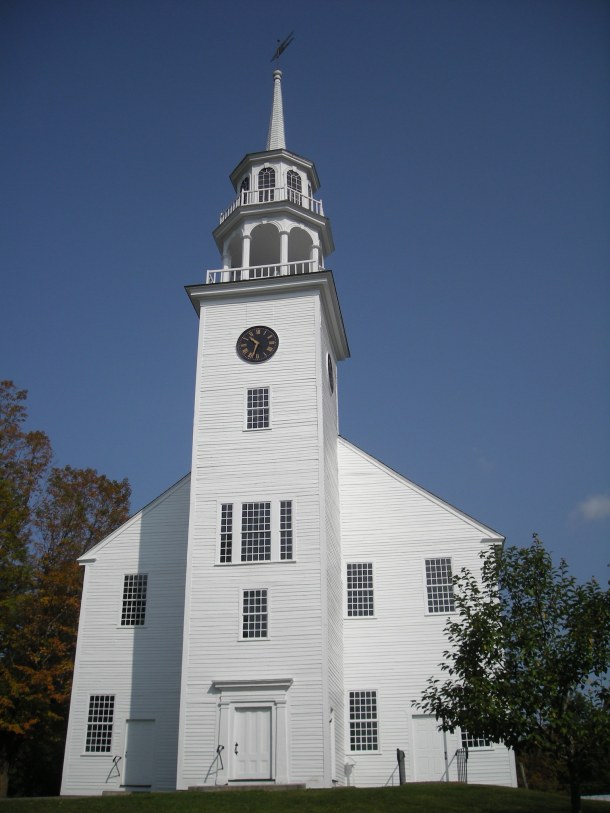
In 1798 and 1799, they served side by side on the committees that built the magnificent Strafford Town House and settled the first minister in Strafford. These included former Patriot leaders Fredrick Smith and Jonathan Rich with former Queen’s Loyal Rangers members Peter Pennock and Alexander Pennock.
Rich had served on the Committee of Safety in 1778 that confiscated Pennock land and land belonging to suspected loyalist Samuel Bliss (Bliss had married a Pennock). Twenty years later, Rich served on the same committee with Bliss to settle the first minister in Strafford, Joab Young, a Universalist.
Universalism was a new sect that had developed in the hill country of Vermont, New Hampshire and Massachusetts. Unlike the predominant Calvinistic theology, which believed in a vengeful God and only a few elect being saved, Universalism had the belief in a loving God and the ultimate salvation of all as the bedrock of its belief.
This religious belief that centered on inclusion spoke to the tenor of the times.
The people of Strafford felt they were no longer a frontier settlement and had come together and embraced the ability to respect diverse views. It is reflected in the Constitution of the Town House itself, which declared that “it shall be a free and open house for the Town to meet in and do public business” and “a free and open house for all the different religious denominations for people to worship, under such regulation as no preference shall be given to one denomination over another.”
This reconciliation, after a period of bitter civil strife and the resulting belief in inclusion and respect of differences, has set the tone in Strafford up until this day. It is an example that, in these troubled times, we might want to replicate on a broader scale.


